Tuesday
01 September, 2026
News Flash
News Flash
By Md Aynal Haque
RAJSHAHI, July 28, 2026 (BSS) - After years of struggling with low prices despite rising production costs, jute farmers in Rajshahi are finally witnessing a turnaround as strong market prices and a bumper harvest have revived hopes for the country's traditional "golden fibre."
With newly harvested jute fetching Tk 4,000-4,500 per maund, significantly higher than last year's opening price of Tk 3,000-3,500, growers are reporting healthy profits and renewed enthusiasm for jute cultivation. Officials believe the favourable market, coupled with increased acreage and better yields, could further strengthen the rural economy.
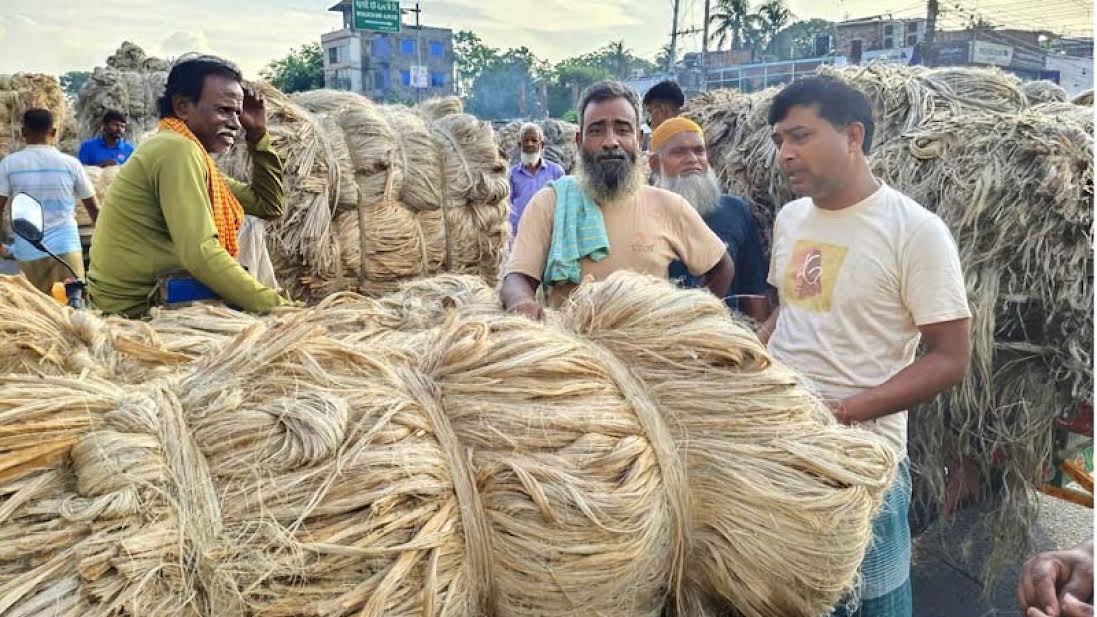
A visit to Nowhata Haat in Paba Upazila on Monday revealed brisk trading of the season's new jute. Farmers arrived carrying bundles of dried fibre on their heads, vans, three-wheelers and locally made Nosimon vehicles, bargaining with traders amid hopes of securing better returns than in previous years.
The encouraging prices have already changed the outlook for many farmers. Bablu Ahmed of Choubaria village cultivated an early jute variety on five bighas of land this season. He harvested around 11 maunds per bigha and sold part of his produce at Tk 4,500 per maund.
"I have already earned an estimated profit of around Tk 25,000 per bigha after meeting production costs," he told BSS, expressing satisfaction over the market price.
Abdul Alim of Bargachi Union said it cost him nearly Tk 22,000 to cultivate one bigha of jute. Thanks to favourable weather, he expects a yield of 10-12 maunds per bigha. At the current market rate, he hopes to make a profit of about Tk 20,000 per bigha. Jute traders also confirmed the stronger market.
Trader Janip Hossain of Nowhata Bazar said jute prices have remained considerably higher since the beginning of the season.
"Last year we bought jute at Tk 3,000 to Tk 3,500 per maund. This year we are purchasing at Tk 4,500 and sometimes even higher depending on quality," he said.
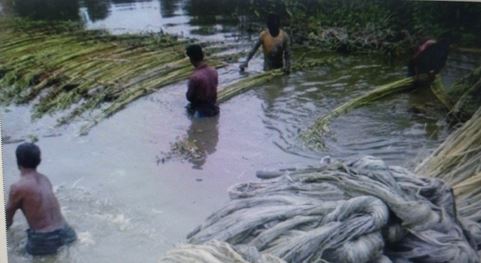
Across Paba Upazila, farmers are now busy harvesting jute while simultaneously preparing land for Aman paddy transplantation. In many fields, labourers were seen cutting jute in groups, bundling the stalks and preparing them for retting before fibre extraction.
Despite the positive market, growers remain cautious. Many fear prices could decline when the peak harvesting season brings larger volumes of jute to the markets. Farmers also pointed to labour shortages and inadequate water bodies for retting, forcing them to transport harvested jute over long distances and increasing production costs.
Farmer Anwar Hossain of Haripur village said better access to water for retting would significantly reduce costs and improve farmers' profits.
According to the Department of Agricultural Extension (DAE), jute cultivation in Rajshahi district has expanded to 18,399 hectares this season, compared with 17,305 hectares last year, an increase of 1,094 hectares.
The district has set a production target of 49,333 metric tons against last year's output of 48,677 metric tons.
Deputy Director of Rajshahi DAE Mohammad Nasir Uddin said farmers initially faced severe drought and a diesel shortage, creating uncertainty over the crop. However, timely rainfall, improved fuel availability and proper field management resulted in good yields.
"The current market price is encouraging. Farmers are likely to earn better profits this year, which will have a positive impact on the rural economy," he said.
Paba Upazila Agriculture Officer M.A. Mannan said if the favourable prices continue throughout the harvesting season, more farmers are expected to expand jute cultivation next year.
Assistant Director of the Department of Jute in Rajshahi, Md. Nadim Akhtar, said jute production in the district is expected to reach 381,696 quintals this year, up from 360,494 quintals last year.
He said the combination of higher production and favourable prices has created fresh optimism among growers.
Farmers believe that if the market remains stable throughout the season, the country's once- celebrated "golden fibre" can once again become one of the most profitable crops and regain its importance in the agricultural economy.