Tuesday
25 August, 2026
News Flash
News Flash
MINAB, Iran, Aug 25, 2026 (BSS/AFP) - For months, Masoumeh Zakeri has endlessly replayed the last night she spent with her nine-year-old daughter before she was killed in a strike on her school during the opening hours of the US-Israel war with Iran.
Motahreh excitedly talked about upcoming holidays, planned weddings and the clothes she wanted to buy. She had a Ramadan pre-fast meal shortly before dawn and then Zakeri tucked her into bed.
"I never saw her again. (That was) the last time," the 44-year-old mother told AFP.
Motahreh woke before her parents and took the bus to Shajareh Tayebeh school in Iran's southern city of Minab. Hours later, the attacks on Iran began and Zakeri received a call telling her to pick up her daughter.
She did not make it in time.
By the time she arrived, the school had been struck, and Motahreh was among at least 155 people killed, most of them children -- the deadliest strike yet reported by Iran.
Motahreh was recovered later that day, her mother said, only identified "by her earrings and bracelet."
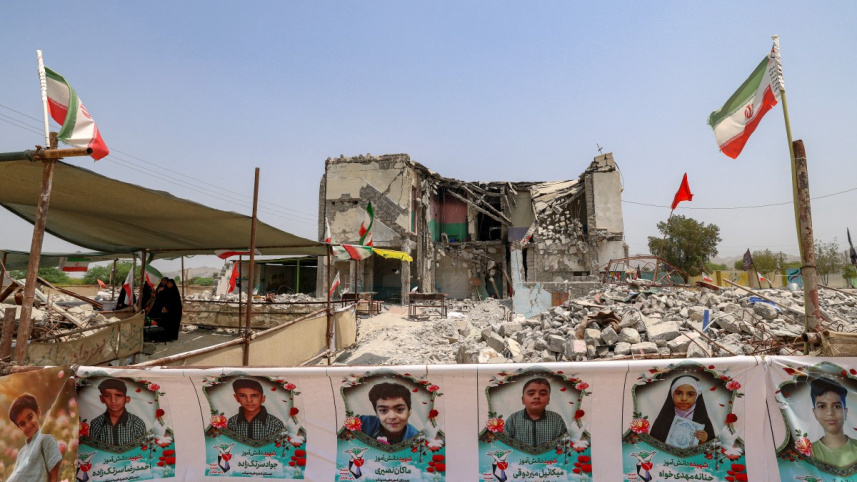
Six months on, a team of AFP journalists obtained rare access to the school which has remained largely in ruins, its collapsed walls and twisted steel now surrounded by portraits of the children killed as Iranian flags flutter above the rubble.
Iran says the attack on the school involved two separate US Tomahawk missiles but neither the United States nor Israel has officially claimed responsibility for the strike.
Rights groups including Amnesty International blamed the US while The New York Times has reported that the school was hit by a US Tomahawk cruise missile.
Since an April ceasefire, the intense bombardments have largely come to a halt but diplomatic efforts to end the war have stalled.
- 'Could not believe it' -
Zakeri said she did not see her daughter's body after it was recovered, fearing its condition would replace her last good memory of her.
"She was very loving, cheerful and really energetic," she said, adding that time has done little to dull her grief.
"Now our house is completely quiet."
Yaghoub Yazdanpanah, 34, a Persian literature teacher, still remembers the frantic phone calls from his wife and relatives that sent him rushing towards the school to collect his six-year-old daughter Fatemeh.
He had to go immediately, he was told, as heavy strikes were already pummelling Tehran and the compound of Iran's supreme leader Ayatollah Ali Khamenei was hit.
Then came another call: his daughter's school had been hit.
"I just couldn't believe it," said Yazdanpanah, who recalled speeding from work only to be slowed by traffic building around the area as fire and thick smoke billowed over the site.
The reality only sank in when he saw men gathering pieces of human flesh scattered by the blast and covering them with fabric. Nearby lay the body of a girl pinned beneath a slab of concrete.
"I couldn't breathe. I went and sat in a corner. I had collapsed and couldn't really stand on my feet," he said.
His daughter's body was found later that day.
Another father, painter Javad Shahrjou, was struggling to recover from the impact of the second missile strike which blew him and his motorcycle away as soon as he arrived to search for his youngest son, Alireza.
"When I entered the yard, children were in pieces... a head here, a foot there. A girl was falling from the second floor," he said.
His seven-year-old son was recovered three days later and identified only by his underwear, socks and shoes.
"He was all charred," he said.
- 'No plans' -
Authorities say the school will be preserved as a memorial as people continue to visit the site. Search operations have continued for the bodies of three missing children.
The parents say they cannot bring themselves to return.
"It's very difficult for me after what I had seen up close," said Yazdanpanah.
Instead, families visit the cemetery where the children are buried.
Arash Tondro, 45, who lives near the school and lost an eight-year-old relative in the strike, said he was still struggling to comprehend why it was targeted.
"The place where the school was had been a military base about 10 or 12 years ago," he told AFP while paying respects to his relative at the cemetery.
Now, he said, "there is absolutely no military site or anything".
Javad, who said he lost his job after his son's death, regularly visits Alireza's grave and recalls the times when his son used to join him "wherever he went".
Zakeri also visits her daughter's grave regularly but said grief has left her unable to think beyond the present.
"Imagining the future is very difficult for me," she said.
"We have no plans at all. We just can't bring ourselves to go anywhere or do anything."