Saturday
15 August, 2026
News Flash
News Flash
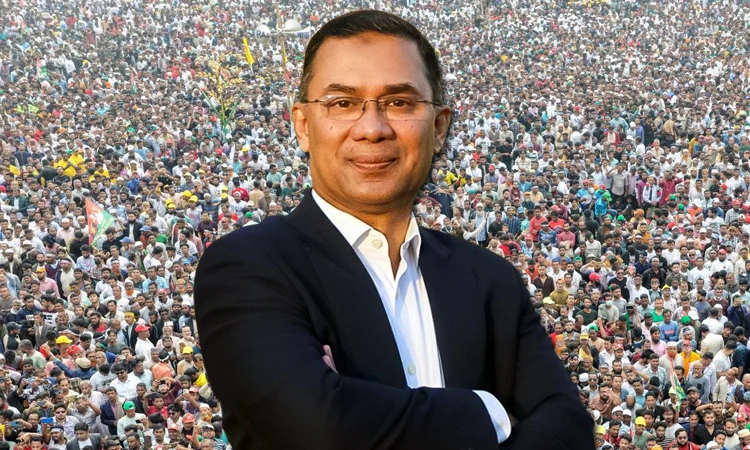
DHAKA, Feb 17, 2026 (BSS) - Tarique Rahman, elder son of Shaheed President Ziaur Rahman and former three-time Prime Minister late Begum Khaleda Zia, today took oath as the new Prime Minister of Bangladesh at a ceremony at South Plaza of Jatiya Sangsad Bhaban.
He formed a cabinet including 25 ministers and 24 state ministers who also took oath today following the premier's swearing-in.
Tarique Rahman is serving as the Chairman of the Bangladesh Nationalist Party (BNP) following the death of his mother former BNP Chairperson Begum Khaleda Zia.
Following is the brief biography of Prime Minister Tarique Rahman:
Tarique Rahman was born on November 20, 1968. His only younger brother was Arafat Rahman Koko. Becoming a victim of fascist vengeance, he died in exile in Malaysia on 24 January 2015.
In 1994, Tarique Rahman married Dr. Zubaida Rahman, daughter of former Navy Chief and former Minister Rear Admiral Mahbub Ali Khan. Tarique Rahman's spouse is a cardiologist. Their only daughter is Barrister Zaima Rahman.
Tarique Rahman was born into a distinguished family whose identity with the people of Bangladesh is intertwined with the country's independence and the 1971 Liberation War.
His father Shaheed President Ziaur Rahman, Bir Uttam, was the proclaimer of Bangladesh's independence. He fought on the battlefield for the country's independence. Ziaur Rahman was the Army Chief of Bangladesh. He was also the country's popular President.
Shaheed President Ziaur Rahman had introduced multi-party democracy in the country. Tarique Rahman's mother, Begum Khaleda Zia, is a three-time elected Prime Minister of Bangladesh. Her uncompromising leadership against autocracy and fascism in favor of the country and its people has made Begum Khaleda Zia an exemplary ideal to the people of the country.
As a member of the Zia family, which has become a symbol of protecting the country's independence and sovereignty, he became familiar with state protocol and political atmosphere from childhood.
Therefore, the family itself was Tarique Rahman's first political school. Although he grew up in a distinguished political family, solely for political reasons he had to face various adverse situations from his childhood and adolescence.
From witnessing the great Liberation War in childhood, to the anti-autocracy movement in adolescence, and throughout his political life, he had to endure many blows and counterblows.
Overcoming all kinds of propaganda and adversities with humility, honesty, and political wisdom, he has been able to win the hearts of the people.
Although Tarique Rahman was born into a distinguished family, his path was not strewn with roses. While still a school student, the first disruption of life came in his otherwise smooth journey. On May 30 in 1981, he witnessed the martyrdom of his father. After his father's martyrdom, during that period their mother became the main shelter for the two brothers. Mother Khaleda Zia sheltered her two sons with affection, just as she embraced Bangladesh until her last breath.
Due to political realities and various circumstances, Khaleda Zia had to take charge of the state and helm of the country's politics. After the martyrdom of President Ziaur Rahman, Khaleda Zia assumed leadership of BNP at the will of democracy-loving people. When Khaleda Zia took charge of the political party founded by Shaheed Zia, anti-people autocratic forces were in state power. Khaleda Zia built an intense mass movement on the streets against autocracy.
Taking responsibility of the party, Begum Khaleda Zia began the movement to reestablish democracy in the country. When Khaleda Zia was leading a fierce anti-autocracy movement across the country, Tarique Rahman had completed his school and college years and was a student of the University of Dhaka.
Tarique Rahman initially enrolled in the Law Department at the University of Dhaka. Later, he migrated to International Relations Department. When Tarique Rahman was a regular university student, the country was turbulent with the anti-autocracy movement under Khaleda Zia's leadership. On campuses across the country including the University of Dhaka, the popularity of Jatiyatabadi Chhatra Dal was sky-high.
To manage the situation, the then-ruling autocrat attempted to reach a compromise with Begum Khaleda Zia but failed. As a result, Tarique Rahman, a student of the University of Dhaka, came under the wrath of the autocrat. Khaleda Zia did not want to send her own son abroad for safety while all students of the country were facing the autocrat's repression. To intimidate Khaleda Zia, the autocratic government unleashed intelligence surveillance on Tarique Rahman; he was even physically attacked. The University of Dhaka campus was made unsafe for him. At one stage he was forced to leave the campus, but he did not leave the country.
During the anti-autocracy movement, the autocratic government frequently kept Khaleda Zia under house arrest. In those turbulent days, Tarique Rahman performed the important responsibility of maintaining communication between Khaleda Zia and the student leaders of the movement. Eventually, in 1990, the autocracy fell. A national election was held under a neutral caretaker government. In the 1991 election, Tarique Rahman participated in campaign activities across the country alongside his mother Khaleda Zia.
Earlier, in 1988, by taking primary membership of BNP at his ancestral home in Gabtali Thana of Bogura, Tarique Rahman had formally entered BNP politics.
In the 1991 national election, BNP achieved victory. Khaleda Zia was elected MP from five constituencies. In that election, Tarique Rahman actively participated in campaigning in all five constituencies alongside his mother. From that time, his formal initiation into political arena began. After the victory in 1991, Khaleda Zia was elected Prime Minister of Bangladesh. After seeing his beloved father as President in state leadership, in 1991 he also saw his mother as Prime Minister.
Thereafter, from 1996 to 2001, he saw his mother serve as Leader of the Opposition in Parliament. During that time, Tarique Rahman played an active role in politics against corruption and misconduct of those in power. Through his skill, planning, and strategic management, BNP gained an absolute majority in the national election held in 2001. In recognition of his organizational skills in party management, he was elected Senior Joint Secretary General of the party in 2002. Continuing this progression, through the party council session in 2009, he was elected Senior Vice Chairman of the party. Even in attaining these positions, he remained steady, calm, and loyal to party discipline. Tarique Rahman's political skill and strategy made him a target of propaganda by his political opponents. From then on, limitless falsehoods and propaganda were carried out against him.
Although BNP assumed responsibility for governing the state in 2001, Tarique Rahman himself did not personally become part of the government. Rather, as a party member, he exchanged views with grassroots people across the country.
He believes that if a political party has active, aware, and trained leaders at the grassroots level, no one can defeat that party. In the early 21st century, with the slogan "One initiative, a little effort, will bring prosperity-self-reliance will come to the country," he traveled across the country.
Focusing on empowering grassroots people and making them economically self-reliant, in 2004 Tarique Rahman began grassroots conferences with the participation of party leaders and activists. Coordinating the country's 64 districts, he organized twenty grassroots conferences nationwide. This initiative established him in politics as a trusted friend of grassroots people.
Tarique Rahman believes that without the economic prosperity of grassroots people, no political reform can be sustainable. He believes that reflection of public opinion in the country's politics, economy, and policy strategies is essential. For this, political and economic empowerment of the people is necessary. Like his parents, Tarique Rahman is frugal and soft-spoken. He believes in action more than words. Like his father, he prefers to talk with the people of rural Bangladesh, mingle with them, and be a companion in solving their problems.
In the course of political events, the BNP-led four-party alliance government handed over power to a caretaker government on October 28, 2006. Thereafter, activities of political adverse forces against BNP intensified further. As part of this, the unconstitutional so-called One-Eleven government arrested Tarique Rahman on March 7, 2007. Tarique Rahman could have left the country before or after the so-called One-Eleven. That proposal was before him.
Instead of taking the opportunity to leave the country, he chose to face the situation legally. He was imprisoned. On the night of December 31, 2007, while in prison, an attempt was made to kill Tarique Rahman. After nearly 18 months of imprisonment, he was released from jail on September 3, 2008.
After his release, he went to London for advanced medical treatment. Thereafter, he had to spend a long 18 years in exile in London. Despite being far from the country due to the situation, he regularly maintained communication with the people of the country through social media. By providing proper direction, he remained active in the anti-fascist movement with party leaders, activists, and supporters across the country.
To suppress BNP's movement, the fascist government chose the path of repression and persecution. To suppress the movement, the "Mother of Democracy" and BNP Chairperson Begum Khaleda Zia was imprisoned on false charges on February 8, 2018. According to the party constitution, on the same day Tarique Rahman assumed responsibility as acting chairman of the party.
He has taken politics as a vow of public service. Overcoming hundreds of adverse situations, he has established himself not only as a skilled and strategic politician but also as a visionary political leader. In the continuity of the anti-fascist movement of over one and a half decades, through the quota reform movement in exchange for numerous martyrdoms that led to the fall of fascism, Tarique Rahman had also sown the seeds of that movement.
In 2018, the first phase of the quota reform movement began nationwide. The seed of the quota reform issue had been planted by Tarique Rahman. On July 15, 2014, at an auditorium near Tower Bridge in London, in a gathering of expatriate Bangladeshis living in the United Kingdom, Tarique Rahman had said that if BNP had the opportunity to govern the state, the quota rate in government jobs would be reduced to below 5 percent. Subsequently, in 2024, the movement surrounding this quota reform issue turned into a mass uprising. Fascism fell.
Tarique Rahman's statement in 2014 on the quota reform issue proves his political foresight.
To isolate Tarique Rahman from the people, the fascist government made all kinds of attempts. He never remained silent. On 7 January 2015, the court of the fascist government imposed a ban on the publication and broadcast of speeches, statements, and comments of BNP's Acting Chairman Tarique Rahman in Bangladesh's media. Until the fall of the fascist government on August 5, 2024, his statements were not broadcast in the country's media. However, Tarique Rahman never stopped. In the interest of the country and its people, he remained active in the movement through social media. He kept leaders, activists, and supporters across the country active in the movement.
When the anti-fascist student-people movement of July-August 2024 was at its peak, and on July 18, Abu Sayeed, Wasim, Mugdho and others were shot dead like birds by the fascist clique desperate to suppress the movement, Tarique Rahman raised his voice to the democracy-loving people of the country and party leaders, activists, and supporters: "One demand, one point-Sheikh Hasina's resignation."
After about nine and a half years, on August 22, 2024, the court formally withdrew the so-called ban on Tarique Rahman's speeches and statements. However, even before that, after the fascist clique fled the country following the bloody mass uprising of students and people on August 5, 2024, the verdict of the fascist government's court became ineffective in the court of the people.
Tarique Rahman's speeches and statements began to be broadcast in the country's media. In a free environment, his historic quote was broadcast in the country's media: "If the defeated remain safe in the hands of the victors, the joy of victory becomes glorious." Because of his generous and courageous outlook, the country was saved from an anarchic situation.
By using the court or spreading false propaganda, Tarique Rahman could not be distanced from the people of the country and party leaders, activists, and supporters. After 17 years, 3 months, and 13 days of exile abroad, when Tarique Rahman landed at Hazrat Shahjalal International Airport in Dhaka on December 25, 2025, a new chapter was written in the political history of the country. Millions of people welcomed him to the motherland with all the love of their hearts and conveyed warm congratulations.
Upon returning to Bangladesh, Tarique Rahman, barefooted in deep emotion, touched the soil of the motherland.
He expressed deep gratitude to Almighty Allah. Facing the people, he reassured the freedom-loving and democracy-loving citizens of the country, saying, "I have a plan."
Ahead of the national election, Tarique Rahman presented his plan before the people across the country. The people responded to and trusted his plan. After more than one and a half decades of fascist rule ended, in the national election held on February 12, 2026, as many as 50 political parties including the Bangladesh Nationalist Party (BNP) participated in it.
Under the leadership of Tarique Rahman, BNP achieved an absolute majority. In the election, Tarique Rahman won in two parliamentary constituencies. However, at present he gave up Bogura-6 seat and is representing Dhaka-17 in Jatiya Sangsad.
Overcoming various adversities in an eventful political life, Tarique Rahman took oath as the eleventh Prime Minister of the country today.
For the first time in the country's history, crossing the four walls of Bangabhaban, he took oath to run the state standing on an open stage in front of the people at the South Plaza of the Jatiya Sangsad Bhaban. He formed the new government.