Thursday
20 August, 2026
News Flash
News Flash
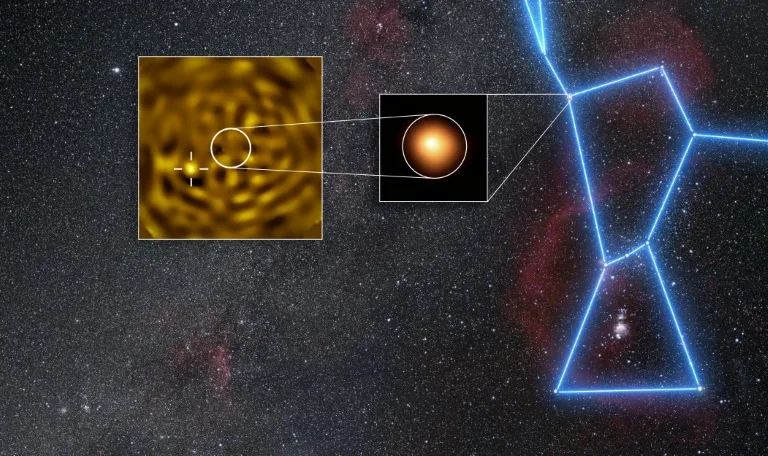
PARIS, France, July 28, 2026 (BSS/AFP) - Astronomers unveiled Tuesday the
first image ever captured of an elusive companion star orbiting Betelgeuse,
one of the brightest and most famous stars in the night sky.
Throughout history, people have gazed up in awe at Betelgeuse, a red
supergiant known to many as the hunter's shoulder in the Orion constellation.
Records suggest that thousands of years ago, ancient Egyptians and Indigenous
Australians noticed that the star's brightness changed in regular cycles.
The reason for this flickering remained a mystery until astronomers in 2024
predicted it was caused by the crossing of a much-smaller companion star.
The best evidence of the existence of the companion star was published in a
study on Tuesday, based on observations by the European Southern
Observatory's Very Large Telescope in Chile.
"This is the conclusion of a century-long quest," lead study author Miguel
Montarges of the Paris Observatory said in a statement.
"We have shown that Betelgeuse is not single, it is accompanied by a faint
stellar companion," he added.
Astronomers had feared that the telescope would not be able to spot the
companion because it would be blinded by the light from Betelgeuse, which is
1,000 times bigger than the Sun.
The companion -- dubbed Betelgeuse B -- had been thought to only have 1.5
times the Sun's mass.
"I jumped from my chair when I saw the processed images," Montarges said.
It turned out that the companion was significantly heavier than had been
believed -- weighing two to three times more than the Sun -- which allowed to
astronomers to spot it.
The observations were taken in December 2024, when the companion star was
farthest away from Betelgeuse.
However it took a long time to process and analyse the data, the results of
which were published in the journal Astronomy & Astrophysics.
While more observations are needed to definitively prove the companion's
existence, "there is very little space left for doubt," Montarges emphasised.
Betelgeuse previously surprised astronomers by dramatically dimming for five
months between 2019 and 2020.
Scientists first thought the change meant the star would soon die in an epic
supernova explosion.
However further observations revealed the dimming was caused by a massive
amount of material ejected from the surface that created a dust cloud which
blocked the star's light.