Wednesday
26 August, 2026
News Flash
News Flash
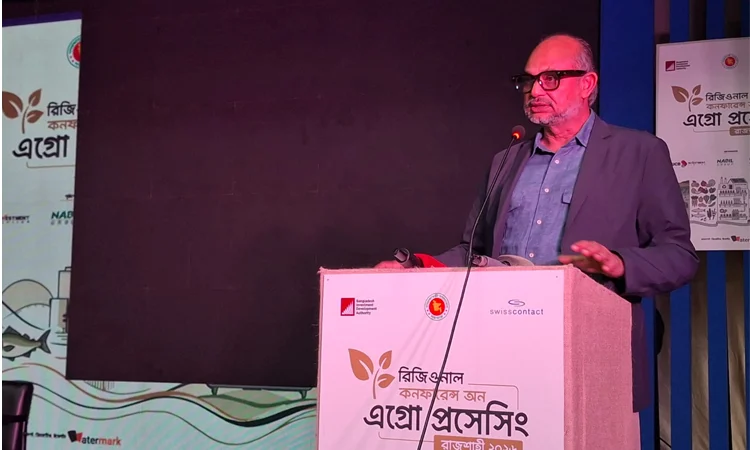
RAJSHAHI, Aug 4, 2026 (BSS) - Prime Minister's Finance and Planning Adviser Dr Rashed Al Mahmud Titumir today said the government has removed major barriers to investment and taken a series of policy measures to transform Rajshahi and the northern region into a new hub of industry and investment, urging local entrepreneurs to take advantage of the improved business environment.
"The government's goal is not only to recover the economy from recent challenges but also to rebuild it on a stronger foundation to achieve sustainable prosperity," he said.
The adviser made the remarks while addressing a regional conference on agro-processing as the chief guest at the Rajshahi Primary Teachers' Training Institute.
The conference was jointly organised by the Bangladesh Investment Development Authority (BIDA) and Swisscontact.
Dr. Titumir said the government is working under the vision of "Bangladesh First, Bangladesh with Everyone and Bangladesh for Everyone," with balanced regional development being one of its key election commitments.
"Our objective is to bring the lagging regions to the forefront. Regional development has now become one of the government's top priorities," he said.
The adviser said the government has set a target of transforming Bangladesh into a US$1 trillion economy by 2034 and is working to ensure a stable and predictable investment climate to achieve that goal.
Highlighting the government's investment strategy, he said, emphasis has been placed on five key areas, beginning with policy continuity.
To help investors make long-term business decisions, he mentioned that the latest national budget introduced a five-year tax framework and ensured equitable tax incentives for all export-oriented products.
"An investor plans for at least five years. We are providing certainty about the state's policy direction," he said.
Dr. Titumir said the government is also simplifying business procedures through extensive deregulation.
From obtaining licences to starting factory operations, he said, every stage will be completed within a fixed timeframe and monitored through an online tracking system.
"The government does not want to do business. Its responsibility is to create opportunities, not obstacles," he said, adding that excessive regulations and bureaucratic complexities had previously discouraged private investment.
On financing, he said, reforms are underway in both the banking sector and the capital market, which had suffered from years of irregularities.
The Bangladesh Securities and Exchange Commission (BSEC) and other relevant institutions are being restructured to build a stronger capital market capable of supporting long-term investment, he added.
He said that a Tk 49,000 crore refinancing programme is currently in operation, alongside a separate Tk 19,000 crore Bangladesh Bank fund and a Tk 5,000 crore refinancing facility for cottage, micro, small and medium enterprises (CMSMEs).
For the northern region, the adviser announced that Tk 3,000 crore has been earmarked through Bangladesh Bank to promote agro-based industries.
"This is the first time in Bangladesh's history that Tk 3,000 crore has been set aside specifically to develop an agricultural hub in the northern region," he said.
However, he observed that many entrepreneurs remain unaware of such financial opportunities and stressed the need to strengthen chambers of commerce and business organisations to improve information dissemination.
Dr. Titumir said the government is digitising tax, VAT and customs systems to reduce harassment and eliminate bureaucratic delays, enabling businesses to complete procedures online.
Referring to global uncertainties, wars and disruptions in supply chains, he said production-oriented investment is now the only sustainable path to creating jobs, increasing revenue and strengthening the economy.
He also stressed the importance of developing skilled human resources to meet industrial demand.
The adviser said Bangladesh's garment industry's competitiveness had long benefited from affordable energy, prompting the government to diversify energy sources.
He highlighted Rajshahi's vast potential for solar power generation, noting that solar panels could be widely installed on public and private buildings and industrial facilities, with investments recoverable within two to two-and-a-half years.
He said the Prime Minister has already directed government offices to begin using solar energy.
On infrastructure, Dr. Titumir said the government is modernising railway connectivity to ensure faster transportation of goods from the northern region to the ports of Chattogram, Mongla and Payra.
Plans are also underway to develop dual-gauge rail lines by addressing existing broad-gauge and metre-gauge limitations, he added.
He emphasised that the northern region should not remain merely a producer of agricultural commodities but should develop agro-processing industries capable of producing higher-value products.
He cited opportunities in potato, maize, mango and litchi processing, as well as the production of Active Pharmaceutical Ingredients (API) from potatoes, dairy products including mozzarella cheese, flower-based industries and stone-based industries.
"The government has established the policy framework and removed major investment barriers. Now it is the entrepreneurs who must come forward," he said.
Dr. Titumir said the government is providing separate support for micro, small, medium and large entrepreneurs and wants to transform primary agricultural producers into entrepreneurs through value addition and subcontracting opportunities.
He also said the Prime Minister is holding regular meetings with domestic and foreign investors and taking prompt initiatives to resolve investment-related problems, describing this as a clear demonstration of policy continuity.
The adviser further called on development partners to support Bangladesh in addressing non-tariff barriers, including Technical Barriers to Trade (TBT) and Sanitary and Phytosanitary (SPS) measures, while advancing Free Trade Agreements (FTAs) and Economic Partnership Agreements (EPAs) in the country's post-LDC graduation period.
Rajshahi Divisional Commissioner Dr. A N M Bazlur Rashid chaired the programme.
Executive Chairman of the Bangladesh Investment Development Authority (BIDA), Chowdhury Ashik Mahmud Bin Harun, Rajshahi City Corporation Administrator Md Mahfuzur Rahman Riton, Rajshahi Deputy Commissioner Kazi Shahidul Islam and local entrepreneurs also spoke.