Monday
24 August, 2026
News Flash
News Flash
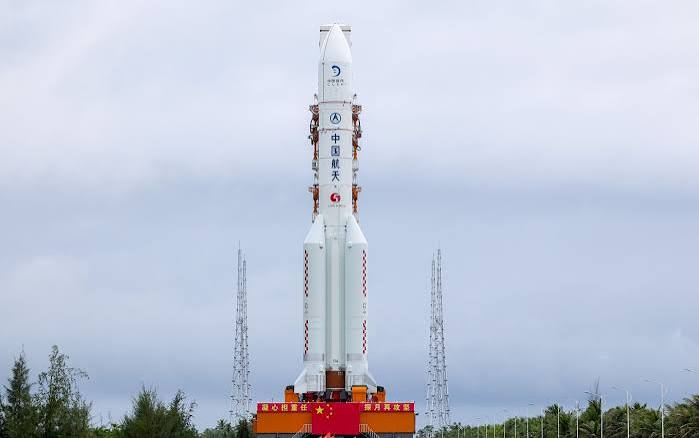
BEIJING, Aug 23, 2026 (BSS/AFP) - China's manned space agency said on Sunday
it is delaying a research moon mission that is part of Beijing's efforts to
land a crew there by 2030, less than two weeks after a rare launch failure.
The agency said after a "comprehensive assessment" the mission, which
involved sending the Chang'e-7 lunar probe on a Long March 5 carrier rocket,
"does not meet launch conditions and cannot take place during the planned
window this year".
The decision to delay was "based on the principle of prudence, reliability
and absolute mission success," it added, without providing further details on
what conditions weren't met or when the launch would be rescheduled.
The mission -- meant to search for water on the moon's south pole -- was
scheduled to depart either over the weekend or Monday, according to media
reports.
Last week, the agency said the probe and carrier rocket had been moved to the
takeoff area at Wenchang Space Launch Center in southern Hainan province.
As of Wednesday, the takeoff site and equipment were in good condition, with
inspections to take place and a launch "scheduled for the coming period".
The Chang'e-7 delay comes just under two weeks after media reports showed a
rocket launched from the Hainan site had exploded, as crowds watched a fiery
ball in the sky.
The failed mission involved a Long March 7A carrier rocket, which had lifted
off from the Wenchang Space Launch Site, state news agency Xinhua said at the
time.
An "anomaly" occurred when the rocket carrying the Zhongxing-4B
communications satellite was in flight, Xinhua added.
The cause of the failure was under investigation, it said.
Beijing has ploughed billions of dollars into its space programme in recent
years to achieve what President Xi Jinping calls the country's "space dream".
China successfully landed a reusable rocket for the first time in July,
according to its space agency, marking a major step in its space ambitions
and in reducing launch costs.
The country is aiming to land astronauts on the Moon before 2030, a race in
which the United States is also competing with its Artemis programme.