News Flash
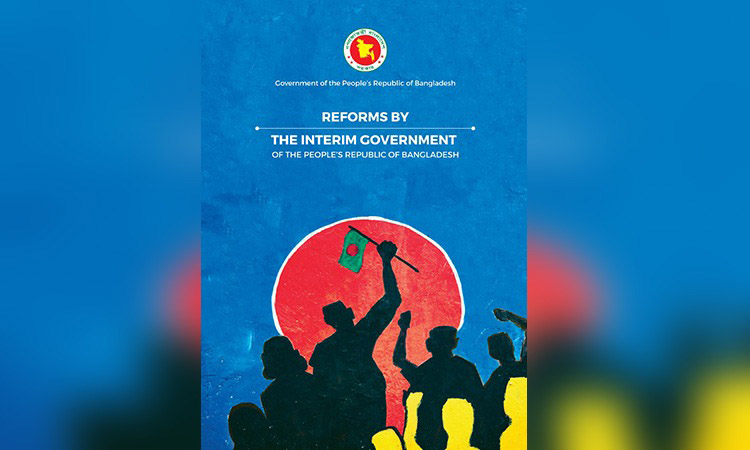
DHAKA, Feb 8, 2026 (BSS) – The government has published a book titled ‘Reform Book’ with brief descriptions of the key reform initiatives undertaken by the interim government since August 2024.
The Chief Adviser’s Press Wing disclosed the matter this morning.
Describing the background of the reforms, the press wing said on August 5, 2024, driven by the courage of millions of Bangladeshis led by young boys and girls who took to the streets to say “Enough is enough” to authoritarian rule, Bangladesh began to emerge from nearly sixteen years of fascist-style repression under Sheikh Hasina.
This led to the July Uprising, leading to the creation of an interim government headed by Professor Muhammad Yunus at a time when the nation found itself in deep crisis. The interim government inherited profound economic, institutional, and democratic breakdown.
Years of corruption and misrule had hollowed out the state. Hundreds of billions of dollars were siphoned from public institutions, the banking sector was crippled by massive non-performing loans, and core regulatory bodies—including the central bank—had been subordinated to private and political interests.
Law enforcement agencies were used for political repression, the judiciary was filled with corruption and political manipulations resulting in the loss of its independence, voter-less elections became the fate of the nation, and media freedom and vibrance of the civil society disappeared.
From this wreckage, the press wing said, the interim government—working alongside millions of citizens across sectors—has initiated a process of transformation.
Immediately after taking charge, it set up Reform Commissions consisting of experts from the relevant fields, and sought recommendations for sector-specific reforms.
On the basis of the reports furnished by these Commissions, and also on its own initiative, the interim government rolled out widespread legal and institutional reforms that would be feasible within its tenure.
In the eighteen months since assuming responsibility, it has enacted approximately 130 laws (comprising new laws and mending laws) and taken over 600 executive decisions, reflecting the urgency of institutional reform and reconstruction.
Roughly 84 percent of these measures have already been implemented, reflecting genuine and tangible reform, rather than rhetorical and cosmetic change.
Major progress has been achieved across the economy and foreign relations. New trade agreements have diversified partnerships and reduced overdependence on single markets, including an Economic Partnership Agreement with Japan granting duty-free access to about 7,400 Bangladeshi products.
Strategic cooperation with China has extended loan maturities, supported major healthcare infrastructure, and improved flood forecasting through shared hydrological data.
Negotiations with the United States reduced reciprocal tariffs from 37 percent to 20 percent preserving access to the world's richest economy. Diplomatic relations with key partners have been improved, and relations with India have been recalibrated on a more balanced and respectful footing.
Accountability has begun. Anti-corruption cases have been filed against hundreds of politicians and officials that served under the fallen regime, with billions of dollars in assets frozen or confiscated.
Banking reforms have introduced real oversight, procurement transparency has been expanded across 42 ministries, and the Bangladesh Bureau of Statistics has been granted full autonomy to report economic data.
Law enforcement reforms have restored discipline in the system to a substantial degree, with over 1,200 officers being suspended pending investigation, and human rights–centered training being introduced for tens of thousands of personnel.
Special commissions have heard testimonies from thousands of victims and families, initiating a long-overdue process of truth and accountability.
The Rapid Action Battalion has been restructured so as to achieve a meaningful change in its operations, and has been renamed the “Special Intervention Force”.
Judicial independence has been restored through structural reforms that place all courts under Supreme Court administration, ending executive interference. Supreme Court judges are now appointed through merit-based processes insulated from political control, laying the foundation for enduring rule of law.
Media freedom has been reestablished. Politically motivated cases against journalists have been dropped, and outlets which were previously banned on political considerations have been allowed to resume operations. No media establishment —including those aligned with the former regime—has been shut down.
Throughout the transition, the interim government carried out inclusive political dialogue, which included seven months of intensive consultations that were televised nationally and that culminated in the July Charter, a foundational document for constitutional reforms that are now awaiting approval through a referendum.
The Charter seeks to entrench fundamental rights, meaningful checks and balances, and safeguards against a return of authoritarianism.
Noting that these reforms mark the first steps toward a reimagined system of governance—one that serves citizens rather than dominates over them, the press wing said, “The work is far from complete; sixteen years of damage cannot be remedied in eighteen months. But Bangladesh has turned decisively away from authoritarian rule”.
The courage that filled the streets in July and August 2024 continues to guide the arduous and challenging work of building the democratic future that its people demanded and deserve, it said.