Friday
28 August, 2026
News Flash
News Flash
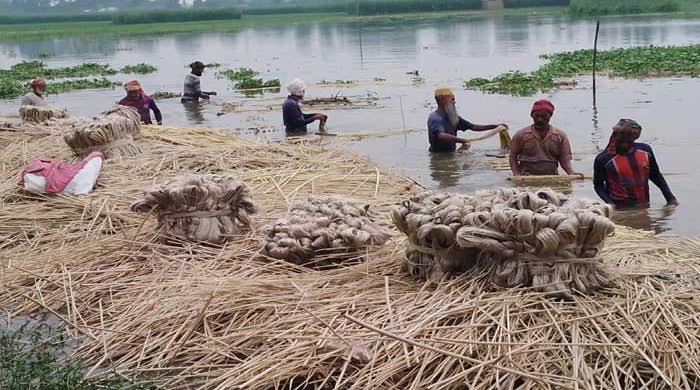
RAJSHAHI, Aug 28, 2026 (BSS)- Rajshahi district is witnessing a plenteous production of golden fibre jute this season, creating a potential market worth around Tk 549 crore as favourable weather, increased cultivation and higher market prices bring smiles to farmers.
The Department of Agricultural Extension (DAE) said the district is expected to produce around 49,000 tonnes of jute this season, while the prevailing market price of Tk 4,000 to Tk 4,300 per maund could generate transactions of about Tk 548.82 crore.
The strong production and prices are expected to inject fresh dynamism into the rural economy, increasing farmers' incomes and boosting demand for goods and services in local markets.
Jute has been cultivated in all nine upazilas of the district this season. A total of 18,399 hectares of land has been brought under jute cultivation against 17,305 hectares last year.
The agriculture department had set a production target of 49,000 tonnes for the current season, compared with 48,677 tonnes produced from last year's cultivation.
According to the latest DAE assessment, harvesting and fibre extraction have already been completed on around 82 percent of the cultivated land, producing nearly 48,200 tonnes of jute.
Agricultural officials expect total production to exceed the target once harvesting and fibre extraction on the remaining 18 percent of land are completed.
Field-level reports suggest that favourable weather from the beginning of the season, adequate rainfall and farmers' intensive care contributed to the higher yield.
The timely rainfall also helped farmers in retting and washing the jute, reducing difficulties associated with the traditional processing of the fibre.
The market situation has further encouraged growers. Jute is currently selling for Tk 4,000 to Tk 4,300 per maund in local markets, while in some cases the price has reached Tk 4,500 to Tk 5,000.
Mita Sarkar, Additional Deputy Director (Crops) of the Rajshahi District Department of Agricultural Extension, told BSS that both the area under cultivation and production increased this year due to government incentives and timely supply of improved-quality seeds and fertilisers.
She said the district could see jute transactions worth around Tk 549 crore if the fibre is calculated at Tk 4,300 per maund.
Meanwhile, Assistant Director of the Department of Jute, Rajshahi, Nadim Akhtar, said around 3,81,696 quintals of jute are expected to be produced in the district this year, about 21,000 quintals more than last year.
Jute farmers are also expressing satisfaction over the current market situation.
Shafiqul Islam, a jute farmer from Monigram area of Bagha upazila, said farmers had been disappointed last year as they did not receive a fair price.
"This year, both yield and price are good. As I can sell jute for more than Tk 4,000 per maund, I am expecting a good profit after meeting production costs," he said.
Abdul Matin, a farmer in Mohanpur upazila, said adequate and timely rainfall made retting and washing easier this season.
"With the good market price, I hope to save some money after meeting my family expenses," he said.
Rabiul Islam of Paba upazila said he was earning a good return by cultivating an early variety of jute on four bighas of land.
However, he identified high labour costs and inadequate water facilities for retting as major challenges facing farmers.
Farmers Saidur Rahman of Bagmara and Hridoy of Charghat also expressed optimism, saying that continued favourable prices could encourage many more farmers to expand jute cultivation next year.
The jute produced in Rajshahi is not limited to meeting local demand. After supplying local markets, a significant portion is sent to major jute-product manufacturing companies in different parts of the country.
With growing international demand for processed jute products, some of the fibre collected from Rajshahi is also being exported, contributing to the country's foreign-exchange earnings.
Former professor of Economics at Rajshahi University, Dr Rafiqul Islam, said increased jute production and better prices are sending a positive signal for the rural economy.
He said the estimated Tk 549 crore in jute-related transactions would increase the demand for goods and services in local markets and help stimulate economic activity in rural areas.
"However, to ensure that farmers receive the full benefit, it is important to reduce the influence of middlemen and expand direct marketing and government-supported storage facilities," he said.