News Flash
ISLAMIC UNIVERSITY, Kushtia, Jan 9, 2026 (BSS)- At the end of the 1990s, when information technology began to fundamentally transform the modern world, Islamic University (IU) in Kushtia took a farsighted step.
With the vision of integrating modern education with Islamic values, the Department of Information Science and Technology (IST) was established in 1998 under the Faculty of Applied Science and Technology.
At that time, IT education was a relatively new concept in Bangladesh’s higher education system. In this context, Islamic University became the country’s first public university to introduce the IST department.
Today, the department is celebrating more than 27 years of its academic and technological journey.
As information technology was emerging globally as a central driver of economic development, education, and human progress, the university authorities, under the leadership of the late Professor Dr Ekin Uddin, started the department with only three teachers, 30 students, and a small number of staff members.
In its early days, the department faced numerous challenges, including a shortage of teachers, limited classroom facilities, and technological constraints. However, through the collective efforts, dedication, and perseverance of teachers and students, these obstacles were gradually overcome.
Over time, the department has continued to progress by regularly updating its curriculum, modernising laboratory facilities, and aligning itself with emerging and promising technologies.
Initially, the department offered only a BSc (Hons) degree under the name “Information Science and Technology.” Later, to better reflect its expanded engineering-oriented scope, the department was renamed “Information and Communication Engineering (ICE).”
In 2019, at the 245th Syndicate meeting, the department again renamed to “Information and Communication Technology” and formal recognition of the engineering degree was granted. This decision is regarded as a significant milestone in the department’s academic advancement.
Currently, the department operates on the ground floor of the Ibn Sina Science Building, although its academic journey began in the Faculty building of Applied Science and Technology.
The academic environment is now enriched with modern multimedia classrooms, software laboratory, hardware laboratory, networking laboratory, research laboratory, signal processing laboratory, computer vision laboratory, microprocessor interfacing laboratory, and a well-organised seminar library.
In addition, an Innovation Lab has been established, which has become a vibrant hub for skill development, experimentation, and creative problem-solving for students.
The ICE Innovation Lab began its journey in September 2019. Initially focused on the Internet of Things (IoT), its research scope has gradually expanded over time.
The lab remains open 24 hours a day, allowing students to work continuously on emerging technologies such as networking, cyber security, machine learning, and artificial intelligence, keeping pace with the demands of the modern era.
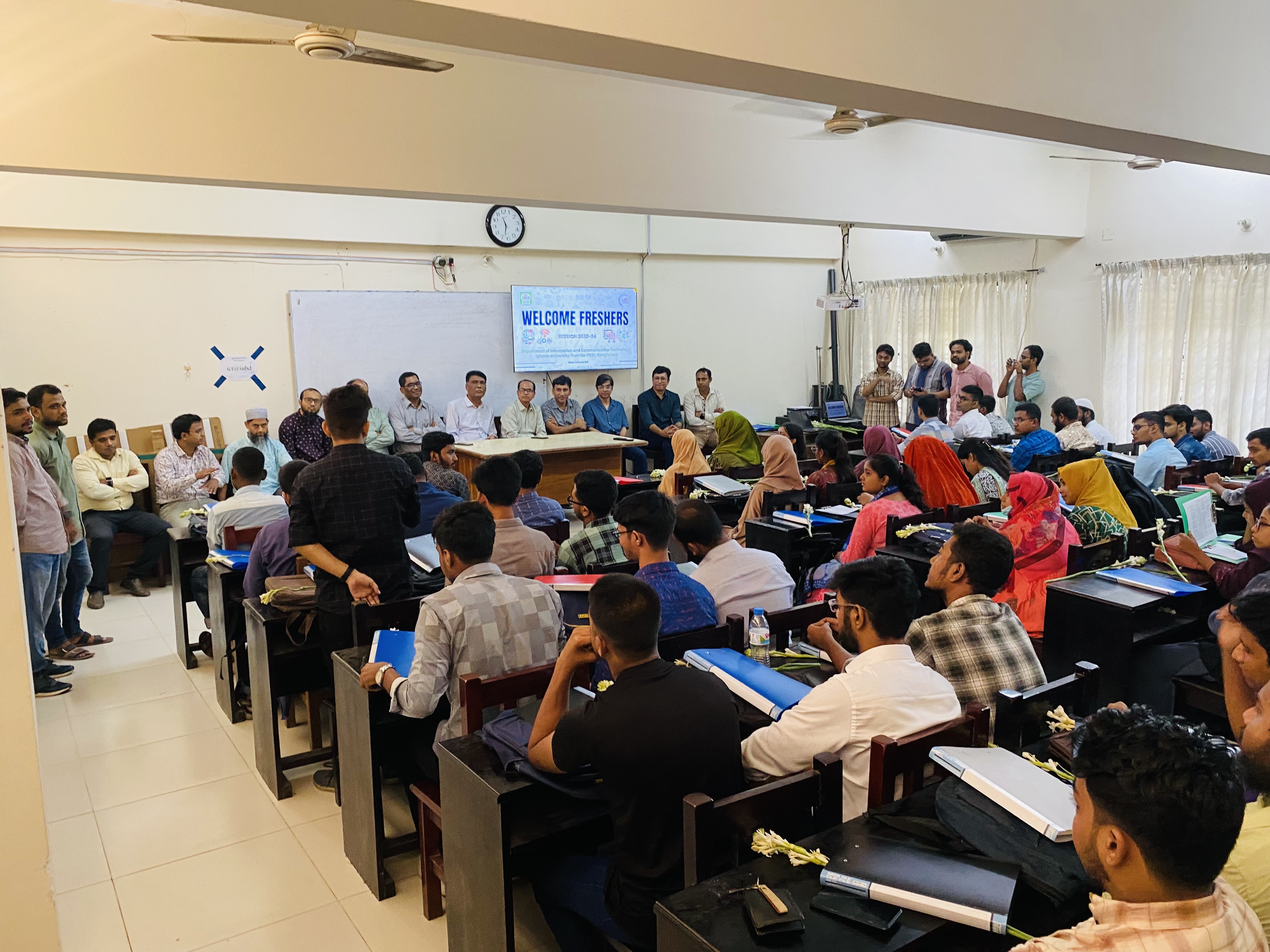
At present, the department successfully conducts its academic activities with 13 faculty members. So far, around a thousand students have graduated with undergraduate and postgraduate degrees from the department.
Among them, many are serving in important positions within the Government of Bangladesh, while others have established themselves successfully in various international technology-based organisations.
Some have also become entrepreneurs, founding their own IT firms and creating employment opportunities. The department’s strong alumni network serves as a valuable support system for newly graduated students.
From this department, seven scholars have been awarded PhD degrees and five students have received MPhil degrees. Currently, there are nine PhD and three MPhil students pursuing advanced research.
Research is one of the core pillars of the department. Faculty members are actively engaged in research across a range of contemporary and significant fields, including Artificial Intelligence, Machine Learning, Computer Vision, Image Processing, Signal and Systems, and Communication Systems.
Students also participate directly in various research initiatives, fostering a strong academic culture based on inquiry, innovation, and collaboration.
Alongside academic activities, the department places special emphasis on enhancing students’ professional and competitive skills. Students regularly participate in national-level competitions such as ICPC, NCPC, and CTF, demonstrating the department’s talent and capability.
To strengthen ties with industry, the department has signed several Memorandums of Understanding (MoUs) with different companies, facilitating internships, training opportunities, and industry-based collaboration.
Student life in the ICT department is further enriched through a wide range of co-curricular activities. The department has an active student organisation, the Students Association of ICT (SAICT), which is managed and run by current students.
All co-curricular activities of the department are conducted under this association. To encourage new students’ interest in programming, programming classes are organised on a regular basis, along with periodic intra-department programming contests. In addition, various cultural activities, seminars, and tours are arranged, helping to strengthen camaraderie and mutual bonds among students.
At the same time, students of this department have been successfully leading the IEEE Student Branch. Till date, the branch has successfully organised two international conferences. Active student participation in these initiatives has further strengthened the department’s international professional standards and educational commitment.
Overall, the ICT department is regarded as a landmark department in the history of Islamic University. Continuously adapting to technological advancements, it is moving steadily forward.