News Flash
By Naziur Rahman Sohel
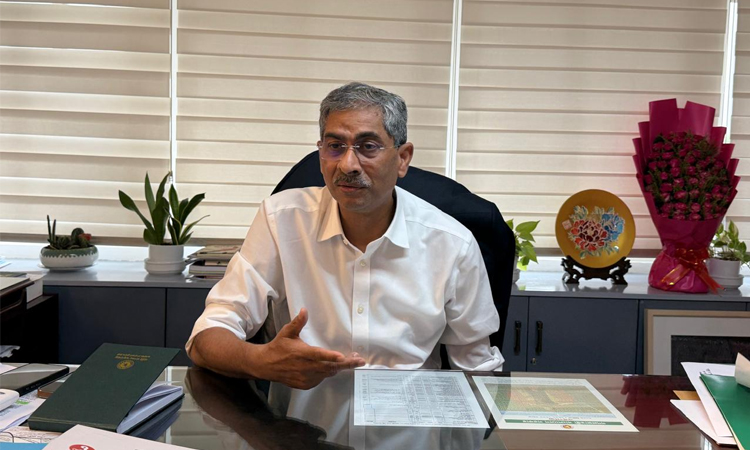
DHAKA, May 9, 2026 (BSS) - Water Resources Minister Md. Shahiduddin Chowdhury Anee has said the government has begun work to build a new Bangladesh by transforming the canal excavation programme initiated by Shaheed President Ziaur Rahman into a modern and scientific movement.
"The main objective of the programme, under the visionary leadership of Prime Minister Tarique Rahman, is to strengthen the rural economy, reduce pressure on underground water resources and tackle the impacts of climate change while making the country self-reliant in agriculture and fisheries production," he said.
Anee made the remarks in an exclusive interview with the state-run Bangladesh Sangbad Sangstha (BSS) at his Secretariat office.
During the interview, he discussed in detail the progress of the government's 180-day master plan, the multidimensional benefits of canal re-excavation and the targets for the next five years.
Anee said canal re-excavation is not merely about digging soil but a multidimensional economic and environmental revolution.
"Shaheed President Ziaur Rahman introduced this programme with great foresight, and at that time, it sparked a rural revolution. But due to long neglect, many canals became silted up while others were occupied illegally. Prime Minister Tarique Rahman has brought the programme back to the forefront," he said.
He added that the initiative is creating employment opportunities for rural workers while expanding irrigation facilities for agriculture.
"This is not only water management; it is also a strong foundation for building a new Bangladesh," he said.
Regarding the ministry's 180-day plan, the minister said specific targets had been set from the very first day of assuming office.
"We have calculated specific targets on how many kilometres of canals can be re-excavated within 180 days. The Prime Minister has already inaugurated the programme in four districts and will visit Chandpur on May 16 to launch another phase of this large-scale initiative," he said.
He added that lawmakers and ministers across the country have turned the programme into a nationwide movement in their respective constituencies.
"Our target is to excavate or re-excavate at least 20,000 kilometres of canals over the next five years," he added.
Describing the economic impact of the project, Anee said the programme has wide-ranging benefits.
"When local people participate manually in the work, money reaches the hands of rural labourers. When they spend that money in local markets, rural trade and commerce expand. Fish farming will be carried out in the canals, while fruit-bearing and medicinal trees will be planted along the banks," he said.
He added that expanded irrigation facilities would increase agricultural production two to three times.
"During the time of Shaheed Zia, Bangladesh achieved food self-sufficiency and even exported agricultural products. We want to return to that stage again," he said.
On protecting groundwater levels, the minister said excessive use of deep tube wells has caused underground water levels to decline significantly, particularly in coastal areas.
"If we can increase the use of surface water through canal excavation, pressure on groundwater will decrease. This will help maintain ecological and climate balance," he said.
Issuing a stern warning against illegal occupiers of canals, Anee said many canals had been turned into markets and residential structures due to years of neglect, while industrial waste and sewerage lines had transformed them into dumping grounds.
"Since the programme began, the process of reclaiming occupied canals have also started. Where there are legal complications, we will strictly enforce the law," he said, adding that restoring canals would also help reduce waterlogging.
The minister further said farmers and labourers are the direct beneficiaries of the programme.
"Bangladesh is an agriculture-based country. It is not possible to establish large industries in every district, but agriculture exists everywhere. Therefore, there is no alternative to canal excavation if we want to bring smiles to farmers' faces. This is the path towards a self-reliant Bangladesh," he added.