Monday
17 August, 2026
News Flash
News Flash
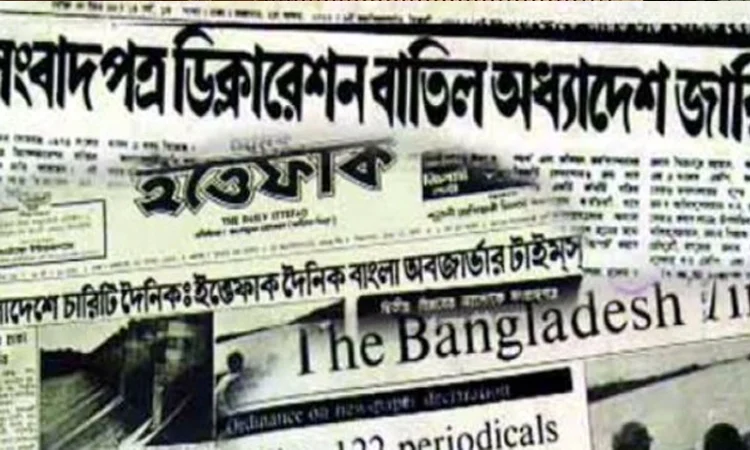
DHAKA, June 15, 2026 (BSS) – June 16 is marked what the journalists describe as a black day in Bangladesh’s history, commemorating the closure of most newspapers by the then BAKSAL government led by Sheikh Mujibur Rahman in 1975, which they say curtailed press freedom and left thousands of media workers unemployed.
On this day in 1975, the government retained only four newspapers under state management and shut down all others, said a statement of BFUJ and DUJ.
As a result, thousands of journalists and media workers reportedly lost their jobs overnight and were forced into severe economic hardship.
The statement said people were deprived of access to accurate information and objective news, while freedom of expression in the media, politics, and groups and among individuals was restricted.
Since 1976, the Bangladesh Federal Union of Journalists (BFUJ), the Dhaka Union of Journalists (DUJ), various political parties, social organisations and professional bodies have been observing the day as ‘Newspaper Black Day’ in protest against what they describe as the repressive ordinance issued by the BAKSAL government.
BFUJ and DUJ jointly organised a discussion this morning at the Tofazzal Hossain Manik Mia Hall at the Jatiya Press Club.
LGRD and Cooperatives Minister and BNP Secretary General Mirza Fakhrul Islam Alamgir addressed the discussion as the chief guest while Information and Broadcasting Minister Zahir Uddin Swapon also spoke at the event.
BFUJ Secretary General Kader Gani Chowdhury presented the keynote paper with DUJ President Md Shahidul Islam in the chair.
DUJ acting General Secretary Didarul Alam Didar moderated the discussion.
Journalist leaders, representatives of civil society and prominent intellectuals attended the event.
Among others, National Press Club President Poet Hasan Hafiz, Television Editors' Council Convener and Bangla Vision Editor-in-Chief Dr Abdul Hai Siddique, and Protidiner Bangladesh Editor and veteran journalist Maruf Kamal Khan Sohel addressed the discussion.
BFUJ Vice-Presidents Khairul Bashar and AKM Mohsin, Assistant Secretary General Dr Sadikul Islam, Publicity Secretary Shahjahan Saju, Organising Secretary Erfanul Haque Nahid, and leaders of different journalists' organisations also spoke at the programme.
Speaking on the occasion, Mirza Fakhrul strongly emphasised re-launching Dainik Bangla, Bangladesh Times and the popular weekly Bichitra to create employment opportunities for journalists who became jobless due to discrimination during the previous Awami autocratic regime.
"These media outlets have historical and traditional values. Therefore, they should be reorganised to create new employment opportunities," he said.
Although many aspects of society and technology have changed over time, adequate employment opportunities for all journalists have not been created, which is extremely unfortunate, he said.
"We have a competent information minister. I hope he will take necessary state initiatives to republish these traditionally important closed media houses," he said.
Fakhrul also called for creating new media platforms, if necessary with the involvement of stakeholders, to ensure the livelihoods of journalists.
Criticising the political history of the Awami League, the BNP secretary general said a review of history shows that the Awami League and democracy never go together.
It did not happen during the one-party BAKSAL rule in 1975, and it was again proven during the terrible fascist misrule of the past 15 years.
Mentioning that no joint or comprehensive book documenting of the dreadful misrule of the last 15 years has yet been published, he urged journalists and researchers to work quickly on the issue and requested the information minister to oversee the matter.
Information and Broadcasting Minister Zahir Uddin Swapon said in the past, during the fascist regime, the state used to turn a blind eye to the media but the incumbent democratic government now wants to work as a real 'collaborator' in solving problems of media and journalists.
“The June 16 is the black day of newspapers. The crisis of the media and the black environment of the journalism profession have now become one. Therefore, instead of getting stuck in the discussion of problems of 50 years, we need to understand the new challenges of artificial intelligence (AI) and digital media and find innovative solutions to those,” he said.
Drawing on the historical context, Swapon said by incorporating the Fourth Amendment to the Constitution in January 1975, the original spirit of the great War of Liberation was destroyed and a one-party rule was established.
He said the dictatorial rulers understood that to prevent the voice and anger of the people, the media would have to be strangled; otherwise, they would not be saved and that is why they officially killed the voice of the newspapers on June 16, 1975.
"We need to read the biography of this virus of fascism that escaped in the past well, which will act as an 'antivirus' against any dictatorial mentality hidden in our own minds," he said.
Bangladesh Association of Journalists (BAJ) organized a discussion titled “Media-During the Awami League Regime and the Spirit of the July Mass Uprising,” at Dhaka Reporters’ Unity (DRU) here.
Speaking as the chief guest, State Minister for Information and Broadcasting Yasser Khan Choudhury said the present government will not interfere in media freedom and it is committed to ensuring a fully independent press.
“The government will not interfere in any media outlet. We want to see a free and independent media. However, freedom does not mean only speaking against the government. You should criticize us where necessary, but you should also present the government's positive achievements to the people,” he said.
The state minister noted that the journalists have an important role in eliminating fascist tendencies from the society and the state. He added that the government wants to maintain a constructive relationship with the media, stressing that all the stakeholders must work together to advance the country.
Criticizing the previous administration, Yasser Khan said many journalists had faced severe repression during what he described as a fascist regime. He said the present government is determined to erase that the dark chapter and ensure an environment conducive to free and professional journalism.
The main speaker at the event, Dr. Mahmudur Rahman, editor of the daily Amar Desh, said that the history of the Awami League reflects a progression from autocracy to fascism. He alleged that Sheikh Mujibur Rahman curtailed freedom and human rights and that Sheikh Hasina transformed the media into a tool of political patronage.
Mahmudur Rahman further claimed that Sheikh Mujibur Rahman initiated a fascist trend by dismissing legendary editor Abdus Salam from his position. He argued that efforts to separate Sheikh Mujibur Rahman from Sheikh Hasina in political discourse are misguided, asserting that there is no meaningful difference between the two.
The event, chaired by BAJ President M. Abdullah, also featured the presentation of a keynote paper by former Vice-Chancellor of Patuakhali Science and Technology University Dr. Abdul Latif Masum.
In his paper, Dr. Masum described the July Uprising as a turning point in political and social history of the country. He said that when the media loses the language of the people, the people create a new language of their own in the streets and when the media attempts to blackout reality, reality itself emerges as history and confronts authoritarianism.
Among others, former BFUJ President M.A. Aziz, DRU President Abu Saleh Akon, former National Press Club General Secretary Ilyas Khan, DRU General Secretary Mainul Hasan Sohel, former DRU President Ilyas Hossain, Amar Desh Managing Editor Zahed Chowdhury, former DUJ General Secretary Jahangir Alam Pradhan, former DUJ General Secretary Sardar Farid Ahmed and former DUJ Vice-President Shaheen Hasnat also addressed the discussion.
They said the amendment, which they described as being contrary to democratic values, led to the establishment of the one-party BAKSAL system. As a continuation of that process, the government closed all newspapers on June 16, 1975, while four publications continued under state management as government mouthpieces.