Monday
24 August, 2026
News Flash
News Flash
DHAKA, Aug 24, 2026 (BSS)- High level salinity in drinking water in coastal areas caused increasing risk of heart disease and stroke, according to a research study.
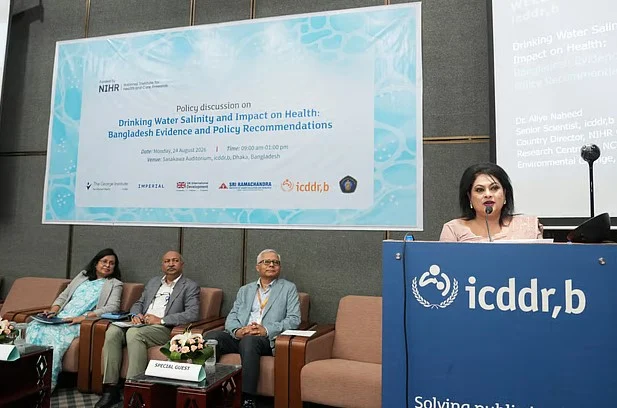
The study findings were revealed today at a policy discussion on “Drinking Water Salinity and Impacts on Health: Bangladesh Evidence and Policy Recommendations”.
The icddr,b in collaboration with Imperial College London arranged the event at the Sasakawa Auditorium of icddr,b in the capital’s Mohakhali.
Dr. Aliya Naheed, a senior scientist at icddr,b, presented the preliminary findings of the Bangladesh programme of the NIHR Global Health Research Centre for Non-Communicable Diseases and Environmental Change.
As part of the programme, researchers tested the salinity of water sources in 172 villages under 71 community clinics in Koyra of Khulna district and Assasuni upazila of Satkhira.
A total of 27,697 water sources were surveyed. Out of them, 6,703 sources (24.2pc) were being used for drinking water. Among the drinking-water sources, salinity was detected in 55.3pc in Koyra and 23.3pc in Assasuni.
Naheed said the water on which millions of people in coastal Bangladesh depend for their daily lives is increasingly becoming a health risk.
Salinity in drinking water is no longer merely an environmental problem, she said adding that excessive sodium intake through water can increase the risk of high blood pressure, heart disease and kidney disease. Women may also face additional health risks during pregnancy, he said.
In another part of the study, researchers assessed the risk of heart disease and stroke among 15,471 adults aged 40 years or older in Koyra and Assasuni.
They estimated that nearly one in five people (21.6pc) had a moderate-to-high risk of developing cardiovascular disease within the next 10 years. The rate was 19.7pc in Koyra and 23.6pc in Assasuni.
Based on these findings, researchers have developed an integrated intervention package combining water services and primary healthcare.
The water-related component aims to increase access to low-salinity drinking water through greater community awareness, proper management and maintenance of water sources, and stronger local governance and monitoring.
The package will include community rainwater harvesting systems, pond sand filters and tube wells, along with a proposed digital registry and monitoring system for drinking-water sources.
The primary healthcare component will combine community mobilization and health education with digital services for hypertension, diabetes and chronic kidney disease.
An algorithm-based Clinical Decision Support System will assist with screening, referrals, treatment and follow-up.
Research conducted in coastal Bangladesh over nearly two decades has found an association between salinity in drinking water—particularly excessive sodium—and increased blood pressure.
Professor Paolo Vineis of Imperial College London said based on existing scientific evidence, no specific health-based threshold for salinity in drinking water has yet been established. Research is ongoing into how sodium and other minerals affect health.
He called on national and international institutions to develop appropriate guidelines for setting health-based standards for drinking water.
Professor Adrian Butler of Imperial College London said storm surges caused by tropical cyclones can result in long-term salinity in drinking-water ponds and shallow groundwater.
He emphasized the importance of rapidly cleaning and restoring water sources after storm surges, as well as maintaining coastal polders and embankments and raising them where necessary.
Dr. Tahmid Ahmed, Executive Director of icddr,b, said evidence on the health impacts of climate change in Bangladesh remains limited.
He said icddr,b is working to address this gap by generating evidence and testing solutions that link safe drinking water, primary healthcare and community participation.
In her speech as the chief guest Dr. Fahmida Khanom, acting secretary of the Ministry of Environment, Forest and Climate Change, said the evidence generated through such research will be important not only for taking action within the country but also for strengthening Bangladesh’s position in international climate negotiations.
Dr. Md. Lutfor Rahman, Director General of the Department of Environment, said regular monitoring and adequate data generation must be strengthened to enable evidence-based decision-making on safe drinking-water management in salinity-prone areas.
Sheikh Momena Moni, additional secretary of the Ministry of Health and Family Welfare, said if drinking-water salinity contributes to hypertension and other health problems, preventive efforts cannot be confined to the health sector alone.
DG Health Professor Dr. Pravath Chandra Biswas, said there is evidence from years of research on the relationship between salinity and health.
He stressed the need to consolidate this evidence and translate it into practical guidelines and policies, while further strengthening prevention and management of non-communicable diseases through primary healthcare.