Tuesday
01 September, 2026
News Flash
News Flash
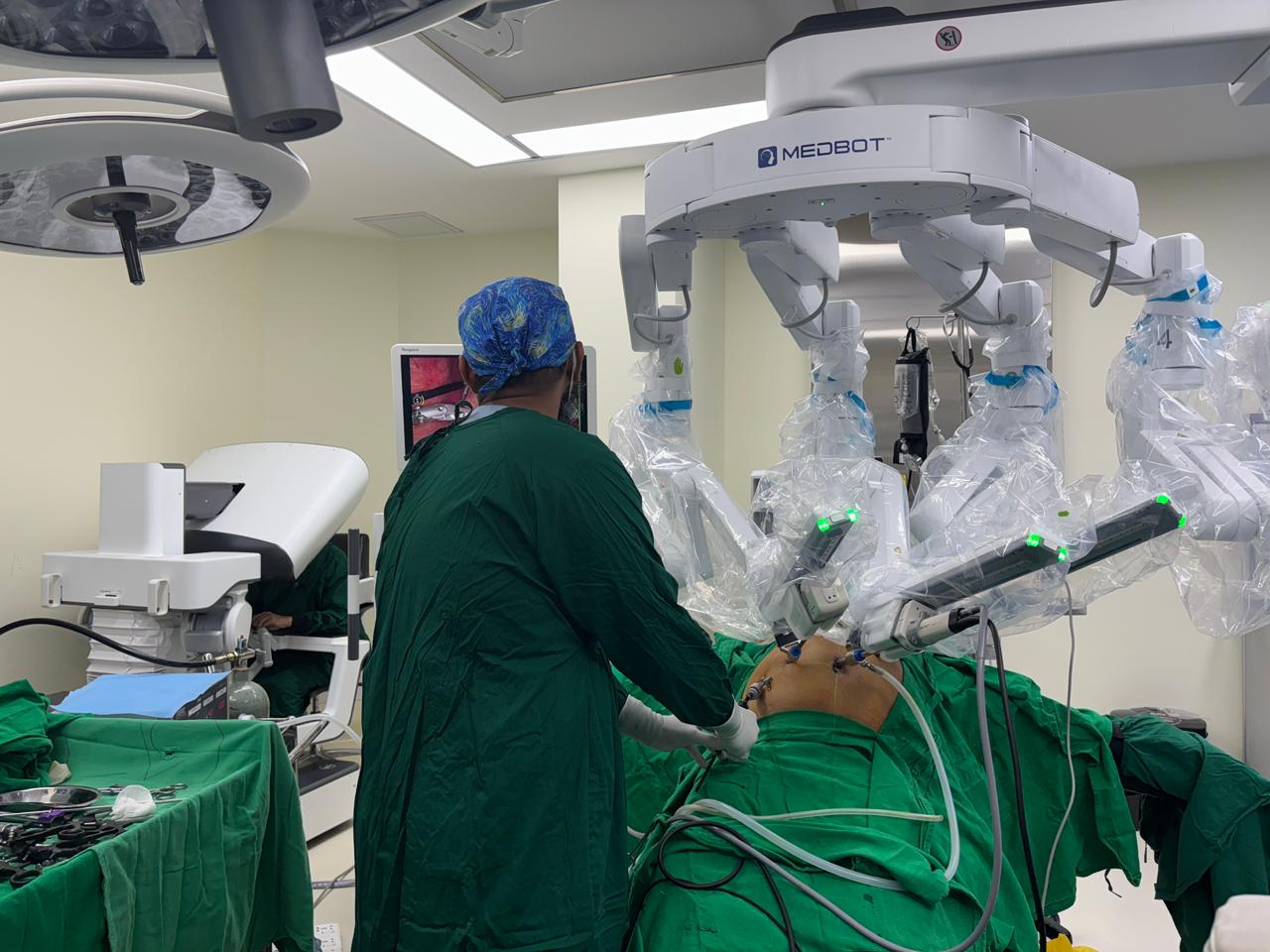
DHAKA, Aug 31, 2026 (BSS) - United Healthcare, a private health facility, today successfully performed what it described as Bangladesh's first-ever robotic surgery, marking a milestone in the country's healthcare sector.
The hospital authorities in a press release said the use of AI-powered robotic surgical technology has opened new possibilities for advanced healthcare services in the country.
According to the release, two robotic surgeries were performed at United Healthcare in United City on Madani Avenue here.
Prof Dr Rafiques Salehin conducted a robotic cholecystectomy on a 34-year-old man suffering from gallstones. Meanwhile, Prof Dr Samsad Jahan (Shelly) performed a robotic hysterectomy on a 45-year-old woman suffering from excessive bleeding from the uterus.
A multidisciplinary medical team of specialists performed the two surgeries with the assistance of the state-of-the-art Medbot Toumai Endoscopic Surgical Robot.
In robotic surgery, doctors can clearly view internal parts of the body using three-dimensional (3D) technology. As the robotic arms can rotate up to 360 degrees, surgeries can be performed with greater precision even in narrow and complex areas of the body.
This can reduce the size of incisions, blood loss and damage to surrounding tissues, while also reducing postoperative pain and enabling faster recovery.
Prof Salehin said robotic surgery is a state-of-the-art technology in modern medical science. The extensive range of movement of robotic arms enables more precise procedures even in complex areas of the body, he added.
It also creates opportunities to protect vital blood vessels and organs, perform procedures through smaller incisions and reduce blood loss.
Prof Shelly said there are plans to expand robotic surgery services soon to cardiac, neurosurgical, urological, general, gynaecological and thoracic surgery.
She said the long-term goal is to provide world-class medical treatment in the country to patients who currently need to travel abroad for advanced treatment.
This will not only reduce the need for overseas medical treatment but also help reduce expenditure of foreign currency, Prof Shelly added.