Tuesday
28 July, 2026
News Flash
News Flash
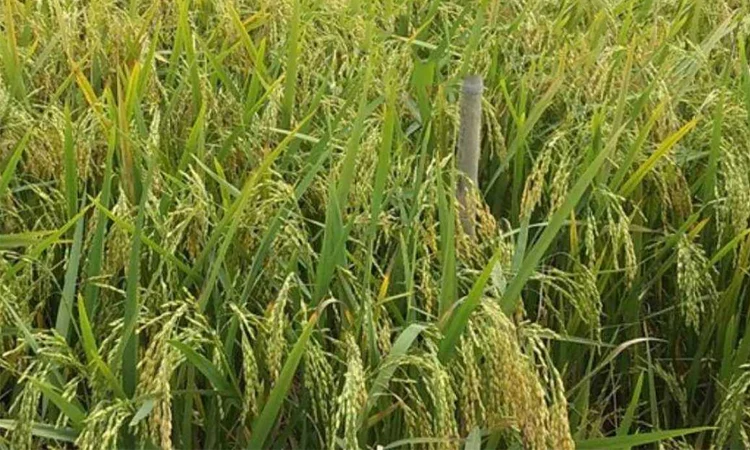
DHAKA, July 28, 2026 (BSS) - Bangladesh Rice Research Institute (BRRI) has unveiled BRRI dhan118, a new short-duration, cold-tolerant Boro rice variety that scientists believe could significantly reduce crop losses in Bangladesh's flood-prone haor region while boosting national food security.
Developed by the Plant Breeding Division of BRRI, the new variety is designed to address one of the biggest challenges faced by farmers in the country's northeastern wetlands, where early planting to escape devastating pre-monsoon flash floods often exposes crops to damaging winter cold, while delayed planting leaves them vulnerable to floods arriving before harvest.
"BRRI dhan118 has been developed specifically for the haor ecosystem. It combines short growth duration with tolerance to low temperatures during the reproductive stage, enabling farmers to harvest before flash floods while minimizing cold-induced spikelet sterility," said Dr. Khandakar Md. Iftekharuddaula, Chief Scientific Officer and Head of the Plant Breeding Division at BRRI.
According to BRRI, the variety can tolerate average temperatures below 20 degrees Celsius for seven to ten consecutive days during the critical reproductive stage, when conventional rice varieties often suffer from spikelet sterility, locally known as chitta, resulting in empty grains and substantial yield losses.
Researchers said BRRI dhan118 matures within 145 to 150 days under normal cultivation and can be harvested by early April when sown during the first week of November, allowing farmers to avoid the annual flash floods that frequently inundate haor areas.
The variety has demonstrated an average yield of approximately 6.8 tonnes per hectare, around 1.1 tonnes higher than BRRI dhan28, one of Bangladesh's most widely cultivated Boro varieties. Under favorable management practices, yields may reach 8.5 tonnes per hectare.
Dr. Partha Sarathi Biswas, Chief Scientific Officer (Plant Breeding) and Head of BRRI Regional Station, Habiganj, who led the development of BRRI dhan118, said the variety has shown promising results during several years of research and field evaluation in the haor region.
"Because the variety was released only in February this year, it has not yet reached farmers on a large scale, making it too early to assess farmer response," he said.
To accelerate adoption, BRRI plans to establish around 5,000 demonstration plots across 50 upazilas in the haor region during the upcoming Boro season. Approximately 100 demonstration plots will be set up in each participating upazila.
"We are currently producing quality seed through off-season seed multiplication so that sufficient seed will be available for large-scale demonstrations and distribution during the next Boro season," Dr. Biswas said.
He explained that when planted early during the first week of November, BRRI dhan118 is expected to produce around 6 tonnes per hectare, while normal planting between 15 and 20 November could increase yields to nearly 8 tonnes per hectare.
Unlike many existing short-duration varieties, the new variety maintains grain filling under low-temperature conditions, significantly reducing spikelet sterility.
The launch comes as Bangladesh continues to recover from severe flooding in the haor region.
"The haor region contributes about 16 percent of Bangladesh's Boro rice production," said Dr. Biswas.
He added that the government has already implemented support measures for affected farmers, including cash assistance and food aid, to help them recover from flood-related losses.
To ensure rapid dissemination of the new technology, BRRI has launched an 18-month expansion programme running from May 2026 to October 2027, with a budget of BDT 428.63 lakh.
The initiative includes establishing 5,000 demonstration plots, producing and distributing 30 tonnes of quality seed through five BRRI regional stations, and training approximately 3,000 farmers and 420 Sub-Assistant Agriculture Officers on improved cultivation practices.
The haor basin, covering the districts of Sylhet, Sunamganj, Habiganj, Moulvibazar, Netrokona, Kishoreganj, and Brahmanbaria, is one of Bangladesh's most important rice-producing regions, contributing an estimated 16 to 20 percent of the country's annual rice output.
BRRI scientists believe widespread adoption of BRRI dhan118, together with other climate-resilient rice technologies, could increase rice production in the haor region by around 10 percent, strengthening national food security while improving the livelihoods of thousands of vulnerable farming households.