Tuesday
25 August, 2026
News Flash
News Flash
By Md Aynal Haque
RAJSHAHI, Aug 25, 2026 (BSS) – The promotion of expansion of sustainable technology and conservation agriculture has been progressing to combat the adverse effects of climate change in the drought-prone Barind region.
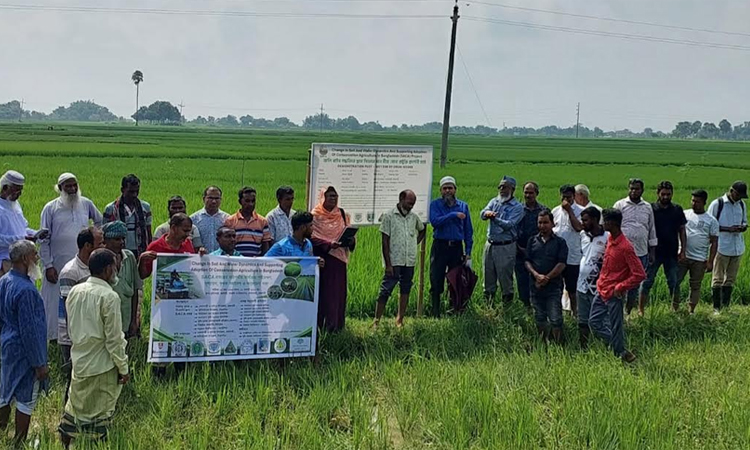
Hands-on training is being provided on alternative rice establishment methods in demonstration plots, using less water, avoiding land puddling and sowing seeds with a drum seeder.
Researchers and agriculturists said reliable information is being obtained about the long-term impact of conservation agriculture on soil and water through successful promotion of the technology.
They are conducting cultivation and demonstration of various rice varieties in an environmentally friendly way, using less water and without tilling the soil.
Through these research and demonstration plots, farmers are being taught hands-on various techniques of modern and profitable rice cultivation.
Detailing salient features of the technology Dr Enamul Haque, Coordinator of Supporting Conservation Agriculture in Bangladesh (SACA) project, said effectiveness of improved rice cultivation technology is being applied at the field level in the Barind area.
He emphasized that the adoption of conservation agriculture practices can significantly improve climate resilience, reduce water use, and shift farmers away from conventional, water-intensive farming methods.
Dr. Mohammad Hossain, Chief Scientific Officer of the Rajshahi region of the Bangladesh Rice Research Institute (BRRI), outlined the core principles of conservation agriculture in the region.
These include reduced tillage, crop rotation, mixed cropping, and the use of Power Tiller Operated Seeders (PTOS) for early planting.
One key feature of conservation agriculture is the retention of crop residues on fields. This practice improves soil health, conserves moisture, reduces input costs, and increases yields-particularly for less water-intensive crops such as mustard, lentils, maize, and wheat.
"Scientific research shows that conservation agriculture leads to higher crop yields and increased net profits for farmers," Dr Hossain said. "It also reduces the costs of labour, seeds, and fertilizers."
Dr. Mohammad Hossain added that reducing tillage and growing low-water-demand crops are effective ways to adapt to erratic rainfall and frequent droughts.
These methods also enhance soil fertility and promote carbon sequestration, contributing to long-term sustainability.
Locally developed machinery like the PTOS allows for early planting, precise seed placement, and lower labour and fuel expenses.
In addition, leaving behind stems and leaves from previous crops protects the soil from erosion, sun exposure, and wind, while boosting organic matter content.
Farmers are being encouraged to adopt crop rotation and mixed cropping to improve soil fertility, control weeds naturally, and increase overall productivity.
In particular, drought-prone areas like the high Barind tract are seeing a shift towards less water-reliant crops.
He stressed the importance of maintaining organic matter on the soil surface.
"Cover crops and crop residues are vital for improving soil structure, preventing erosion, and retaining moisture," he noted.
Dr Mohammad Hossain also stressed the urgency of reducing pressure on groundwater resources by cultivating water-efficient crops and maximizing the use of surface water.
"There's a real opportunity here to improve rural livelihoods through increased productivity, agribusiness development, and improved food and water security," Dr Hossain said.
Dr Israil Hossain, another agricultural expert, noted that farmers need more training and knowledge about conservation agriculture (CA) and modern farming machinery to fully benefit.
He recommended targeted programs to provide access to CA equipment and incentives for early adopters.
Training local service providers on CA methods is also essential to ensure that farmers receive the support they need to implement these practices effectively.
Monzurul Huda, former director of the Department of Agricultural Extension, highlighted the importance of promoting conservation agriculture technologies across the Barind tract to prevent further degradation of soil health.
"In the face of climate change -- with erratic rainfall, droughts, and natural disasters -- this technology offers an efficient way to grow crops with minimal water use, especially by avoiding traditional practices like paddling for paddy cultivation," Huda said.