News Flash
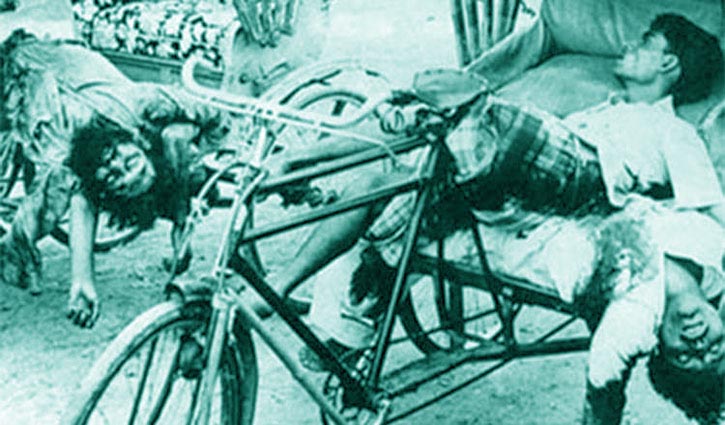
DHAKA, Mar 25, 2026 (BSS)- The nation today observed the Genocide Day in remembrance of the brutality carried out by Pakistani Army on the unarmed Bangalees on the black night of March 25 in 1971 under the infamous "Operation Searchlight".
President Mohammed Shahabuddin and Prime Minister Tarique Rahman issued special messages on the eve of the day.
The government organized various programmes at the state level to mark the day with due respect. As part of the programmes, one-minute symbolic 'blackout' was observed from 10.30pm to 10.31pm on March 25 throughout the country.
However, the key point installations (KPIs) and the essential establishments remained out of the purview of the programme.
Newspapers also published special supplements on genocide committed by the occupation Pakistani forces on the night of March 25, 1971.
Besides, discussions were held in all educational institutions including schools, colleges, madrasahs and technical institutes where valiant freedom fighters and noted personalities shared their memories with students, highlighting the genocide and the Great Liberation War.
Rare photos and documentaries on mass killing were exhibited at selected venues in all city corporation areas, including the capital.
Similar programmes were observed across the country marking the day.
In Pirojpur, a discussion was held at Shaheed Abdur Razzak-Saif Mizan Memorial Hall, organized by the district administration. Speakers recalled the dark night of March 25, 1971, and stressed the importance of presenting the true history of the Liberation War to the younger generation. District Commissioner Abu Sayeed highlighted the sacrifice of freedom fighters as a lasting inspiration.
In Natore, a memorial meeting was held at Bangladesh Army University of Engineering and Technology (BAUET). Vice Chancellor Brig Gen SM Lutfor Rahman called for building the nation imbued with the spirit of the Liberation War. Freedom fighters shared their experiences, and special prayers were offered for the martyrs.
In Bogura, a discussion titled ‘Genocide Day and the Liberation War’ was held at Aminul Haque Dulal Auditorium. District Commissioner Md Toufiqur Rahman emphasized the need to educate young people about the true history of 1971.
In Cumilla, a discussion and documentary screening were held at Nawab Faizunnesa Government Girls’ High School. Speakers highlighted the brutality of the March 25 genocide and paid tribute to the martyrs, stressing the importance of educating the younger generation.
In Barishal, the district administration organized discussions and cultural programmes. Divisional Commissioner Mohammad Mahfuzur Rahman described March 25 as a dark chapter in human history and recounted the Pakistani forces’ atrocities under Operation Searchlight. Competitions and a documentary screening were also arranged.
In Sunamganj’s Shantiganj, people placed wreaths at the graves of martyred freedom fighters Taleb Uddin and Kripendra Das. A discussion later highlighted the significance of the day and the sacrifices of the martyrs.
In Rajbari, a remembrance and discussion meeting was held at Yasin High School auditorium. Freedom fighters shared their experiences of the Liberation War, emphasizing the need to present accurate history to the younger generation.
In Sunamganj, a separate programme highlighted the history of ‘Shikha Satero’, where 17 youths were brutally killed in 1971. Speakers described it as a tragic chapter of the Liberation War and called for state recognition of the unnamed martyrs.
Such programmes were also arranged in different parts of the country.
On that dark night of March 25 in 1971, the Pakistan occupation forces carried out one of the most heinous genocides in history against the unarmed people of Bangladesh in the name of "Operation Searchlight.