News Flash
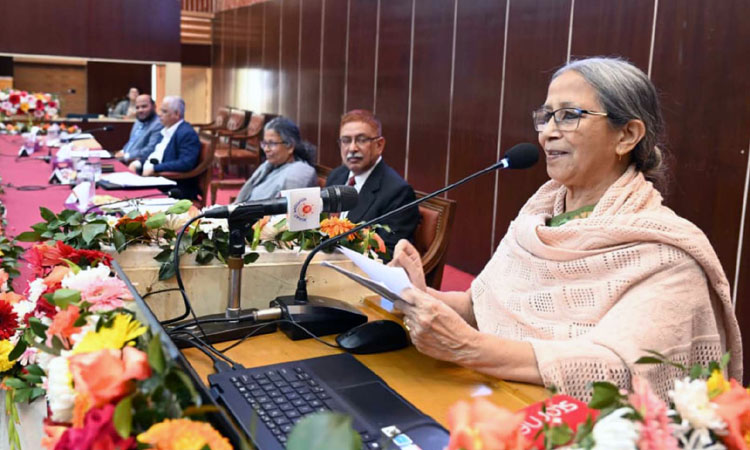
DHAKA, Feb 07, 2026 (BSS) - Fisheries and Livestock Adviser Farida Akhtar today said that the work in the fisheries and livestock sector is not merely an economic or scientific matter, it is deeply connected with religion, culture and social norms and practices.
"The fisheries resources are the part of our overall philosophy of life," she said while addressing an inception workshop at the Bangladesh Agricultural Research Council (BARC) here as the chief guest.
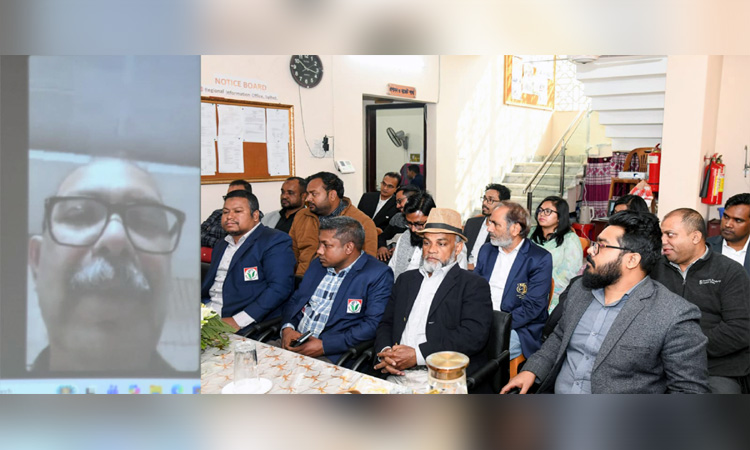
The workshop titled 'Review of Research Proposals and Formulation of Planning for the Project on Development and Management of the Natural Fish Breeding Grounds of the Halda River' was organized by the Bangladesh Fisheries Research Institute (BFRI) of Chandpur.
Chaired by BFRI Director General Dr Anuradha Bhadra, Bangladesh Fisheries Development Corporation Chairman and Additional Secretary Md. Imam Uddin Kabir and Director General of the Department of Fisheries Dr. Md. Abdur Rouf joined the function as special guest and guest of honour.
Chief Scientific Officer of the Riverine Station, Chandpur Dr Md. Amirul Islam chaired the technical session where BFRI Senior Specialist Dr. Md. Khalilur Rahman, Prof. Dr. Md. Mosharef Ali of Bangladesh University of Engineering and Technology, Assistant Prof Mohammad Shamsil Arefin of Chittagong University, and Prof Dr. S. K. Ishtiaq Ahmed of Chittagong Veterinary and Animal Sciences University spoke as resource persons.
The Adviser said that the Halda River is a resource belonging to the people. Therefore, research presentations and final reports should be prepared in the language that the general public can easily understand. While presentations and titles may be in English, she opined, the final report must be published in Bangla.
Emphasizing the inclusion of women in socio-economic research, she said that understanding the realities of the Halda riverbanks requires consideration of the experiences and positions of women living there. No socio-economic research can be complete without women's participation, she said, calling for the issue to be clearly incorporated into research methodologies.
Regarding the current risks facing the Halda River, she said that destructive human activities are the main threat. Instead of masking the issue by using the term "anthropogenic," it should be clearly identified as human mistakes and harmful actions.
She also highlighted the need for swift action to remove the Bhujpur rubber dam if it is found to be harmful. Even while research is ongoing, she said, corrective measures should be taken immediately in certain cases.
Referring to the harmful effects of tobacco cultivation, she said that tobacco farming along riverbanks poses a threat to fisheries resources.
She expressed her hope that some protection would be ensured as the ban on tobacco cultivation on triple-cropped land has been included in relevant policies.
The adviser also stressed the need for effective initiatives in sluice gate management and in controlling the invasive species known as "sucker fish." This fish behaves like a looter, she said.
Regarding project implementation, she said that the goal should be completed within the stipulated timeframe. Time extensions should not be fixed at the outset, but considered only when genuinely necessary.
She proposed holding a mid-term workshop in late 2026 or early 2027 to evaluate project progress and make necessary adjustments.
The adviser expressed optimism that, through the coordinated efforts of all concerned, conservation and management activities for the Halda River would be successfully implemented.