News Flash
KHULNA, April 17, 2026 (BSS) - State Minister for Environment, Forest and Climate Change Dr Sheikh Faridul Islam today said rising salinity intrusion along with soil and water pollution has become a major obstacle to achieving sustainable development in Bangladesh's coastal areas.
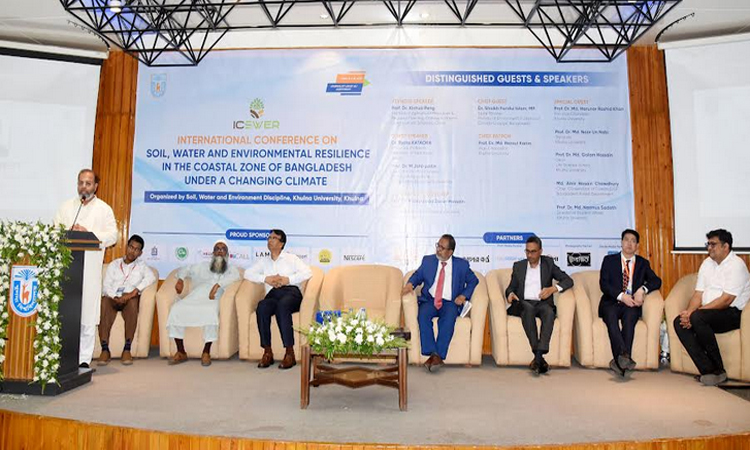
He made the remarks while addressing the inaugural session of a two-day international conference titled "Soil, Water and Environmental Resilience in the Coastal Zone of Bangladesh under a Changing Climate" at Khulna University.
Organised by the university's Soil, Water and Environment Discipline, the conference began at the Liaquat Ali Auditorium on the campus this morning.
The state minister said the south-western region, including Khulna, is facing severe impacts of climate change and has effectively become a 'real climate victim' due to its geographic vulnerability.
"Frequent natural disasters are causing irreparable damage to lives and livelihoods in this region. Our biggest challenge now is how to adapt and survive under these adverse conditions," he said.
Highlighting environmental risks, he noted that salinity intrusion, coupled with soil and water pollution, has intensified in areas such as Rampal, Mongla, Koyra and Satkhira.
He underscored the importance of such conferences in identifying effective, nature-based solutions to tackle these challenges.
Referring to the Sundarbans, the state minister said the world's largest mangrove forest is facing multiple threats and called for urgent collective action to protect the ecosystem.
"For our own survival, we must protect the environment. We are also partly responsible for the current environmental degradation," he added.
Emphasising the role of research, he said there is no alternative to quality research in finding sustainable, long-term solutions and called for greater involvement of students and farmers in such initiatives.
Khulna University Vice-Chancellor Prof Dr Md Rezaul Karim, speaking as chief patron, said coastal communities are increasingly experiencing salinity, water scarcity and land degradation due to climate change, which directly affects their livelihoods.
"As a coastal university, Khulna University aims not only to excel in education and research but also to engage with society and contribute to solving real-world problems," he said.
Head of the Discipline Prof Dr Mohammad Jaber Hossain presided over the event, while Pro-VC Prof Dr Md Harun-Or-Rashid Khan spoke as special guest.
Among others, Dean of the School of Life Science Prof Dr Md Golam Hossain, Chief Conservator of Forests Amir Hossain Chowdhury and Director of Student Affairs Prof Dr Md Nazmus Sadat also addressed the session.
The keynote paper was presented by Prof Dr Xinhua Peng of the Chinese Academy of Agricultural Sciences.
In the second session, guest speakers Dr Ryota Kataoka from the University of Yamanashi, Japan, and Prof Dr M Jahiruddin of Bangladesh Agricultural University delivered their speech.
More than 200 research papers were presented through oral and poster sessions, while over 300 delegates from home and abroad, including Japan and China, participated in the conference.
Following the inaugural session, the state minister visited the country's first Soil Archive at the ground floor of the university's Academic Building-2.
He expressed satisfaction after observing soil samples collected from different regions and said the archive would open new avenues for research. Later, he planted saplings on the campus.