News Flash
DHAKA, June 5, 2026 (BSS) – To align higher education with the demands of the labor market, National University has begun implementing various initiatives, including bringing reform in its curriculum.
As part of this effort, 12,000 college teachers across the country are being provided training in Information and Communication Technology (ICT).
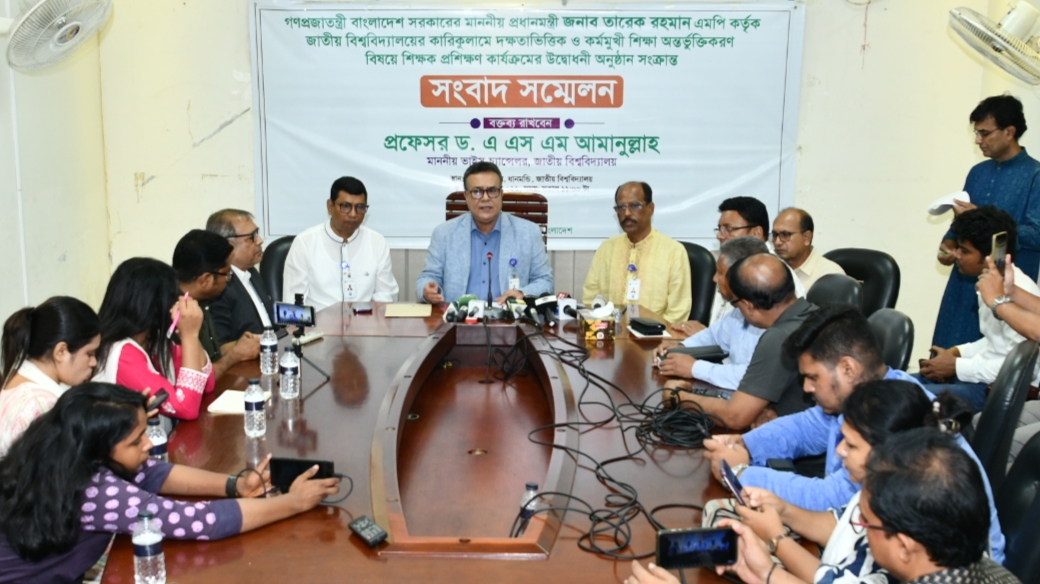
NU Vice-Chancellor Professor Dr. A S M Amanullah disclosed this information at a press conference held on Friday at the university's city office in Dhanmondi.
He said that currently, approximately 40 lakh students are studying in 2,284 educational institutions affiliated with National University, spread across 500 upazilas in 64 districts of the country. To ensure employment for these students, initiatives have been taken to make university education more skill-based and technology-dependent.
The Vice-Chancellor further said that in the context of the Fourth Industrial Revolution, Artificial Intelligence (AI), the digital economy, and the changing demands of the global job market, National University has made ICT courses compulsory at the undergraduate level. This curriculum, developed with the assistance of the government's a2i project and UNICEF Bangladesh, is currently being implemented.
He informed that to create skilled teachers for imparting ICT education to a vast number of students, 12,000 college teachers are being trained initially. Prime Minister Tarique Rahman will formally inaugurate this training program at an event to be held on June 7 at the Bangladesh-China Friendship Conference Centre in the capital.
He also informed that the National University's Multi-Language Institute and the 'One Student One Tree' program will also be inaugurated at the same event.
Prof Amanullah said that 89 core trainers and 840 master trainers have already been prepared to implement the teacher training activities. The a2i project and UNICEF Bangladesh have provided technical assistance for this work.
Noting that the current industry-academia linkage of National University is about 10 percent, he said a plan has been taken to increase this rate by 10 percent each year. As a result, it is expected that this rate will rise to 50-60 percent by 2030.