News Flash
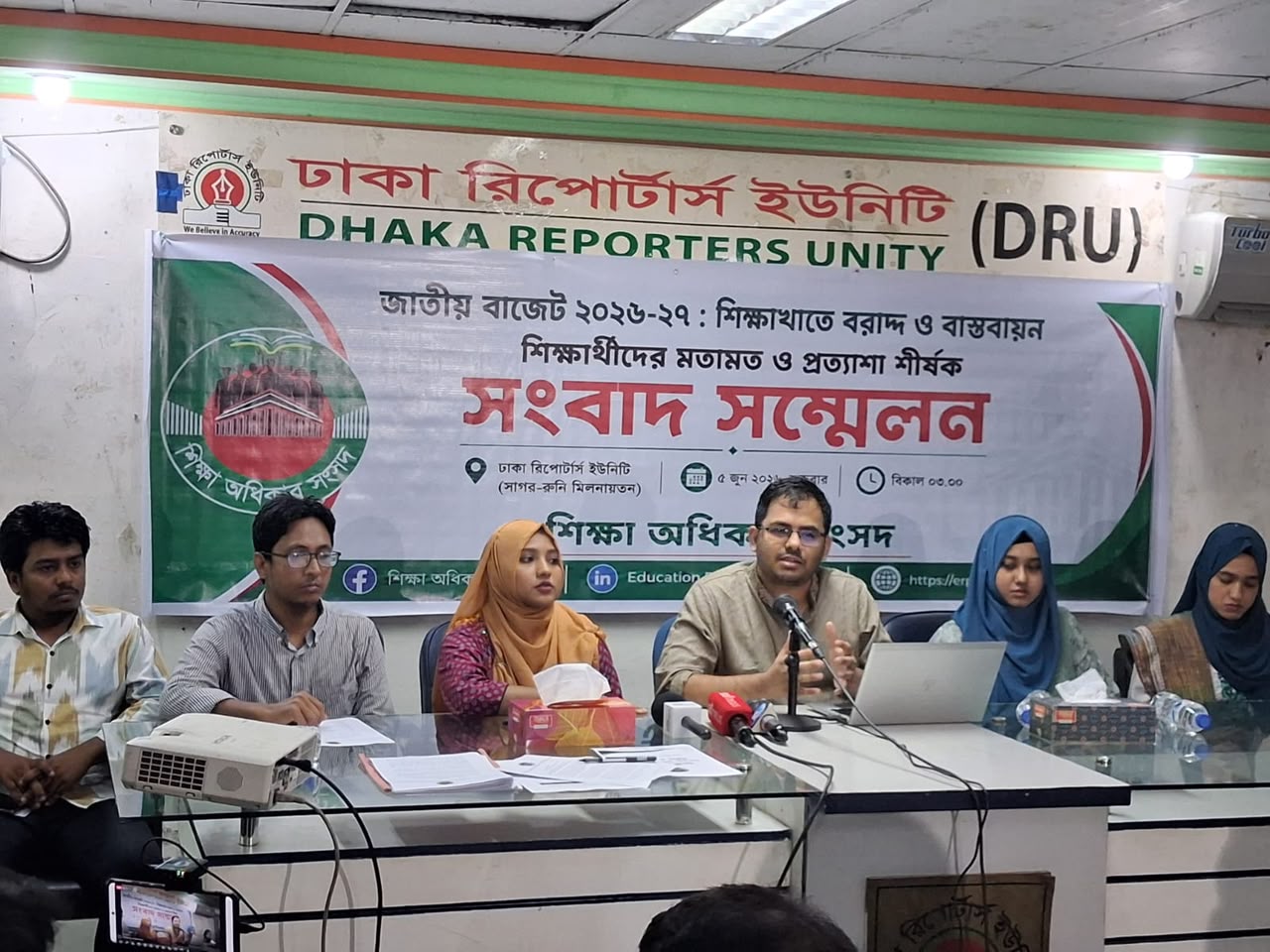
DHAKA, June 5, 2026 (BSS) – Students from higher education institutions across the country have demanded that the upcoming national budget give maximum priority to primary and technical education, to aim for qualitative and structural reforms in the education sector.
During a research survey conducted by ‘Education Rights Parliament’ the students also demanded ensuring an allocation of at least 5 percent or more of GDP for the education sector in the upcoming 2026-27 fiscal year budget.
'Education Rights Parliament' published the findings and recommendations of the research survey at a press conference held at the Sagar-Runi Auditorium of the Dhaka Reporters Unity (DRU) this afternoon.
According to the students, there is no alternative to developing the primary level to strengthen the foundation of education, and to technical education to ensure future employment.
Assistant Professor at the Institute of Education and Research (IER) of Jagannath University Md. Shahnewaz Khan Chandon, Member Secretary of the Education Rights Parliament highlighted the survey report. Abu Sadat Md. Mostansir Billah, Misbahur Rahman Asim, Mahfuzur Rahman Manik, and Mazharul Islam of the organization were present, among others.
They said the survey is highly significant as it comes ahead of the first budget of the new democratic government. The survey was conducted to convey students' independent opinions on the education budget in a democratic environment, particularly the research-based views of education science students, to policymakers, they added.
They said the survey was conducted with the direct participation of 350 students studying in various higher education institutions across the country. In terms of the education level distribution of participants, 61.14 percent were undergraduate (Honours) level students and 36 percent were postgraduate (Master's) level students.
A large portion, 50 percent of the respondents, was students directly from Education, Education Administration, and Education and Research (IER) disciplines. Additionally, students from various departments including English, Economics, and Sociology also participated in the survey.
Students from 17 public universities, 9 private universities, 4 graduate-level madrasas, and various colleges affiliated with the National University participated in the survey. Notable among the universities were University of Dhaka, Jagannath University, University of Chittagong, Noakhali University of Science and Technology, Bangladesh University of Professionals (BUP) and Ahsanullah University of Science and Technology.