News Flash
By S M Zahid Hossain
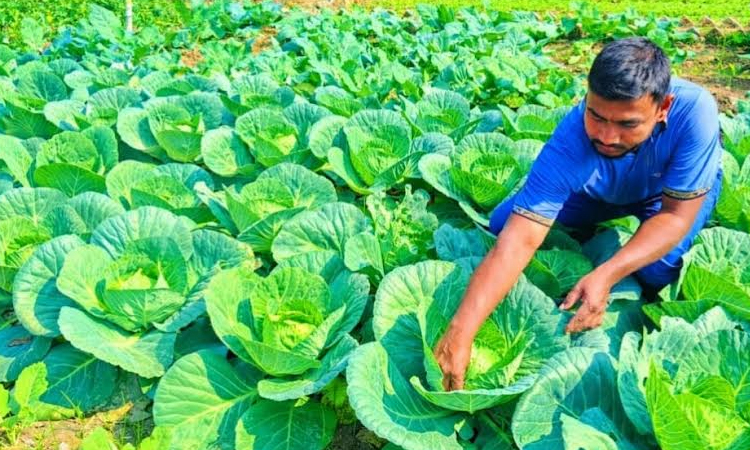
KHULNA, Jan 14, 2026 (BSS): An innovative initiative to cultivate pesticide-free vegetables on fallow government land has drawn widespread attention in Dighalia upazila of the district, demonstrating how planned utilization of unused lands can boost food production and environmental sustainability.
The initiative was launched in 2024 by former Dighalia Upazila Nirbahi Officer (UNO) Md Ariful Islam, who undertook a plan to bring nearly 20 decimals of long-neglected land inside the Dighalia Upazila Parishad complex under cultivation. The land, which had remained abandoned for years and was covered with weeds and waste, has now been transformed into a vibrant vegetable garden.
With the active involvement of Upazila administration employee Md Liaqat Ahmed, the land was cleared and prepared for farming. At present, a wide variety of seasonal vegetables, including cucumber, red spinach, beetroot, coriander, brinjal, tomato, spinach, cabbage, cauliflower and taro, are being cultivated.
The Dighalia Upazila Agriculture Extension Office has been providing regular guidance and technical support, ensuring that environment-friendly and modern cultivation methods are followed. As a result, the garden is yielding satisfactory production of fresh and pesticide-free vegetables.
Dighalia Upazila Agriculture Officer Md Kishore Ahmed described the initiative as highly commendable. "Through close coordination with the Upazila administration, we are providing advice on eco-friendly vegetable farming. Producing pesticide-free vegetables ensures safe food and serves as a role model for others," he said.
Current Dighalia UNO Md Harun Or Rashid said efforts are underway to expand the initiative further. "If fallow government land is utilized in this manner, food production will increase and the environment will be protected. We plan to replicate similar initiatives on other government lands in the Upazila in the future," he added.
The vegetable garden has attracted daily visitors from nearby areas, inspiring local residents to cultivate vegetables in their own homesteads and unused plots of land.
Local vegetable trader Abdul Majid said the vegetables grown at the Upazila complex are extremely fresh and of better quality than those available in the market. "Such initiatives will help increase the local supply of safe vegetables," he noted.
Another trader, Sajib, said the initiative has encouraged both farmers and traders. "If similar projects are taken up at the government level, it will benefit everyone involved in the agricultural value chain," he said.
Upazila administration employee Md Liaqat Ahmed said that after achieving encouraging results from small-scale cultivation last year, the project has been expanded further this year under the guidance of the current UNO. "With continuous support from the Agriculture Office, we are taking proper care of the crops," he added.
Stakeholders believe that replicating such initiatives across the country by utilizing fallow government land would strengthen food security while increasing public awareness about sustainable agriculture and environmental protection.
Such exemplary efforts by the local administration are expected to play a significant role in promoting agricultural development and sustainable food management nationwide.