News Flash
By Md Aynal Haque
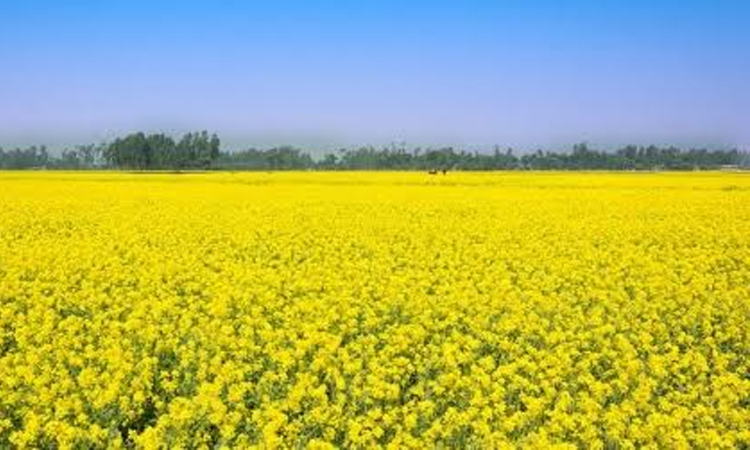
RAJSHAHI, Jan 20, 2026 (BSS) - Vast stretches of land across the Rajshahi region have turned golden with blooming mustard flowers, raising hopes among farmers for a bumper harvest this season.
Favourable weather conditions and the absence of natural disasters encouraged many farmers opted for early mustard cultivation this year and are expecting higher yields. Smiles are evident on the faces of farmers as the crops flourish across both plain lands and char (riverine island) areas.
Beyond the mainland, extensive mustard cultivation is taking place in the char lands of major rivers, particularly the Padma, Mohananda, Korotoa and Barnoi. Compared to plain lands, mustard farming has expanded more significantly in the remote Padma char areas.
The scenic yellow fields have also attracted numerous nature lovers, with people of all ages visiting the farmlands to capture photographs.
Sources at the Department of Agricultural Extension (DAE) said that, like previous years, mustard cultivation has increased alongside lentils, wheat and winter vegetables. The trend reflects growing interest in edible oil crops due to favourable market prices.
During the current Rabi season, around 6.46 lakh tonnes of mustard are expected to be harvested from approximately 3.89 lakh hectares across all eight districts of the Rajshahi division.
According to DAE data, a target of 3.06 lakh tonnes has been set from 1.82 lakh hectares in four districts under the Rajshahi Agricultural Zone, while another 3.40 lakh tonnes are targeted from 2.07 lakh hectares in four districts under the Bogra Agricultural Zone. Officials expect production to surpass last year's output due to favourable climatic conditions.
DAE Additional Director Dr Azizur Rahman said landless and marginal farmers have brought vast tracts of sandy char land under mustard cultivation in the Ganges basin this year, with crops showing healthy growth throughout the region.
He attributed the expected bumper production to suitable weather, high-yielding varieties, modern technologies and government initiatives, which together have helped exceed targets for both acreage and yield.
Various research and development organisations, including the Bangladesh Agricultural Research Institute (BARI) and several NGOs, have also taken collaborative steps this season to help achieve production targets.
Local farmers said good market prices and low production costs have encouraged many to cultivate mustard as an additional crop. They noted that mustard requires less irrigation, fertiliser and pesticides while offering higher returns.
As a result, most fields are now adorned with yellow mustard flowers against lush green backdrops. Farmers remain optimistic that production will exceed last year's level if favourable weather continues.
Mustard cultivation typically begins in Agrahayan, and during Poush and Magh, farmlands remain fully covered with yellow blooms, attracting visitors from nearby areas.
Ghulam Mostafa, 48, a farmer from the char areas of Bagha upazila, told BSS that he cultivated mustard on three bighas of land this year. He said mustard farming is cost-effective and profitable, adding that crushed mustard plants are also used as cattle feed and fuel.
Similar views were expressed by Mahasin Ali, 45, a farmer from Amodpur village in the plain areas. He said farmers who suffered losses last year due to natural disasters are hopeful of recovering those losses this season and achieving financial stability.
Shafiullah Sultan, Upazila Agriculture Officer of Bagha, told BSS that flood-induced silt deposition has enhanced soil fertility in char areas, leading to increased mustard cultivation. He said farmers have shown particular interest in BARI-14, BARI-18 and Tori-7 mustard varieties.
He expressed optimism that mustard production this year will play a significant role in boosting farmers' incomes and reducing the country's edible oil deficit.