News Flash
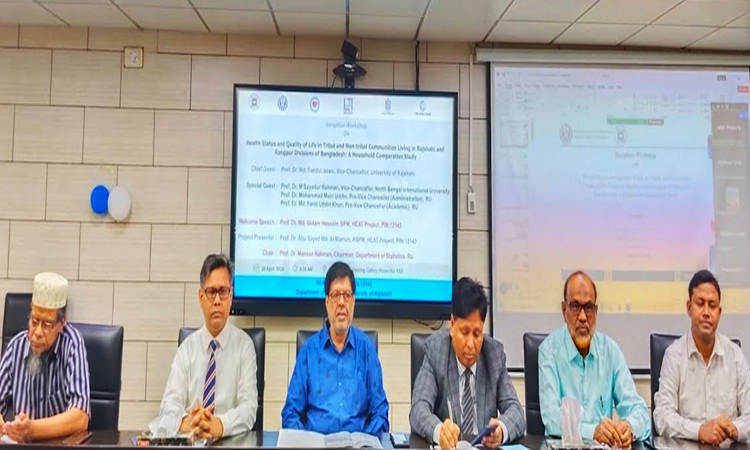
RAJSHAHI, April 26, 2026 (BSS) – Speakers at a workshop here today stressed on carrying out accurate date-based research for assessing the real conditions of indigenous people in Rajshahi and Rangpur divisions to improve their living standards.
Accurate, data-based research is extremely crucial for improving the health and living standards of marginalized and disadvantaged communities and without assessing the real conditions of Indigenous peoples, it is difficult to adopt effective policies, they opined.
In this connection, they said that a country's overall development is meaningful when all communities in society receive equal opportunities for development.
They make the remarks at the inaugural research workshop on the existing disparities in health conditions and living standards between Indigenous and Bengali communities living in Rajshahi and Rangpur divisions.
The event was taken place at the Engineering Faculty Gallery of Rajshahi University’s (RU) Jamal Nazrul Islam Science Building today.
The workshop was organized to mark the launch of the HEAT-ATF-W3(a) sub-project titled, “Health Conditions and Living Standards of Indigenous and Non-Indigenous Populations Living in Rajshahi and Rangpur Divisions of Bangladesh: A Household-based Comparative Survey.”
Vice-Chancellor (VC) of Rajshahi University (RU) Prof. Dr. Md. Faridul Islam attended the workshop as the chief guest while VC of Uttarbanga International University Prof. Dr. M. Sayedur Rahman, Pro-VC (Academic) of RU Prof. Dr. Md. Farid Uddin Khan and Pro-VC (Admin) of RU Prof. Dr. Mohammad Moin Uddin were present as special guests.
Speaking on the occasion, they said household-based comparative survey can play a supportive role in future planning, health policy, and development programs. The research findings will serve as important guidelines for policymakers, development agencies, and stakeholders in the health sector.
At the workshop, they announced that the survey will cover various aspects of life for different Indigenous groups living in various districts of Rajshahi and Rangpur divisions — including Santal, Oraon, Mahato, Munda, Pahan, and Rajbanshi communities.
Topics include lifestyle, access to healthcare, disease patterns, maternal and child health, nutrition, sources of income, education, and social security.
Simultaneously, data will be collected from the Bengali population in the same regions for comparative analysis.
The organizers said that this research will make it possible to identify the extent and causes of disparities in health and living standards between the two communities, as well as determine necessary policy actions.
Through household-level field data collection, the real situation of Indigenous and non-Indigenous populations will be presented.
The research findings will serve as important guidelines for policymakers, development agencies, and stakeholders in the health sector.
At the event, hosted by Mehnaz Tabassum, a student of the Department of Statistics at Rajshahi University, the welcome speech was delivered by Professor Dr. Md. Golam Hossain of the same department.
The keynote paper was presented by Professor Dr. Abu Sayed Md. Al Mamun of the Department of Statistics, Rajshahi University.
Teachers, researchers, students, officials from relevant departments, and various stakeholders were present at the event.
Also attending virtually from India was Dr. Premananda Bharati, retired professor from the Indian Statistical Institute.