News Flash
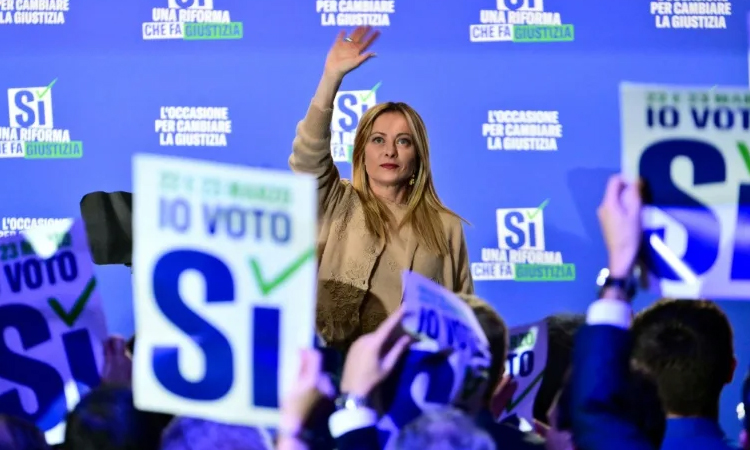
ROME, March 14, 2026 (BSS/AFP) - Italians vote next week on a highly divisive judicial reform that Prime Minister Giorgia Meloni says is essential for impartiality, but which opponents condemn as a power grab.
The referendum comes amid an ongoing struggle between Meloni's hard-right government and magistrates, who claim the proposed changes will compromise their independence.
The reform would separate the functions of prosecutor and judge -- both currently considered magistrates with shared career paths -- while also changing their oversight body.
The outcome of the constitutional referendum, to be voted on March 22 and 23, is uncertain.
Recent polls indicate a slight lead for the "No" camp, with the opposition presenting the poll as a chance to vote against Meloni's government.
A failure to pass the referendum would be a blow for Meloni, who has led an uncharacteristically stable coalition government since October 2022.
But she has dismissed suggestions that she might quit if she loses.
At a rally on Thursday in Milan, Meloni described the change as a "historic reform that addresses the root causes of the dysfunctional justice system".
- 'Petulant litanies' -
Late conservative prime minister Silvio Berlusconi was famous for his battles with the judiciary, who he accused of being left-wing.
Meloni and her ministers have also not shied away from attacking rulings they claim are too lenient, particularly on the issue of immigration.
Judges have fought back, with more than 80 percent of members of Italy's National Magistrates Association participating in a one-day strike in February 2025 against the reform.
In a public spat last month, Justice Minister Carlo Nordio -- who had called criticism from judges "petulant litanies" -- said the reform would correct a "para-Mafia mechanism" within the judiciary.
Currently, judges or public prosecutors can move between one function or other, although only a tiny minority do so. Since 2022, they have only been allowed to change once.
While many consider the structure a bulwark against political interference in the work of magistrates, pro-reform campaigners say too-cosy relations between prosecutors and judges harm the defendant.
"If the person who accuses you and the person who judges you are two co-workers who life paths continually intersect, there is a risk of confusion that could weaken a key principle of the Italian constitution -- the impartiality of judges," Meloni said.
- Settling scores? -
The second element of the reform, judged by some the most important, involves changes to the Superior Council of the Judiciary (CSM), an oversight and disciplinary body whose members are elected by their peers and parliament.
The reform would divide the CSM into two separate councils: one for judges, one for prosecutors, while setting up a 15-member disciplinary court.
Members would be drawn by lots, not voted by their peers, while a fraction of the judges chosen randomly for the court will come from lists compiled by parliament.
Criminal defence attorney Franco Moretti, who heads the "No" campaign, said the new disciplinary court risked being "potentially the armed wing of politics".
"When needed, it could be used to settle scores, so to speak, with that part of the judiciary that has dared touch it," Moretti said at a debate this month.
Another critique of the reform -- which has already been approved in parliament -- says the random selection of judges runs counter to a system of meritocracy.
Experts also warn that, contrary to Meloni's assertions, the changes do not address the structural issues bogging down Italy's legal system, which lead to notoriously lengthy trials and huge caseloads.
- 'Aura of invincibility' -
Referendums in Italy can be politically perilous. In 2016, then premier Matteo Renzi staked his career on a constitutional reform that voters rejected, causing the fall of his government.
"There's no chance I'll resign under any circumstances," Meloni told this week's rally, saying that if voters wanted to punish her, they could do in next year's general elections.
Valerio Valentini, a political reporter for news website Il Post, said this assertion was intended to stop the vote becoming a referendum on the government.
If the reform is rejected, "that does not necessarily mean the government will fall," he said.
"But she would lose that aura of invincibility she has had so far."