News Flash
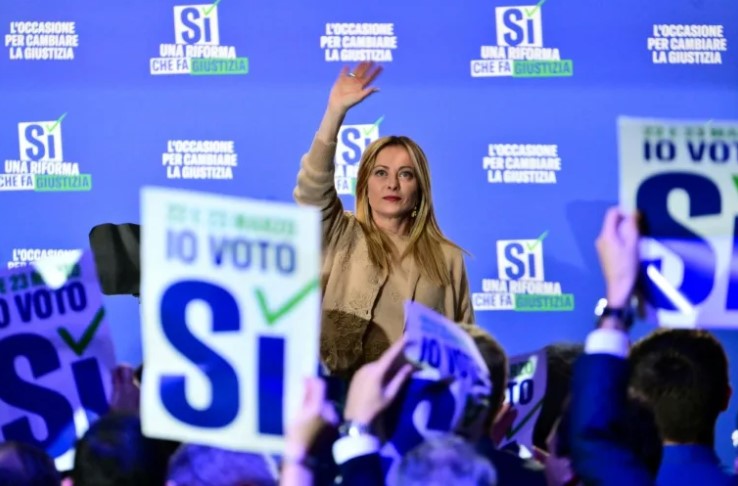
ROME, March 22, 2026 (BSS/AFP) - Italians begin voting Sunday in a two-day referendum on reforms that Prime Minister Giorgia Meloni says will make the judiciary more independent -- but which critics argue will do the opposite.
The poll risks turning into a referendum on the far-right leader herself, ahead of parliamentary elections next year.
Meloni's hard-right government wants to change Italy's constitution to separate the role of judges and prosecutors and reform their oversight body.
She says the plan is essential to guarantee impartiality and improve the functioning of Italy's creaking justice system.
It will make it "more modern, more meritocratic, more autonomous, more accountable and above all, free from political constraints", Meloni said in a video this week.
But critics condemn it as a political power grab that fails to address the real challenges, from years-long trials to prison overcrowding.
Elly Schlein, the leader of the centre-left Democratic Party, said it was badly drafted and "weakens the independence of the judiciary".
Opinion polls show the two camps are neck-and-neck.
A decisive "No" would be a blow for Meloni, who has led an uncharacteristically stable coalition government since October 2022.
However, she has dismissed suggestions that she might quit if she loses.
Voting closes at 1400 GMT on Monday, with preliminary results expected later that day.
- 'Execution squads' -
The late conservative prime minister Silvio Berlusconi was famous for his battles with the judiciary, who he accused of being left-wing.
Meloni and her ministers have also repeatedly attacked rulings they claim are too lenient, particularly on the issue of immigration.
Their reform has sparked intense opposition within the judiciary, with more than 80 percent of members of Italy's National Magistrates Association staging a one-day strike last year.
The referendum campaign has been hard fought and bitter.
In a public spat last month, Justice Minister Carlo Nordio -- who had called criticism from judges "petulant litanies" -- said the reform would correct a "para-mafia mechanism" within the judiciary.
Giusi Bartolozzi, Nordio's chief of staff, also drew widespread criticism when she said during a talk show that the reform would "get rid of" magistrates who operated like "execution squads".
- Too-cosy relations -
The most divisive part of the reform involves changes to the Superior Council of the Judiciary (CSM), an oversight and disciplinary body whose members are elected by their peers and parliament.
The reform would divide the CSM into two separate councils, one for judges and one for prosecutors, and create a new 15-member disciplinary court.
Members would be drawn by lots, no longer voted by their peers, with three members of the court chosen by Italy's ceremonial president and three from a list of experienced lawyers approved by parliament.
Criminal defence lawyer Franco Moretti, who heads the "No" campaign, said the new court risked being "the armed wing of politics".
"When needed, it could be used to settle scores with that part of the judiciary that has dared to touch it," he said at a debate this month.
The second part of the reform would prevent judges and public prosecutors from switching between the two functions, addressing concerns that too-cosy relations between the two groups harm defendants.
Critics respond that only a tiny minority change roles. In any case, since 2022 they have only been allowed to switch once, while in the first decade of their career.
- 'Send us home' -
Referendums in Italy can be politically perilous.
In 2016, then-premier Matteo Renzi staked his career on a constitutional reform that voters rejected, toppling his government.
This weekend's reform is highly technical and some voters admitted to being swayed more by the politics than the substance.
"I'm voting 'No' because I don't like those who support 'Yes'," Mario Alessi, a 60-year-old sales manager from Rome, told AFP earlier this week.
Meloni has sought to distance the vote from her own leadership.
"The Italians who want to send us home can easily do so in a year, but today we're voting on justice," she said this week.