Tuesday
01 September, 2026
News Flash
News Flash
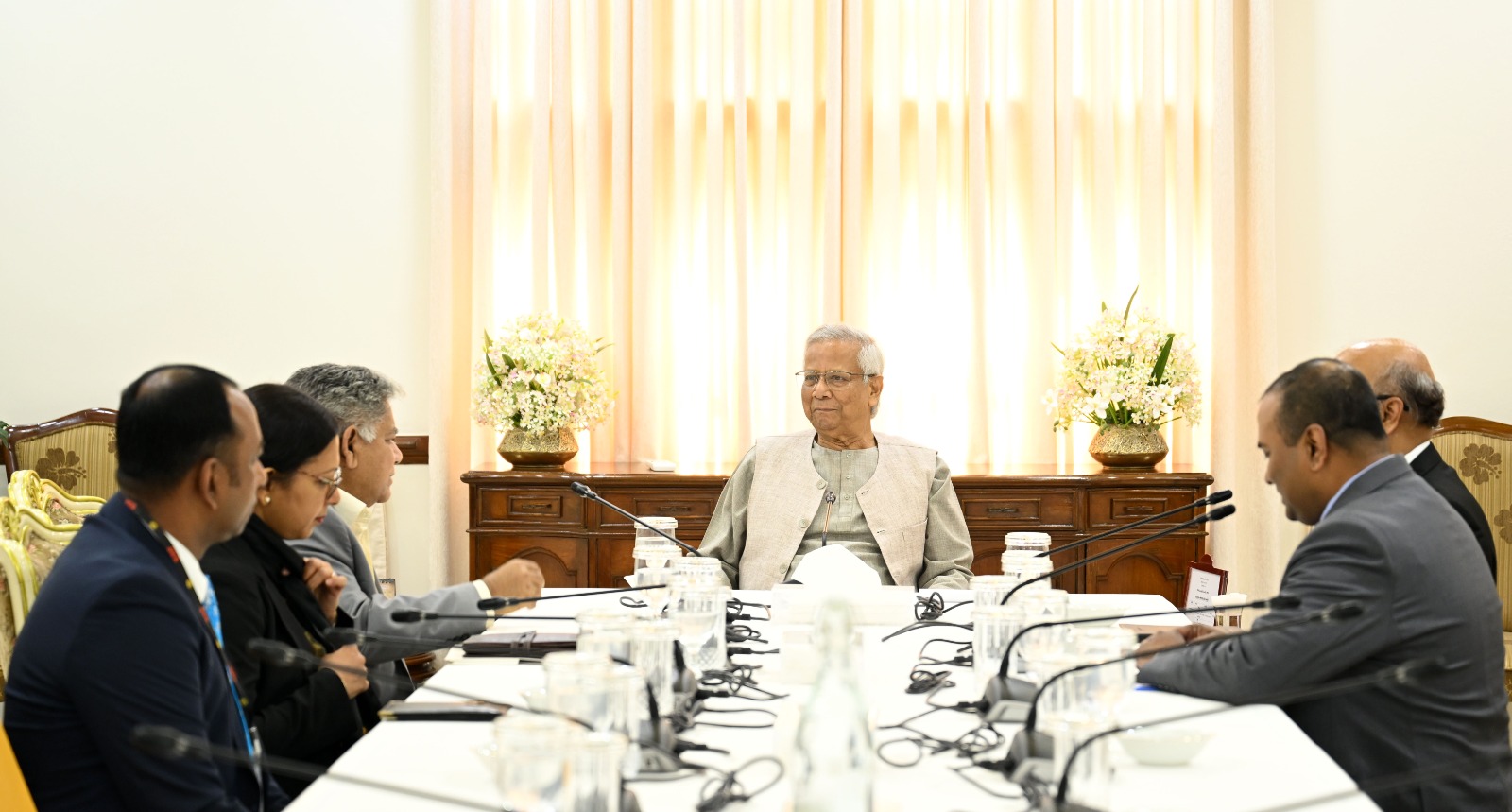
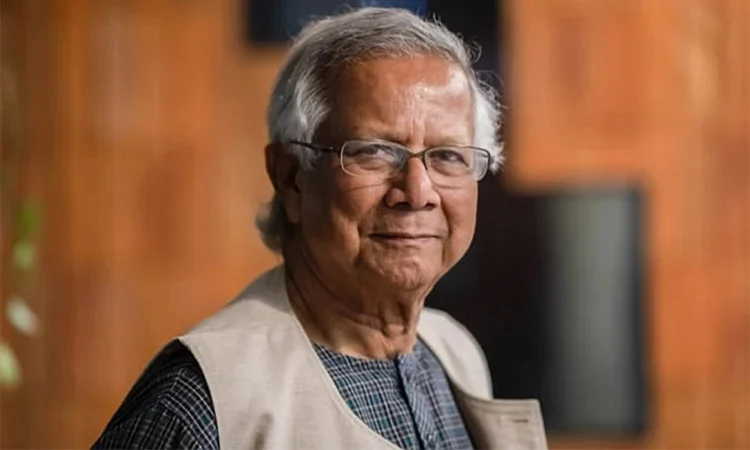
DHAKA, Jan 14, 2026 (BSS) - Chief Adviser Professor Muhammad Yunus today stressed that the Bangladesh Shipping Corporation (BSC) must remain a strong and profitable organization.
"BSC has recently emerged as a profitable organization and this momentum must be maintained," he said.
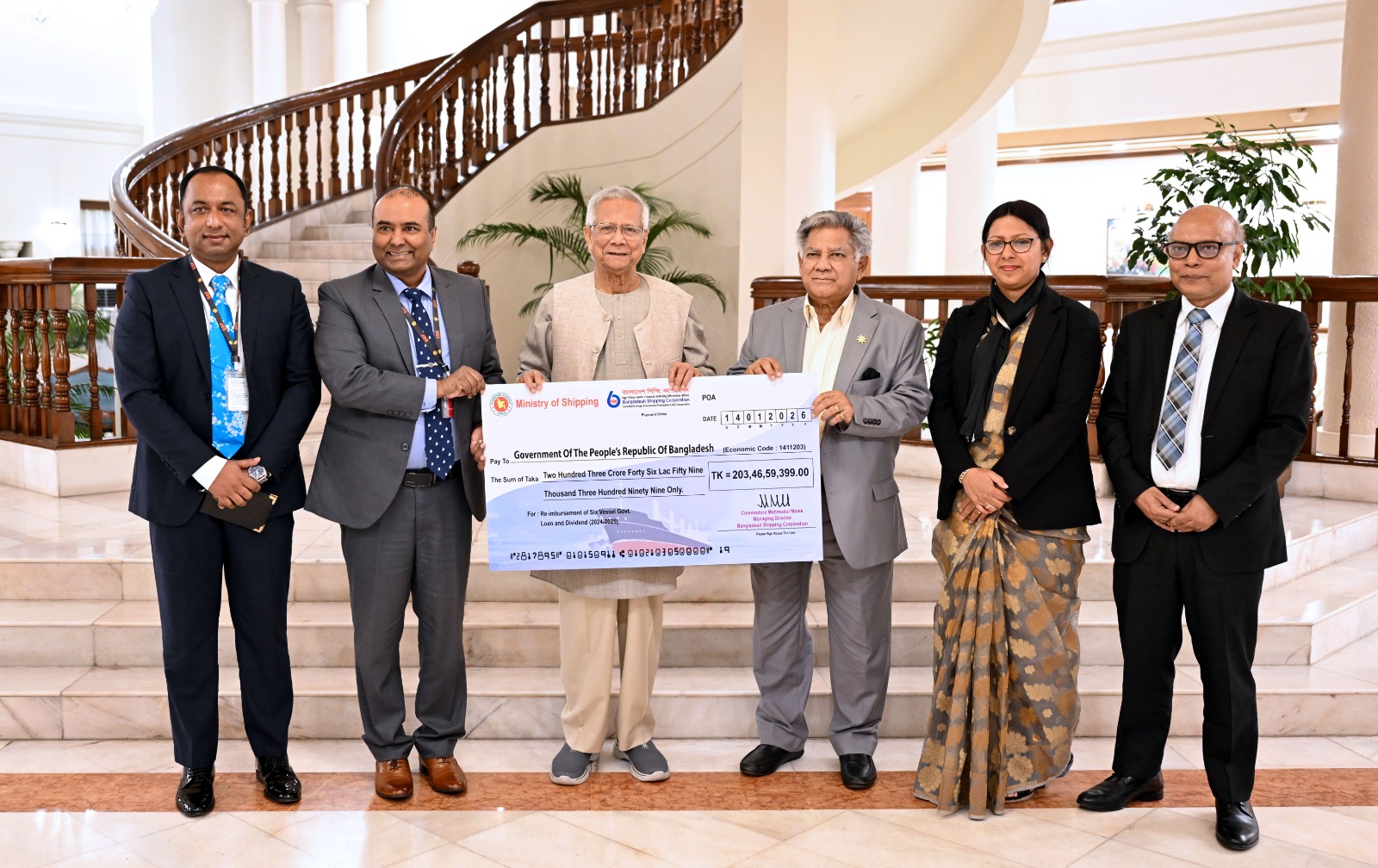
The Chief Adviser made the remarks at a function at the State Guest House Jamuna here as he received a cheque for Taka 203.47 crore from the BSC, said the Chief Adviser's Press Wing this afternoon.
Shipping Adviser Brigadier General (Retd) Dr M Sakhawat Hussain and BSC Managing Director Commodore Mahmudul Malek handed over the cheque to the Chief Adviser.
The amount was handed over to the government as installments under the Subsidiary Loan Agreement (SLA) signed for repayment of loans taken for six ship-purchase projects implemented under the organization, along with the government's share from dividends declared for the fiscal year 2024-2025.
On the occasion, Prof Yunus stressed that future planning should be formulated in such a way that the corporation's income can further strengthen itself and add new ships to its fleet.
He said that the inclusion of more ships in BSC's fleet would increase motivation among seafarers and create new employment opportunities.
The Chief Adviser also emphasized that trainers of marine academies must be retained by providing them with appropriate honorariums so that they can produce world-class seafarers.
Speaking on the occasion, Commodore Mahmudul Malek said that a Loan Agreement (LA) was signed on October 14 in 2016 between the Government of Bangladesh (Economic Relations Division) and the Government of China (China Exim Bank) for the implementation of a project to procure six ships for BSC on a g-to-g basis.
The project involved the acquisition of six new ships - three new product oil tankers and three new bulk carriers, each with a capacity of approximately 39,000 DWT, he added.
The principal amount of the loan was 1,199,999,070 Chinese Yuan, equivalent to Taka 14,576,798,785, the BSC MD said, adding, subsequently, another Subsidiary Loan Agreement (SLA) was signed on October 27 in 2024 between the Finance Division of the government and BSC to facilitate repayment of the loan.
Under this agreement, a total of Taka 2,425.02 crore will be repaid by BSC to the Government of Bangladesh (Finance Division, Ministry of Finance) over a period of 13 years, he said.
In accordance with the signed SLA, a cheque amounting to Taka 475,25,13,340, representing the total interest during the grace period, was formally handed over to the Chief Adviser on November 26 in 2024, Malek added.
According to the BSC officials, through this project, after a long gap of 27 years, six commercial ships were added to BSC's fleet during the 2018-19 period.
Of the six ships acquired under the project, five vessels-MV Banglar Joyjatra, MV Banglar Arjan, MT Banglar Agrojatra, MT Banglar Agrodut and MT Banglar Agrogati-are currently engaged in commercial cargo transportation in international maritime trade, proudly carrying the national flag of Bangladesh.
It is noteworthy that in its 54-year history, BSC earned its highest revenue in the last fiscal year, generating nearly Taka 800 crore in income and achieving a record profit of Taka 306.56 crore.
The five ships added to the fleet under the project have played a significant role in this continuous progress.
Following the directives of the Chief Adviser, BSC has already taken several initiatives to procure new ships.
Under a fully self-financed arrangement, BSC has procured two bulk carrier vessels, of which the first ship, Banglar Pragati, was delivered on October 28 in 2025 and has already been deployed for commercial operations.
The second vessel, Banglar Nobojatra, is scheduled for delivery on January 30 this year.
In addition, activities are underway to acquire two MR product oil tankers with government financing and one Ultramax bulk carrier vessel with BSC's own financing.
Moreover, plans have been taken to procure four more large vessels (mother vessels) from China on a g-to-g basis, along with several other ship acquisition initiatives.