Tuesday
01 September, 2026
News Flash
News Flash
DHAKA, Jan 29, 2026 (BSS) - The government today debunked claims circulating on social media that if the "Yes" vote wins in the referendum, the interim government would continue for the next six months.
"Disinformation is circulating on Facebook regarding the referendum scheduled to be held on February 12. Multiple Facebook posts claim that if the referendum result is "Yes," the Yunus government will hand over power after six months," the government said in statement posted on CA Press Wing Facts' verified Facebook page tonight.
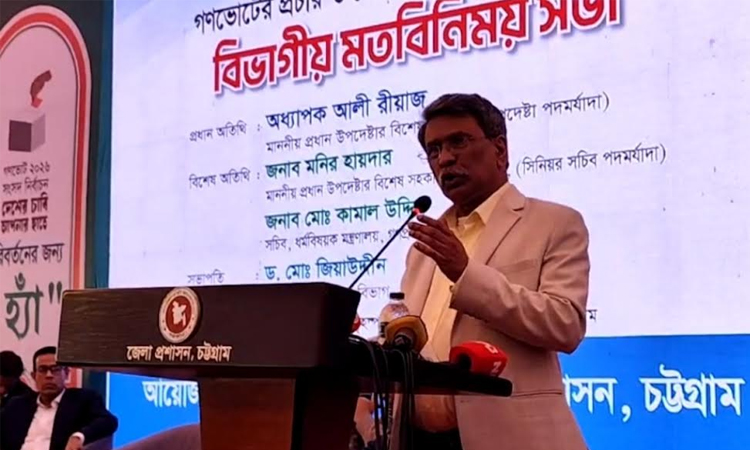
Along with the circulating claim, a photo card from Independent Television has been shared on Facebook, it said, adding, the photo card posted from the television channel's Facebook page carries the headline: "After the election, members of parliament will act as a Constituent Assembly for 180 days: Ali Riaz."
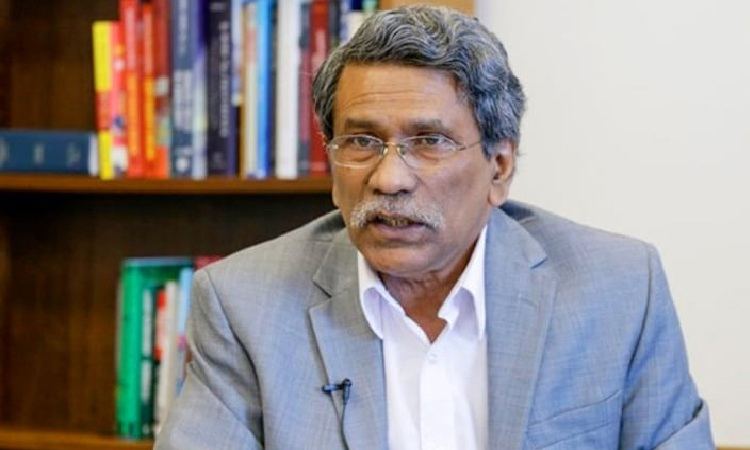
The statement clarified that a related keyword search shows that Professor Ali Riaz, Vice Chairman of the National Consensus Commission and a renowned political scientist, said: "The idea that acting as a constitutional reform council would create obstacles to the transfer of power is completely incorrect".
"From the very first day after being elected, parliament will carry out its normal functions such as forming a government, running the state, and preparing the budget," Prof Riaz said, adding, "However, fundamental changes are needed to remove the existing constitution from the path of fascism. For this purpose, the elected members will take a separate oath and complete the reform process within 180 days."
In other words, the statement said, Prof Riaz did not say that the current interim government would function as a Constituent Assembly for 180 days.
Rather, he stated that the elected members of parliament would carry out this responsibility.
Moreover, the July National Charter (Constitutional Reform) Implementation Order, 2025 clearly states that if "Yes" wins in the referendum, parliament will have a dual role, whereby elected representatives will serve simultaneously as members of the National Parliament and as members of the Constitutional Reform Council.
In other words, the elected representatives will function as the government, not the interim government, the statement explained.
According to the Article 7 of the July National Charter (Constitutional Reform) Implementation Order, 2025-
7. Formation, functions, and dissolution of the Constitutional Reform Council:
(1) If the majority vote cast in response to the question presented in the referendum is marked "Yes," then-
(a) Immediately after the issuance of this Order, a Constitutional Reform Council shall be formed comprising the representatives elected in the next general election of the National Parliament, and the council shall be empowered to exercise all authority related to constitutional reform;
(b) The representatives elected in that election shall simultaneously serve as members of the National Parliament and as members of the Constitutional Reform Council in accordance with this Order;
(c) The Council shall complete constitutional reform in accordance with the July National Charter and the referendum results within 180 (one hundred eighty) working days from the date of its first session, after which the activities of the Council shall come to an end.
Thus, under Clause (b) of Article 7, the elected parliament will have a dual role, the statement said, adding, on the one hand, elected representatives will perform the responsibilities of forming a government and running the state as members of parliament; on the other hand, they will simultaneously exercise constitutional reform authority as members of the Constitutional Reform Council.
According to the Order, once constitutional reform is completed within 180 working days from the start of the parliamentary session, the Constitutional Reform Council will be dissolved.
From that point onward, the statement said, parliament will no longer have a dual role, and elected representatives will function solely as members of parliament.
No indication can be found in this Order that the interim government would remain in power for 180 days, it said, adding, rather, it clearly refers to the dual role of parliament.