News Flash
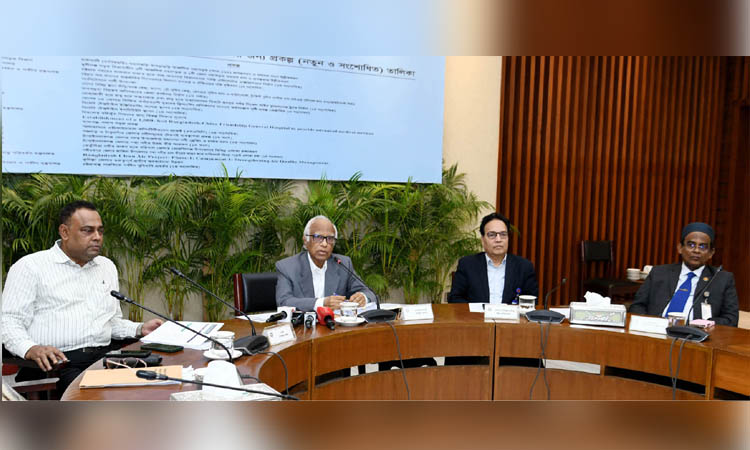
DHAKA, Jan 25, 2026 (BSS) - Planning Adviser Dr Wahiduddin Mahmud today said
that Bangladesh must avoid falling into a 'debt trap' as it approaches
graduation from the Least Developed Country (LDC) category.
"We don't want to take loans for large projects unnecessarily. Institutions
like the World Bank often come with many project proposals. If some of those
are genuinely high priority, we may consider them. But, from now on, these
issues are being discussed in details and assessed very carefully," he said.
Speaking to reporters after the day's Executive Committee of the National
Economic Council (ECNEC) meeting, he said the government no longer wants to
accept loan-funded projects unless they are of critical national priority and
cannot be financed or implemented with domestic resources or expertise.
He also said that the government is apparently shifting away from undertaking
large-scale development projects financed primarily through foreign loans.
Dr Mahmud noted that certain projects may appear essential at first glance-
such as initiatives aimed at monitoring pollution levels-but these do not
always justify large, loan-dependent projects involving expensive equipment
and foreign consultants.
"Measuring pollution is not that difficult. The instruments involved are not
extraordinarily complex. There is no need to take large foreign loans and
bring in foreign consultants for such purposes," he said.
He pointed out that as Bangladesh prepares to graduate from LDC status,
interest rates on foreign borrowings are increasing, making loans more
expensive. "That is why we want to rely on our own capacity as much as
possible," he added.
The Planning Adviser observed that multilateral lenders such as the World
Bank and the Asian Development Bank (ADB) are often eager to finance projects
and present them attractively with appealing names and well-structured
designs. However, he said the government would no longer accept such projects
without rigorous scrutiny.
"We will take only those loan projects that are truly necessary-those that
can't be financed domestically or where foreign technological support is
genuinely required. Everything else should be done with our own resources,
even if on a smaller scale," he said.
Dr Mahmud said this approach reflects a clear policy stance that the current
government intends to leave as a guideline for future administrations.
"From a policy perspective, we believe that when taking foreign loans from
development partners, projects must be carefully vetted. Only those that are
beyond our financial or technological capacity should be considered," he
said.
He cautioned that excessive reliance on borrowing offers little long-term
benefit. "There is no point in becoming trapped in a vicious cycle of debt,"
he remarked.
According to him, foreign borrowing should be limited mainly to large
infrastructure projects where substantial loans can help attract domestic and
foreign investment. "If such investments lead to export-oriented industries
and generate foreign exchange earnings, then debt servicing will not be a
problem," he said.
However, Dr Mahmud expressed concern that Bangladesh has for many years
depended heavily on loans even in social sectors, including education.
"We want to move away from this long-standing dependence on loans across all
sectors, especially in social sectors," he said.
The Planning Adviser also said the government has decided to issue strict
instructions to all ministries, making project completion deadlines
mandatory.
"Projects for which ministries have committed to completion by June or
December this year must be completed within those deadlines. Otherwise,
funding for those projects will be stopped," he said.
A formal directive conveying this decision would be sent to all ministries to
enforce accountability and improve discipline in project implementation, Dr
Mahmud added.