News Flash
RAJSHAHI, April 10, 2026 (BSS)- Adviser to the Prime Minister Dr. Rashed Al
Mahmud Titumir has called for giving importance to both industrialization and
agro-based development to utilize the vast potential of the Rajshahi region.
He said if industries are developed centering on the region's agricultural
production, it would inject new momentum into the economies of Rajshahi,
Natore, and Chapainawabganj.
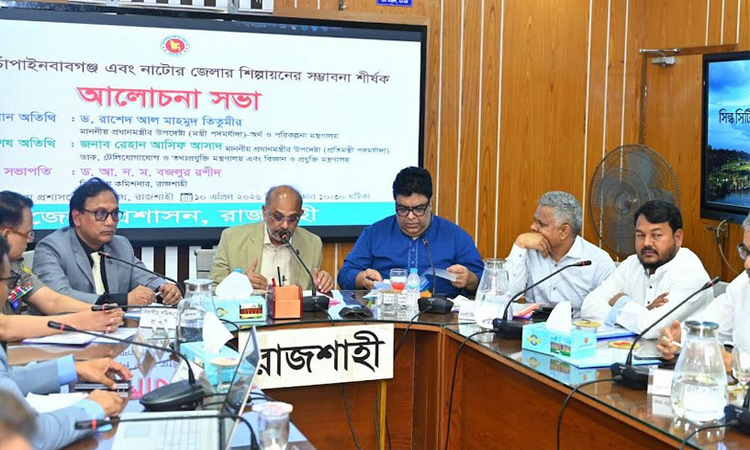
He made these remarks at an exchange meeting held on Friday at the conference
room of the Rajshahi Deputy Commissioner's office.
Business leaders, agricultural entrepreneurs, and public representatives from
Rajshahi, Natore, and Chapainawabganj took part in the meeting, where they
interacted with Dr. Rashed Al Mahmud Titumir and PM's Adviser Rehan Asif
Asad.
Speakers at the meeting identified the gas crisis as the main barrier to
industrial development in the northern region.
They noted that due to the shortage of gas, promising industrial sectors
remain stagnant, new investments are not coming in, and even ready projects
cannot be launched. This is hindering employment generation and regional
economic growth.
Rajshahi City Corporation Administrator Mahfuzur Rahman Riton said that
although the BSCIC-2 project in Rajshahi is ready, it cannot be launched due
to the lack of gas connection. Ensuring gas supply quickly would accelerate
industrialization.
Rajshahi Deputy Commissioner Kazi Shahidul Islam said that both industry and
agriculture must be given equal importance to ensure the region's
development.
"There is significant potential for agro-based industries in the area. If
gas, infrastructure, and necessary facilities are ensured, sustainable
economic progress can be achieved in the northern region by utilizing local
resources and production," he added.
Natore Zila Parishad Administrator Rahim Newaz said that there is no gas
connection in the Natore BSCIC area, even though a gas line passes nearby.
Due to the lack of gas, large industries are not being established there.
Motiur Rahman, director of the Natore Chamber of Commerce and Industry, said
that if gas supply is ensured, Natore's leather industry could become self-
reliant.
Abdul Wahed, president of the Chapainawabganj Chamber of Commerce and
Industry, said that due to the gas crisis, no large industrial establishments
have been developed in the district.
On the other hand, due to the lack of sufficient cold storage, a large
quantity of mangoes is wasted every year, causing significant losses to the
local economy.
In his speech as the chief guest, Dr. Rashed Al Mahmud Titumir, Adviser in
charge of the Ministry of Finance and Planning, said the government is
working to ensure equitable regional development.
The Rajshahi region has immense agricultural potential and is capable of
producing surplus goods after meeting local demand, he noted, adding,
"Developing industries around agriculture would help the region advance
rapidly, and the government is working toward that goal."
As special guest, Rehan Asif Asad, adviser in charge of the Ministries of
Posts, Telecommunications and Information Technology, and Science and
Technology, said balanced development is possible by utilizing the unique
characteristics of each region.
The government is working to develop the northern region and taking various
initiatives to bring this lagging area into the mainstream of development, he
added.
The meeting, organised by the Rajshahi district administration, was chaired
by Divisional Commissioner Dr. Bazlur Rashid.
Among others present were Chapainawabganj Zila Parishad Administrator Harunur
Rashid, Rajshahi Zila Parishad Administrator Ershad Ali Isha, Rajshahi
University Vice-Chancellor (VC) Professor Dr. Md. Faridul Islam, Rajshahi
Metropolitan Police Commissioner Dr. Jillur Rahman and Deputy Commissioners
and Police Superintendents of the three districts, along with officials,
businesspeople and agricultural entrepreneurs.
Earlier in the morning, the two advisers visited activities of the Barind
Multipurpose Development Authority (BMDA) in Godagari upazila of Rajshahi.
They inspected the banks of the Padma River in Bhagwanpur area, observed
agricultural activities in Sarmangla, and visited solar-powered irrigation
systems in Kalipur.