News Flash
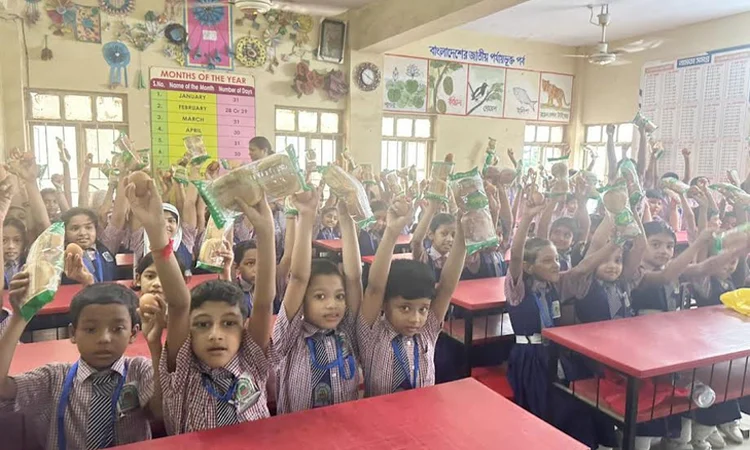
CHATTOGRAM, Sept 8, 2026 (BSS) - It is 10:30am at Anwara Model Government Primary School. The students of Pre-Primary (2) sit quietly in their classroom as they eagerly wait for their tiffin during the break.
As soon as the bell rings, school assistant Sohrab Hossain arrives with the food. He distributes two pieces of 'ban roti' and a boiled egg to each student, ensuring that everyone receives the same meal. Some children immediately express their excitement, while others begin eating with great satisfaction.
After finishing their tiffin, the students collect the empty packets and eggshells and place them in the designated garbage bins in the classroom. Teachers say the practice is helping children develop habits of cleanliness and discipline.
The students receive meals at the same time every day under a five-day weekly menu. For three days, they are served bread and eggs; on one day, they receive bread and UHT milk and on another day, they are provided with fortified biscuits and bananas.
Currently, all 367 students of Anwara Model Government Primary School, from pre-primary to Class V, are regularly benefiting from the school feeding programme.
Rumaisa Chowdhury Isal, a student of Pre-Primary (2), smiled when asked whether she liked the tiffin. Although she enjoys the food, she said she particularly likes milk, biscuits and bananas.
"I really like sitting and eating with my friends," the young student said.
According to the Chattogram District Primary Education Office, a pilot school feeding programme is now being implemented in 150 upazilas across all eight divisions of the country. Around 300,000 students in 13 upazilas of Chattogram division are currently participating in the programme.
The government plans to gradually introduce a comprehensive school feeding or mid-day meal programme nationwide from January 2027. Under the initiative, nutritious meals will be provided to around 11 million primary school students during school hours every day.
Besides improving children's nutrition, the programme aims to increase school attendance, reduce dropout rates and improve students' concentration and academic performance.
The pilot programme was launched in Anwara Upazila of Chattogram district on March 29, 2026. At present, around 22,000 students from 110 government primary schools in the upazila are regularly receiving nutritious meals.
Initially, a private supplier organisation, Swadeshpalli, began supplying ban roti, bananas and boiled eggs in the upazila. Later, UHT milk from Paragon and fortified biscuits from Pran Company were also included in the programme.
A five-member Mothers' Committee has been formed at each school to supervise the programme. The committee includes three mothers, one guardian representative, usually a father, and the school head teacher.
Committee members check the quality and quantity of food every day when supplies arrive. Any problem with the food is immediately reported and addressed.
Upazila Primary Education Officer Md Hindol Bari said the school feeding programme has brought significant positive changes to the schools.
"Previously, many children came to school on an empty stomach because their mothers were busy with work or their families faced financial difficulties," he said. "As a result, they often could not concentrate properly in class. Now, after receiving meals at school, the students are more attentive, cheerful and engaged in learning."
He said many students previously left school during the tiffin break, but the practice has declined significantly since the introduction of the feeding programme.
"Students now stand in queues to receive their meals and dispose of food packets and banana peels in designated bins after eating. This is helping them develop discipline and cleanliness," he said.
He also noted that the programme is creating a stronger sense of equality among students, as everyone receives the same food.
"Another positive development is that more parents are now showing interest in enrolling their children in government primary schools," he added.
Headmistress Romena Akhter Khanam said student attendance has increased significantly since the programme began.
"Previously, the average attendance rate was between 65 and 70 percent. Now it has increased to between 90 and 95 percent," she said.
Parents have also welcomed the initiative.
Maisha Binte Ayan, a resident of the nearby Birpur area, was waiting for her child outside the school. She said the programme had brought relief to many parents.
"This initiative is undoubtedly commendable," she said. "Children often stay at school for a long time, and they do not always come to school after eating properly at home. Previously, this was a major concern for us. Now we feel relieved knowing that our children will not remain hungry at school."
Arju Akhtar, a resident of Anwara Sadar and a member of the Mothers' Committee, said there were initially some concerns about food quality, particularly the quality of bananas.
"However, most of those problems have now been resolved," she said.
Deepak Das, a resident of the Adarshpara area, said parents wanted the quality of food to remain consistently high.
"Our only request is that the food quality is maintained," he said. "The children receive ban roti several days a week, and it would be good to consider introducing more variety in the menu."
Chattogram District Primary Education Officer Firoz Ahmed said a WhatsApp group has been created to ensure the smooth implementation and monitoring of the school feeding programme.
The group includes the Upazila Nirbahi Officer (UNO), Upazila Primary Education Officer (UPEO), Assistant Upazila Primary Education Officers (AUPEOs), head teachers and food suppliers.
"The entire process, from food supply to distribution, is being regularly monitored through the group," he said, adding that community involvement in the programme is also gradually increasing.
Officials and parents believe that the school feeding initiative is not only helping improve children's nutrition but is also playing an important role in increasing attendance, reducing absenteeism and keeping students more attentive and motivated in the classroom.