News Flash
DHAKA, Feb 03, 2026 (BSS) – Energy experts today urged the next government to build a national consensus on energy transition while taking immediate steps to tackle the ongoing crisis.
They suggested that the next government should initiate realistic and sustainable long-term plans to overcome the crisis in the energy sector.
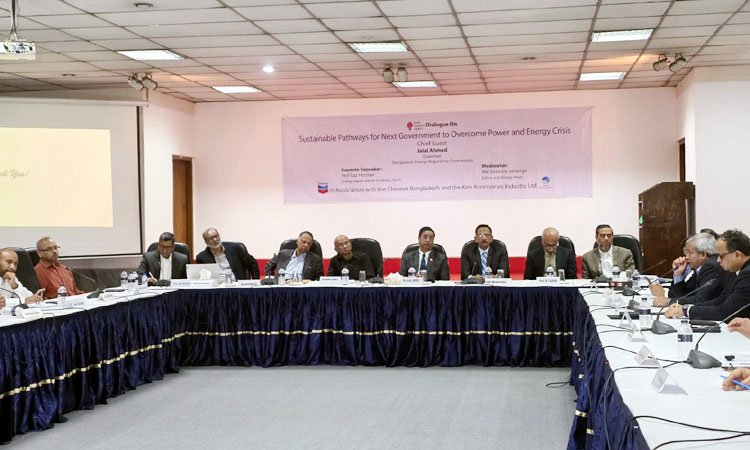
The recommendation came during a dialogue titled “Sustainable Pathways for the Next Government to Overcome the Power and Energy Crisis” held at the CIRDAP Auditorium in the city.
The dialogue was organized by Just Energy News, an English news portal, and moderated by its editor, Shamim Jahangir.
The speakers emphasized that data-driven plans should be adopted when assessing energy demand, avoiding the exaggerated forecasts of the past, as the power and energy sector continues to face a deep crisis.
“Bangladesh's energy sector has been facing a crisis mainly due to long-term neglect of primary energy. There is a significant limitation in the capacity of FSRUs for importing LNG, which is often overlooked,” said Jalal Ahmed, Chairman of the Bangladesh Energy Regulatory Commission (BERC).
He said that no realistic reservoir management study was carried out since 2001, adding, “Gas exploration activity was stand stilled for the past 16 years. However, limited allocation was in the energy sector but huge amount spent in the power sector. Sustainable power supply is not possible without investment in primary energy.”
“There is no progress in the coal sector and no new integrated energy policy was formulated since 1996,” he said.
Ahmed further said that it is important to give importance to efficient use of existing resources and alternative fuels rather than new thermal power plants.
Especially, policy support must be ensured now to increase the use of renewable energy in the export sector as per the conditions of the European Union by 2030, he added.
Professor Dr Ijaz Hossain presented the keynote speech saying that about 97 to 98 percent of Bangladesh's total energy depends on fossil fuel.
At the same time, Bangladesh depends about 60 percent of energy and electricity import, which was increased further in the last one year, he said.
He said currently daily gas demand is not less than 4,000 million cubic feet. But the average daily gas supply is about 2,500 to 2,600 million cubic feet, of which about 59 to 60 percent is being used in power generation and captive power.
“The calculation of gas consumption in the household is shown to be about 11 percent, but in reality it is not more than 5-6 percent. Although about 8.5 percent system loss is shown in gas distribution and transmission companies,” he said.
Hossain said that currently 30 to 33 percent of the total gas supply in the country is imported LNG. As a result, this 10 percent loss means a direct loss of LNG, which is equivalent to several billion dollars a year, he said.
BNP National Standing Committee member Iqbal Hasan Mahmud Tuku said that electricity is not an easy matter, adding, “Electricity is a commercial product, on the other hand, it is a public service run by the state. The government has to keep track of production and expenditure, and on the other hand, provide electricity to people at affordable prices.”
“Maintaining this balance required deep thought and a long time, which is not possible in five years tenure,” he said.
Additional Secretary and member of the Bangladesh Energy and Power Research Council, Dr Md Rafiqul Islam, said, “To ensure the country's energy security, the potential of solar, wind, hydropower, biomass, and the blue economy must be effectively utilized.”
He added, “For this, it is important to formulate short-, medium-, and long-term plans, along with specific time-based roadmaps and action plans, and ensure accountability.”
Dr Islam also said that immediate solutions are not possible without long-term and integrated initiatives, adding, “Renewable energy, energy efficiency, and conservation must be prioritized through research-based and implementable policies.”
Former Justice Mainul Islam Chowdhury, convener of the National Review Committee, said, “Bangladesh's power sector is highly dependent on natural gas, oil, and coal. Even though the country's power demand has increased, gas shortages and fluctuations in global energy prices are destabilizing the sector. In this situation, LNG imports, regional power connections, and the use of renewable energy—including solar, biomass, and nuclear energy—are being expanded.”
He added that rapid industrialization and uninterrupted power supply will be difficult to achieve if the power sector remains unstable.
Energy expert Professor M Tamim said, “The new government will have to navigate difficult times and make politically complex decisions. It is important to verify and review the ongoing situation before canceling any power deals; otherwise, supply will be disrupted and people will suffer.”
He added that micromanagement and difficult decisions will be necessary to ensure electricity supply.
Professor Mushtaq Hossain Khan of the Department of Economics, SOAS University of London, said Bangladesh's economy is confronting several serious unresolved crises, which could lead to collapse. “About 35 percent of defaulted loans in the banking sector and the deep financial crisis in the power sector are the biggest risks,” he said.
He added, “The main reason for the crisis in the power and energy sector is not the lack of policy, but institutional corruption since 2010. Although power generation has increased fourfold, costs have increased 11 times, and the capacity charge has increased 20 times.”
Bangladesh Jamaat-e-Islami Assistant Secretary General Ahsanul Mahbub Zubair said there is a need for consensus among all political parties and relevant stakeholders on national issues. He added that changing policies with every new government does not solve problems but often exacerbates them.
Zubair assured that Jamaat-e-Islami has prepared practical and intellectual proposals on national issues, which can be used in the next government's policy formulation.
BEPRC Chairman Mohammad Wahid Hossain said, “There are strong challenges for the incoming government, especially in the power and energy sectors.”
Among others, former secretary of Implementation Monitoring and Evaluation Division (IMED) Abul Mansur Md Faizullah, former BERC member Md Mizanur Rahman, CEO of Change Initiative M Zakir Hossain Khan, Lead Energy Analyst of IEEFA Shafiqul Alam, President of LPG Autogas Owners Association Md Serajul Mawla, Vice President of LOAB Humayun Rashid, Secretary General of CNG Refueling Station Owners Association Farhan Noor, and Chief Corporate Affairs Officer of Robi Shahid Alam spoke at the event.