News Flash
DHAKA, May 2, 2026 (BSS) – Sabina Akhter, a domestic helper, and her husband, Md Saidur Rahman, an e-rickshaw puller, with their three children, used to live in the capital’s Karail slum.
With great joy, Sabina said, “It was very difficult to pay the house rent after covering every expense, including rickshaw rent and food. Now I can pay the house rent – that’s a big deal.”
She added that the pressure has eased somewhat after receiving the family card allowance. “Now at least I can pay my rent on time,” she said.
It is not just Sabina, but many like her who have received this assistance for the first time through a government benefit.
Many beneficiaries said that although the amount is small, it plays a very significant role in their daily lives.
On April 16, after speaking to local residents who have received ‘Family Cards’, it was learned that the government’s ‘Family Card’ programme has become a new topic of discussion in the area. Cash assistance of Taka 2,500 per month – although modest – is a great relief for residents of Karail.
Beauty Begum, another resident of the Karail slum, has been living there for about 25 years. Although she is ageing and tired, she still works as a domestic helper in other households.
She said, “It is difficult to work at this age. I feel a little relieved after receiving this money.”
A different aspect of the programme emerges in the words of student Mim Akhter. She is now able to cover her university expenses with the money received in her mother’s name.
She said, “My travel and fees are paid with this money. Earlier, I had to take it from my mother and father.”
On the other hand, Sahida Akhter has used the money she received from the ‘Family Card’ to buy goods for her son’s small shop, creating the possibility of additional family income.
In fact, the money is not only being used for consumption – in some cases, it is also being used for investment.
It is noteworthy that before the 13th National Parliament election, BNP promised the ‘Family Card’ programme in its election manifesto as a means of providing economic security to people, especially women.
In line with this, Prime Minister Tarique Rahman officially inaugurated the programme on March 10 to fulfil that promise.
The slogan of the project, implemented by the Ministry of Social Welfare, is: ‘Not the individual, but the family is the main unit of development’.
To this end, the Ministry of Social Welfare and the Department of Social Services have prepared the ‘Family Card Piloting Implementation Guidelines 2026’.
Officials said a central database is being created based on national identity cards to ensure transparency and prevent irregularities. The government is also monitoring whether beneficiaries are receiving funds regularly.
The initiative is part of the government’s commitment to achieving national development and social justice by empowering women and recognising them as heads of families in social protection programmes.
Under the pilot phase, the programme is being implemented in 15 wards across 13 city corporations and unions in 13 districts, said Social Welfare Minister Abu Zafar Md Zahid Hossain, MP, at a recent press conference.
Ward committees conducted door-to-door surveys, collecting data on the socio-economic conditions of households, including family size, education, housing conditions, household assets (such as televisions, refrigerators, computers and mobile phones) and remittance flows.
The collected data were verified by union and upazila committees before finalising the beneficiary list.
During the pilot phase, information on 67,854 women-headed households was collected across the country, he added.
Zahid said that, using a software-based Proxy Means Test (PMT), households were classified into categories such as extreme poor, poor, lower-middle-income, middle-income and affluent groups.
Out of 51,805 households initially identified as extreme poor, poor and lower-middle-income, verification found 47,777 households with valid data. After excluding cases involving multiple benefits, government employment or pension entitlements, 37,567 women-headed households were finally selected for assistance.
Officials said the automated PMT-based system minimises the possibility of corruption, nepotism or manual interference in selecting beneficiaries.
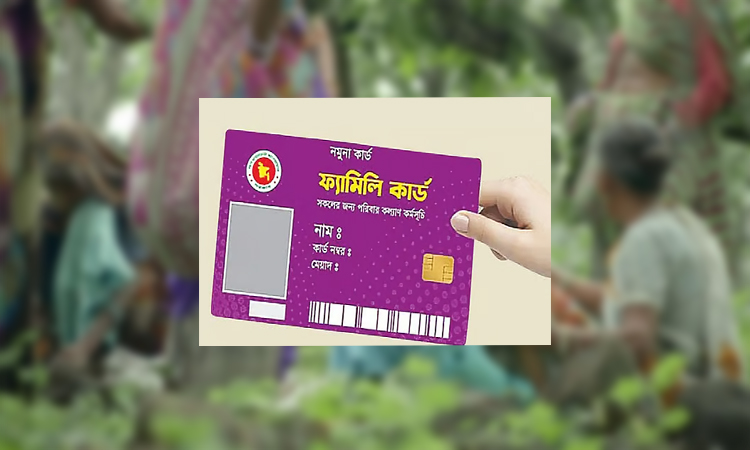
Under the programme, each eligible household receives a modern ‘Family Card’ equipped with a contactless chip, QR code and NFC (Near Field Communication) technology, ensuring security, durability and ease of use.
Each card covers up to five members of a household, while larger joint families may receive multiple cards proportionately.
During the pilot phase, selected beneficiaries receive a monthly allowance of Taka 2,500, and the government may later consider providing equivalent food assistance.
However, families are not eligible if any member receives a salary, allowance or pension from government, autonomous or state-owned institutions. Households with commercial licences, large businesses, luxury assets such as cars or air conditioners, or savings certificates worth Taka 500,000 or more are also excluded.
The allowance is transferred directly to beneficiaries through the Government-to-Person (G2P) digital payment system, credited to women’s mobile wallets or bank accounts, enabling them to receive support without delay or intermediaries.
For the pilot implementation up to June 2026, the government has allocated Taka 38.07 crore, of which Taka 25.15 crore (66.06%) will be distributed as direct cash support and Taka 12.92 crore (33.94%) will be used for programme implementation, including data collection, development of the online system and card production.
The ‘Family Card Pilot Implementation Guideline 2026’ has already been prepared and uploaded on the website of the Ministry of Social Welfare.
Zahid Hossain said the Family Card programme has initially been launched on a pilot basis. The government will review the programme monthly, with the Ministry of Finance and the Ministry of Social Welfare jointly conducting the evaluation.
He said the government has set a three-month period for “lesson learning”, which will continue until June 30. During this period, authorities will assess the strengths and weaknesses of the programme and take corrective measures where necessary before expanding it further.
Dr Md Shafiqul Islam, Pro-Vice-Chancellor of Kishoreganj University and Professor of Political Science at Chittagong University, said, “This programme is boosting women’s confidence by delivering money directly into their hands. They are no longer just family members, but are also establishing themselves as the economic driving force of the family.”