News Flash
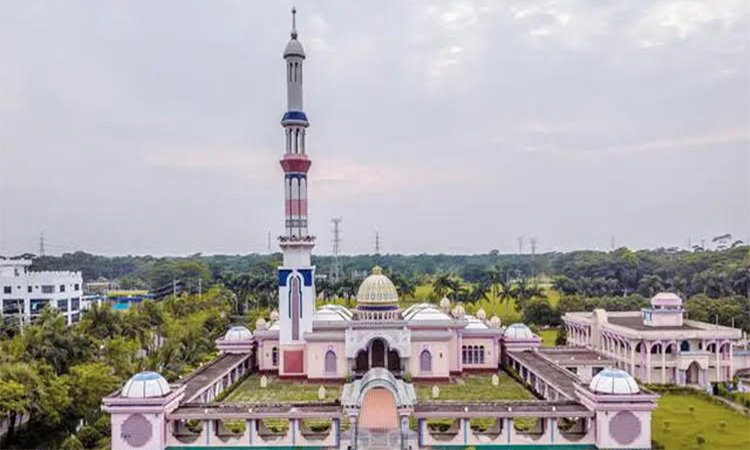
BARISHAL, March 1, 2026 (BSS) - The internationally acclaimed Baitul Aman Jame Masjid, widely known as Guthia Mosque, continues to attract thousands of visitors daily with its stunning architecture, intricate calligraphy, and vibrant night illumination.
Located in Changuria village under Guthia union of Uzirpur upazila, about 22 kilometers southwest of Barishal city along the Banaripara road, the 20-domed mosque stands as one of the most remarkable religious structures in the region.
Approximately 1,500 worshippers can pray inside the mosque at a time, while another 5,000 can offer prayers in the outer premises. Separate prayer arrangements have also been made for women.
Constructed on nearly 14 acres of land, the mosque and Eidgah complex was initiated on December 16, 2003, by S. Sarfuddin Ahmed Santu in front of his residence. His younger brother, Md. Aminul Islam Nipu, supervised the three-year construction project, which was completed in 2006.
The architectural design of the mosque reflects influences from Middle East styles. The founder, along with architect friends, visited countries including the UAE, Turkey, Saudi Arabia, India, and Pakistan before finalizing the design.
The structure was inspired by several prominent mosques abroad while maintaining its own distinct identity.
The mosque complex features a 193-foot-high minaret, a large Eidgah ground capable of accommodating over 20,000 people, administrative offices, quarters for the khatib and muezzin, an orphanage, a Hafezi madrasa, a cemetery, a postal bungalow, a helipad, and a spacious parking area.
A large pond lies to the right of the main entrance, with the mosque positioned on its western side. The pond has been excavated in a way that allows the reflection of the mosque to shimmer on its surface.
The surrounding area is landscaped with colorful flowering plants, paved walkways, and a scenic ghat beneath almond trees. Two fountains at the entrance add to the visual appeal, especially at night when illuminated by decorative lights.
The mosque’s interior is equally impressive. The holy Ayatul Kursi is inscribed in circular calligraphy around the central dome, while Surah Ar-Rahman adorns the inner walls. Additional Quranic verses are displayed under the domes and at key points throughout the structure.
These calligraphic works, created using colored glass, precious marble, granite, and ceramics, were executed by artist Arifur Rahman of Barishal, assisted by calligrapher Bashir Mesbah.
Nine large and ornate chandeliers hang beneath the nine interior domes. The mosque floor is laid with white marble tiles imported from India. A modern sound system installed from abroad ensures clear audio during prayers and religious gatherings.
For security, artificial lakes surround three sides of the complex, along with barbed-wire fencing. The mosque has its own high-power generators to ensure uninterrupted electricity supply.
Beyond its religious significance, the mosque has also contributed to local economic development. Numerous shops have sprung up in the surrounding area, and tourism has increased significantly as visitors from across the country flock to witness its architectural grandeur — particularly the captivating night-time illumination.
The Baitul Aman Jame Masjid stands not only as a place of worship but also as a symbol of architectural excellence and community transformation in Barishal.