News Flash
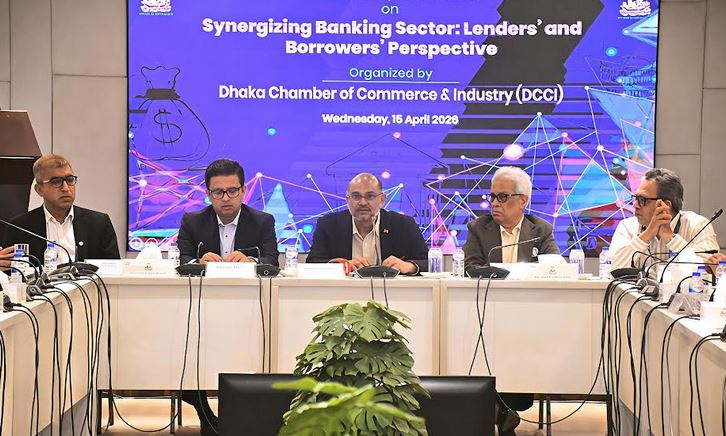
DHAKA, April 15, 2026 (BSS) - Dr Rashed Al Mahmud Titumir, Prime Minister's adviser on the Ministries of Finance and Planning, today noted that the government is following a policy of non-interference toward the Bangladesh Bank (BB) and emphasizing a shift from dictating the central bank to a model of policy coordination.
He addressed the critical need for financial independence following a period of significant economic mismanagement, noting, "The actions of the fallen government led to the looting of public resources and a subsequent credit rating downgrade of two notches by the IMF and other international agencies."
"We do not want to dictate to Bangladesh Bank in any way," Titumir stated, clarifying that the relationship will instead focus on the synchronization of fiscal and monetary policies.
The adviser made these remarks while speaking at a Focus Group Discussion (FGD) on 'Synergizing Banking Sector: Lenders' and Borrowers' Perspective' organized by the Dhaka Chamber of Commerce and Industry (DCCI) at its conference room in the city.
DCCI President Taskeen Ahmed delivered the welcome remarks and keynote presentation.
Senior Executive Director of the Walton Hi-tech Industries PLC Md Zahidul Islam, Deputy Managing Director of City Bank PLC Ashanur Rahman, Managing Director of the NCC Bank PLC M. Shamsul Arefin, Director (SME & Special Programmes Department) of the Bangladesh Bank Nawshad Mustafa and Chairman of the Bangladesh Association of Banks (BAB) Abdul Hai Sarkar, were the distinguished panel discussants.
In his speech, Titumir highlighted that the Governor of Bangladesh Bank has already initiated a program for economic recovery, restoration, and reconstruction.
"This new agenda moves away from prescribed textbook styles of management to focus on objectives that go beyond traditional price and financial stability, specifically targeting growth and employment generation," he added.
To address the firefighting phase of the current economy, he mentioned that the central bank is expected to roll out several targeted initiatives including Targeted Refinancing and Performance-Based Stimulus.
Titumir critiqued past COVID-19 stimulus packages for being marred by nepotism and benefitting those close to power.
He advocated for a transition to performance-based stimulus packages to ensure that aid reaches productive sectors rather than the 5,000 major borrowers who currently hold a high concentration of defaulted loans.
To assist industrial sectors lacking adequate assets, he said, the government and the central bank are exploring Credit Guarantee Schemes and joint funds.
In his presentation, Taskeen Ahmed has highlighted a paradoxical landscape in the national banking sector, where record-high excess liquidity exists alongside a contraction in private sector credit.
In a detailed presentation, he outlined the critical challenges facing both lenders and borrowers, urging a comprehensive synergy framework to restore economic stability.
He mentioned that the banking sector currently holds total liquid assets of Taka 626,044.90 crore, marking a 6.78% increase.
However, he said, despite excess liquid assets reaching Taka 321,255.47 crore, private sector credit growth has slowed to 6.03%, down from 7.15%.
The DCCI President noted that banks are accumulating liquidity as a buffer against perceived credit risks rather than deploying it for productive lending.
This trend is exacerbated by a massive surge in government borrowing from the banking system, which rose by 673% between July and January of the 2026 fiscal year, he added.
The DCCI President proposed a three-pillar Synergy Framework.
The pillars are Stabilize the System; Expand and Equalize Credit; and Governance Reform.
He laid emphasis on enforcing strict NPL targets (below 10% for State-Owned Banks and below 5% for Private Commercial Banks by June 2026) and prosecuting willful defaulters under the Banking Companies Amendment Act.
The President concluded that the current problem is not a scarcity of capital, but rather a crisis of risk perception and credit allocation dysfunction that must be corrected to prevent further business failures and economic slowing.