News Flash
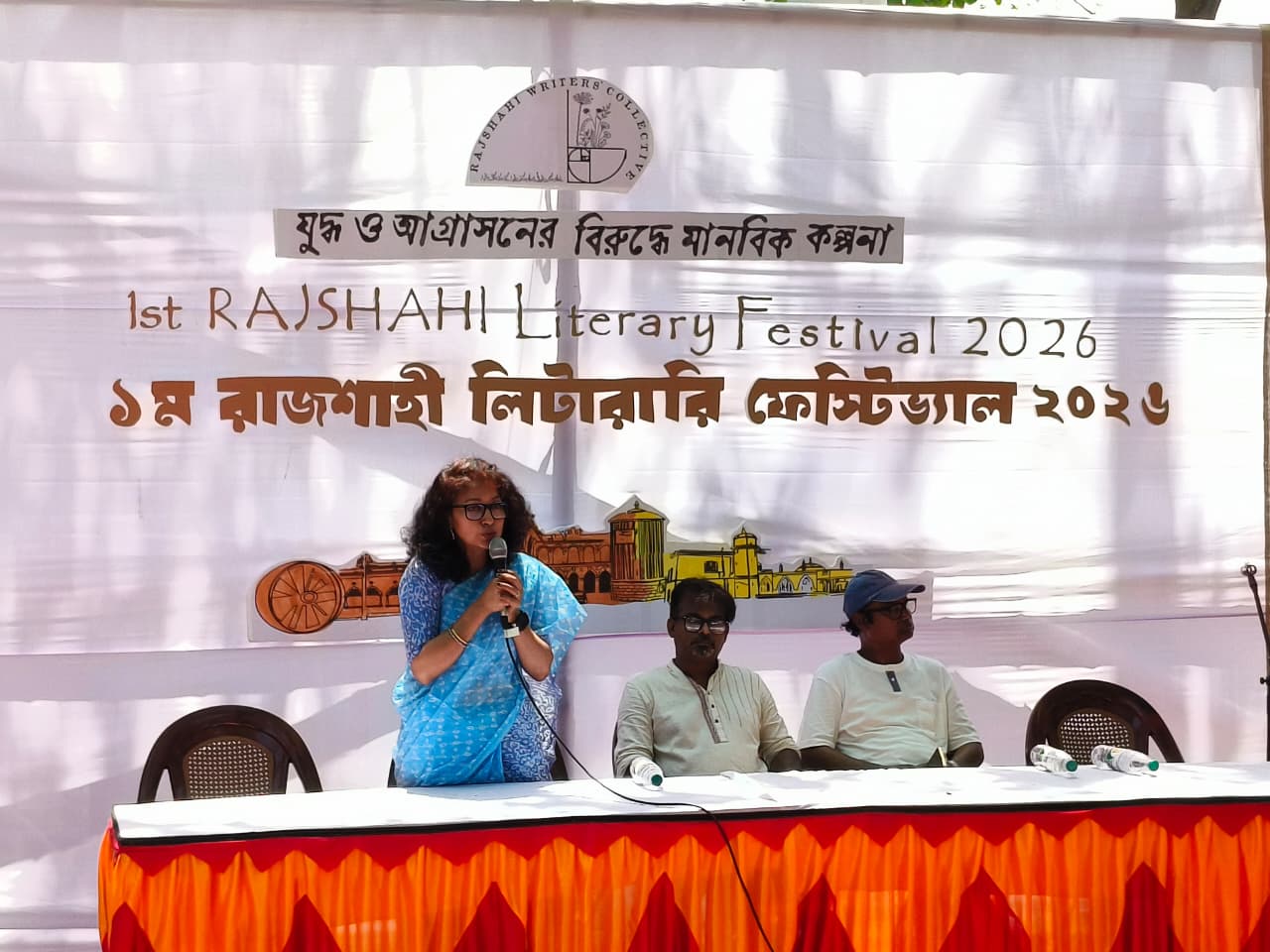
RAJSHAHI, April 3, 2026 (BSS)- A two-day "First Rajshahi Literary Festival
2026" has begun here carrying messages of literature, art and humanitarian
resistance.
The festival was inaugurated today (Friday) at the Boro Kuthi Open Stage
(adjacent to Padma Garden) in the city.
Organised by the Rajshahi Writers Collective, the event will continue until
tomorrow (Saturday).
The festival commenced with the theme "Human Imagination Against War and
Aggression," beginning with the national anthem performed by Sannidhi Sangeet
Niketan.
The programme was hosted by Atikur Rahman Atik, organiser of the Rajshahi
Writers Collective and President of Barendra Youth Forum.
A welcome speech was delivered by poet and organiser Rafique Jibran while the
festival declaration was read by organiser and editor Nadim Sina. Poet and
musician Kofil Ahmed also took part in music and discussions.
Solidarity speeches were delivered by writer and researcher Pavel Partha,
Rajshahi University teacher Kazi Shusmin Afsana, poet Mostak Rahman, and
lawyer and cultural activist Murad Morshed.
In their remarks, the speakers strongly emphasized the necessity of unified,
organised, and ethical resistance against war and aggression.
They stated that remaining silent in the face of continuous violence,
occupation, and exploitation by dominant powers is equivalent to abandoning
humanity.
In this context, they called upon writers, artists, and conscious citizens to
take a stronger stand against imperialist aggression, particularly of the
United States and to build active solidarity with the struggles of oppressed
people.
The speakers expressed deep solidarity with war-affected and oppressed people
in Gaza, Iran, Venezuela, Ukraine and other parts of the world.
The bloodshed, suffering, and resistance of people in these regions are not
merely geographical realities but also matters of collective moral
responsibility, they noted.
They clearly stated that standing for humanity means taking a fearless stance
against war, occupation and aggression.
In the first session, members of the Rajshahi Recitation Council participated
in poetry recitation.
Students from various educational institutions in Rajshahi took part in anti-
war and anti-aggression art activities. The festival venue also features
exhibitions of little magazines, books, and posters.
Various segments of the two-day festival include poetry readings, little
magazine readings and experience-sharing sessions, discussions on anti-
establishment literary practices, presentations and discussions on selected
books.
There will also be sessions on anti-war literature, history and heritage-
based human memory, little magazine movements, and representations of
resistance and humanity in films and visual media.
Renowned writers, researchers, and filmmakers from across the country are
expected to participate.
Additionally, the festival includes screenings of anti-war documentaries and
short films, along with performances of songs, musical dramas, and street
theatre.
A musical drama will be performed by Ladli Mohan Maitra and Alo Rani Maitra.
A street theatre titled "The Court of Humanity: Trial of the Crimes of
Imperialism" will also be staged.
The organisers believed, "In the current global reality, silence is a crime.
Through this festival, we aim to establish art, literature, and culture as
languages of resistance. Our goal is to inspire the younger generation to
build a humane and just society."