News Flash
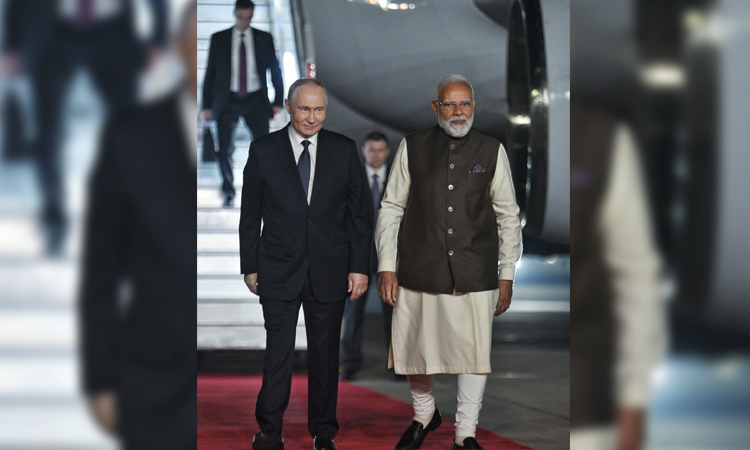
NEW DELHI, Dec 4, 2025 (BSS/AFP) - Russian President Vladimir Putin landed in India on Thursday for a two-day visit aimed at deepening defence ties, as New Delhi faces heavy US pressure to stop buying oil from Moscow.
Prime Minister Narendra Modi, who is facing heavy US pressure to stop buying oil from Moscow, was at the airport to welcome the Russian leader in person, greeting him on the red carpet with a hug, before riding together in the same car.
Putin, on his first visit to India since the Ukraine war, is accompanied by his Defence Minister Andrei Belousov, with possible deals on fighter jets and air defence systems expected to be discussed.
In an interview with India Today, Putin said he was "very happy" to be meeting "my friend" Modi.
"The range of our cooperation with India is huge," he said in remarks translated by the broadcaster, citing ship and aircraft manufacturing, nuclear energy and space exploration.
Modi will host Putin for a private dinner on Thursday evening, followed by a summit meeting on Friday.
Beyond defence, trade relations are expected to feature prominently as India walks a diplomatic tightrope -- relying on strategic Russian oil imports while trying not to provoke US President Donald Trump during ongoing tariff negotiations.
Kremlin spokesman Dmitry Peskov said talks to expand the supply of Russia's advanced S-400 air defence systems had an "important place on the agenda".
Indian media reports suggested Moscow may also offer co-production of Russia's Su-57 fighter jets.
India is one of the world's top arms importers, and Russia has long been a principal supplier.
But New Delhi has also sought alternative suppliers, as well as boosting domestic production -- with the Russian share of India's arms imports falling from 76 percent in 2009-13 to 36 percent in 2019-23, according to the Stockholm International Peace Research Institute.
- Energy imports -
Putin's visit comes after Trump imposed 50-percent tariffs on most Indian products in August, citing Delhi's continued purchases of Russian oil -- revenue Washington argues helps fund the war in Ukraine.
India, the world's most populous nation, has become a major buyer of Russian oil, saving itself billions of dollars and providing Moscow with a much-needed export market after it was cut off from traditional buyers in Europe because of the war.
But Delhi has recently cut down on crude imports under pressure from sanctions on Russia's top oil producers Rosneft and Lukoil.
The Indian government fears any fresh energy or defence deals with Russia could irk Trump, with possible ramifications on trade negotiations with Washington.
Peskov said Russia was not concerned about US tariffs.
"What concerns us is how we are going to maintain and increase the volume of our bilateral business with India, without allowing anyone to interfere," he said Tuesday at a briefing for Indian media organised by Sputnik India.
Nandan Unnikrishnan, of the New Delhi-based think-tank Observer Research Foundation, told AFP: "There may be some reduction in energy purchases -- under US pressure -- but the overall direction of the ties will be maintained because both countries need each other at the strategic level."
- 'Critical moment' -
A senior Indian foreign ministry official, speaking on condition of anonymity, said there was a need to address the trade imbalance "one way or the other".
Bilateral trade reached $68.7 billion in 2024-25 -- almost six times higher than the pre-pandemic levels -- but Indian exports accounted for only $4.88 billion.
Delhi has been pressing Moscow for expanded market access for its key industries including pharmaceuticals, automobiles and the service sector.
Harsh V Pant, a professor of international relations at King's College London, said the visit was an attempt by "to reset their relationship at a critical geopolitical moment for both".
"For India, the optics is a statement of intent for strategic autonomy, and Putin, who rarely travels, is sending a message about the importance of the relationship by travelling here," Pant told AFP.
The Indian foreign ministry official described the ties between Moscow and Delhi as the "most stable relationship in modern times".
The official acknowledged the global geopolitical significance, but insisted that the meeting should seen in the context as "just another annual summit".