News Flash
By S M Zahid Hossain
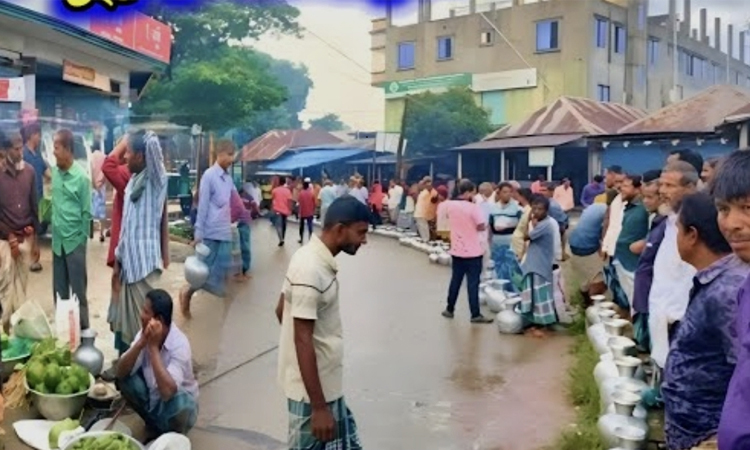
KHULNA, Dec 5, 2025 (BSS) - At the break of dawn, when dense winter fog still blankets the fields and the sun struggles to rise over Dumuria, a rare rural market bursts into life for just a single hour.
Known locally as the Dumuria milk market, the bazaar is located near Bara Ani Bazar, about 25 kilometres west of Khulna city, and has evolved into a vital lifeline for hundreds of small dairy farmers who gather each morning with bottles of fresh milk.
By 6am, long before daylight fully appears, more than a hundred milk sellers — mostly smallholders from neighbouring villages such as Tipna, Bamuandia, Khajura and Mirzapur — take their designated spots.
Carrying milk from indigenous-breed cows reared on natural feed, they begin calling out prices as buyers — including household consumers and traditional dairy processors (Ghosh) — move from one seller to another. Within an hour, usually by 7am, the entire market activity comes to a close, and sellers pack up their empty cans and head home with cash in hand.
Over the decades, the milk market has evolved into a community hub where milk trading is accompanied by the sale of fresh vegetables, fish, poultry and other essentials. Though brief, the gathering resembles a festive meeting point for villagers across several unions, locals said.
Local Union Parishad Chairman Gazi Humayun Kabir Bulu, 70, told BSS that the origins of the market date back to the mid-1960s.
“In 1964, the milk market began to form naturally. At that time, communication infrastructure was poor. People travelled by boats along canals to bring goods. The crowd of buyers and sellers made this milk market well-known,” he said.
With improved road networks and new marketplaces emerging in recent decades, the scale of the old bazaar declined. “Still, it survives because of milk trading,” he added.
According to local people, between 100 and 150 sellers bring 10–12 maunds of milk daily. Prices range from Tk 1,600 to Tk 2,000 per maund.
On average, milk worth Tk 16,000 to Tk 20,000 is sold each day, amounting to nearly Tk 4–5 lakh a month and as much as Tk 57–60 lakh annually. Sellers do not have to pay any toll or market fee.
Farmers like Harendra, 75, and Mohsin, 55, say they raise six cows, of which two are currently lactating, producing three to four kilograms of milk each.
“We sell milk at Tk 40 to Tk 60 per kilogram. Since the market is close to our village, we can sell easily every morning,” said Mohsin.
Talking to BSS, Abdul Wadud, 65, who owns four cows, said he sells four to five kilograms of milk a day, benefiting from steady demand. “Our cows eat natural fodder — grass, straw, khoil. We do not use harmful feed. So the milk quality is good,” he said.
Buyers also attest to this claim. Shyamal Das, Shamsuzzaman Sentu, Mehedi Hasan and several other regular buyers said milk sold at the Dumuria market is pure and typically free of adulteration.
“Compared to other areas, prices are lower here and the quality is better,” said Shyamal.
The market has also become an important source for traditional sweet-makers.
Santosh Ghosh of Telikhali village said he buys milk here because chhana turns out superior when made from indigenous-breed cow milk.
“For good quality sweets, we rely on Dumuria’s milk,” he added. Several Ghosh families, including Bishu and Kalu Ghosh, collect milk here throughout the year.
Local people said dairy farming has reshaped the local economy over the past decade. Growing demand for milk has encouraged many families to rear cows, making households more self-reliant.
“Every home in these villages has at least one or two indigenous cows. People are earning regularly from milk,” said Nurul Islam of Khajura village.
According to the Dumuria Livestock Office, the upazila targeted 25,000 tonnes of milk production for FY 2023–24. Monthly production is already around 2,170 tonnes, and officials expect total output to exceed 64,600 tonnes — more than 5,400 tonnes above target.
Talking to BSS, Upazila Livestock Officer Md Ashraful Kabir said,
“We provide regular veterinary services, medicines and guidance to farmers so they can rear cows properly and remain protected from diseases.”
Contacted last week, the immediate past Dumuria UNO, Md Zahurul Islam, told BSS that the milk market is a model for grassroots economic progress.
“Through morning milk trading, hardworking families are earning and meeting local demand at affordable prices. The administration will continue supporting livestock development,” he said.