News Flash
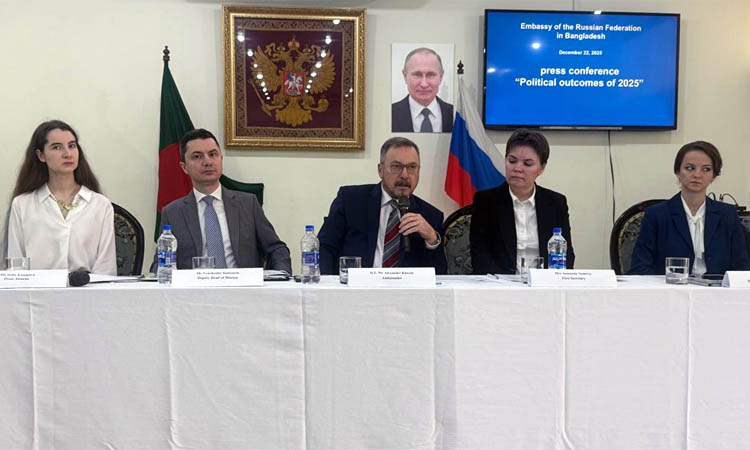
DHAKA, Dec 22, 2025 (BSS) - Russian Ambassador to Bangladesh Alexander Khozin
today said Moscow has deferred the commencement of the main debt repayment
for the Rooppur Nuclear Power Plant (NPP) project by 1.5 years, with the
first installment now scheduled for September 15, 2028.
The Ambassador disclosed the information at a press conference titled
"Political outcomes of 2025" held at the Embassy of the Russian Federation in
Dhaka, where he and senior diplomats briefed on key developments in bilateral
relations, trade, energy cooperation and people-to-people exchanges.
The envoy said the revised repayment schedule was agreed upon in July this
year following amendments to the Intergovernmental Credit Agreement (IGCA).
The amended protocol, approved by the Ministries of Finance of both Russia
and Bangladesh, formally deferred the start of the main debt repayment by 18
months.
"The extension of the IGCA, along with renewal of the Letter of Credit,
ensures continuity of financial operations for the Rooppur Nuclear Power
Plant project," the Ambassador said, adding that it reflects Russia's
continued commitment to Bangladesh's flagship energy initiative.
Briefing on the progress of the Rooppur NPP, Ambassador Khozin said work is
currently focused on commissioning Unit-1 of the plant, which is at the final
stage of readiness.
Final construction and installation works, start-up and adjustment
activities, as well as mandatory inspections and regulatory procedures, are
being carried out simultaneously, he said.
"All necessary efforts are being made to ensure systematic progress toward
commissioning of the facility," the envoy continued.
Alexander Khozin stressed that successful and timely completion of the
project is the result of coordinated work between the Russian side and the
Bangladeshi customer and supervising authorities.
He expressed optimism that electricity generation would begin soon.
"As early as next year, we plan to start supplying the first megawatts of
electricity to the national grid of Bangladesh," he said, describing it as a
major milestone that would confirm the project's readiness for full-scale
operation.
Regarding allegations of mismanagement of Rooppur project funds during the
previous government, the Ambassador said Russia does not comment on
Bangladesh's domestic political processes.
However, he noted that transparency has been ensured throughout the project
through proper documentation, certification and verification of milestone
achievements, including equipment manufacturing and supply.
On broader bilateral relations, Ambassador Khozin said Bangladesh remains
Russia's second-largest trade partner in South Asia.
Despite global challenges, bilateral trade turnover has exceeded US$2 billion
annually for the past three years, with Russia exporting machinery, wheat,
fertilizers and other agricultural products, while importing ready-made
garments and textile goods from Bangladesh.
Russia has played a consistent role in strengthening Bangladesh's food
security, noting that around two million tonnes of Russian wheat were
exported to Bangladesh in 2025, he said.
Supplies of fertilizers, including potash, as well as mustard seeds, have
also increased significantly, while exports of Russian veterinary vaccines
rose by 25 percent this year.
Energy cooperation continues to form the backbone of economic ties between
the two countries, the Ambassador said, highlighting Russia's involvement not
only in nuclear energy but also in gas exploration, LNG supply discussions
and renewable energy prospects.
Russian companies, he added, are ready to invest in solar and other renewable
energy projects in Bangladesh.
He also pointed to expanding cooperation in labour migration, noting a sharp
rise in the number of work permits issued to Bangladeshi workers in Russia in
recent years.
Education remains another traditional pillar of bilateral cooperation, with
growing interest among Bangladeshi students in pursuing higher education in
Russia, the Russian envoy added.