News Flash

DHAKA, Jan 4, 2026 (BSS) - The Commission of Inquiry on Enforced Disappearances today submitted its final report to Chief Adviser Professor Muhammad Yunus, stating that enforced disappearances in Bangladesh were largely politically motivated and carried out with involvement from the highest levels of the immediate past government.
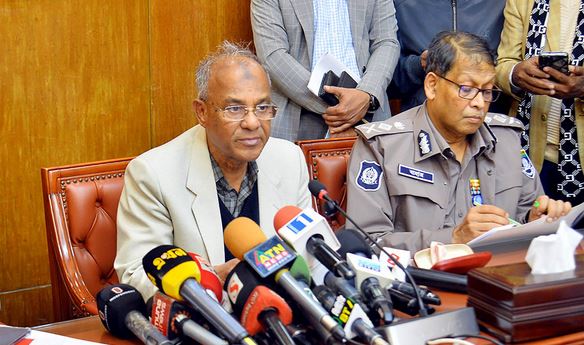
The report titled “Unfolding the truth: a structural diagnosis of enforced disappearance in Bangladesh” was handed over at the State Guest House Jamuna in this afternoon, according to a press release of the Chief Adviser’s press wing.
Commission President Justice Moyeenul Islam Chowdhury, members Justice Md. Farid Ahmed Shibli, Md. Nur Khan, Dr. Nabila Idris and Md Sazzad Hussain were present.
Industries Adviser Adilur Rahman Khan and Principal Secretary to the Chief Adviser Siraz Uddin Mia were also present.
According to the Commission, a total of 1,913 complaints were submitted to the Commission. After verification, 1,569 complaints were identified as enforced disappearances under the Commission’s definition. Of these, 287 cases fell into the category of “missing and dead.”
Commission member Nabila Idris said the actual number of enforced disappearances could be significantly higher.
“The number of enforced disappearances could be four to six thousand,” she said, adding, “Contacting many of the victims of disappearances leads to the discovery of more victims who have not contacted us, do not know about us or have moved to other countries.
There are many people with whom we contacted ourselves, but they did not agree to talk on the record.”
The Commission members stated that evidences collected during the investigation proved that enforced disappearances were mainly politically motivated crimes.
According to the report, 75 percent of the victims who returned alive were leaders and activists of Jamaat-Shibir, while 22 percent were leaders and activists of BNP and its affiliated organizations.
Among those still missing, 68 percent were leaders and activists of BNP and its affiliated organizations, and 22 percent were leaders and activists of Jamaat-Shibir.
The report said evidences were found indicating direct involvement of the then Prime Minister Sheikh Hasina, her security and defence adviser Tarique Ahmed Siddique, and then Home Minister Asaduzzaman Khan in high-profile disappearances.
Notable cases cited include BNP leaders Ilias Ali, Hummam Quader Chowdhury, Salahuddin Ahmed, Chowdhury Alam, Jamaat leader and former Brigadier General Abdullahil Amaan Azmi, Barrister Mir Ahmed Bin Quasem, and former Ambassador Maroof Zaman.
Commission members stated that in many cases the former Prime Minister herself was the direct order-giver behind disappearances.
They also said information obtained regarding the rendition of disappeared victims—secret transfers without legal process—to India indicated that these actions were carried out on orders from the highest levels of the government.
Chief Adviser Professor Muhammad Yunus thanked the Commission members for their work and described the report as historic.
“On behalf of the nation, I thank all of this commission,” he added.
“The incident that you have described—the word used in Bengali is ‘paishachik’— these incidents can be described with that word. You have seen those atrocities through talking to those who have gone through these atrocities, through their experiences. This work could not have been completed without strong morale.”
He further said the report documents how institutions were distorted while maintaining the appearance of democracy.
“This report is a documentation of the kind of demonic behavior that can be perpetrated on people by twisting all the institutions of Bangladesh and wearing the garb of democracy,” he said.
“It shows how low people can go down, how demonic and disgusting they can be. Those who committed these terrible incidents are human beings like us.
They are living a normal life in society after committing the most atrocious incidents.
As a nation, we have to come out of such atrocities forever. We have to find a way to remedy this atrocity so that it does not return,” he added.
The Chief Adviser called for the report to be made available to the public in simple language and instructed the Commission to submit necessary recommendations and proposals for future action.
He also directed that locations of extrajudicial killings and enforced disappearances be mapped, in addition to the ‘Aynaghar’ (Mirror House).
The Commission said its investigation found that the highest number of killings and disappearances occurred in the Baleshwar River in Barisal, where hundreds of victims were allegedly killed and dumped.
Evidences were also found of bodies being disposed of in the Buriganga River and in Munshiganj.
The members of the Commission expressed special thanks to the Chief Adviser, saying the work would not have been possible without his firm stance.
“We were able to do it because you were strong. You always gave us whatever support we needed. You strengthened our morale,” they added.
They also urged the Chief Adviser to reconstitute the National Human Rights Commission, continue the work initiated by the inquiry, and ensure protection and justice for the victims of enforced disappearances.