News Flash
DHAKA, Jan 30, 2026 (BSS) - The interim government this week noted tangible progress in streamlining investment and trade processes, citing improved inter-agency coordination and faster decision-making as key drivers of economic competitiveness.
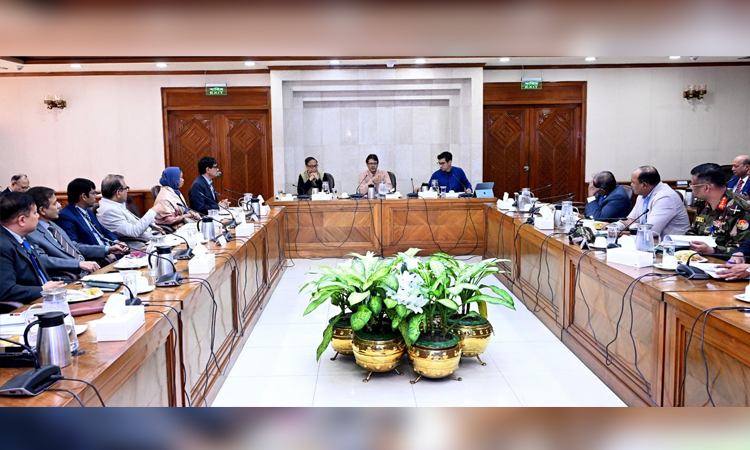
The updates were presented at the 7th meeting of the Investment Coordination Committee, where senior policymakers and regulators reviewed reforms aimed at reducing bottlenecks, digitising services, and accelerating investment execution.
The meeting was held at the Chief Adviser's Office in the city’s Tejgaon area on Thursday, said the Chief Adviser’s Press Wing this afternoon.
“Process improvements can significantly strengthen our competitiveness and directly impact livelihoods,” said Special Envoy of the Chief Adviser, Lutfey Siddiqi, who chairs the committee.
“While we have limited control over external factors such as tariffs and market access, we have full control over our own policies and procedures. Efficiency gains here are immediate, tangible, and substantial,” he added.
The meeting was attended by Ashik Chowdhury, Executive Chairman of BIDA, BEZA and the PPP Authority; Bangladesh Bank Governor Dr Ahsan H Mansur; Chittagong Port Authority Chairman Rear Admiral SM Moniruzzaman; along with secretaries and heads of key ministries and agencies.
Key Reform Initiatives:
Among the major proposals discussed were a tenfold increase in pre-arrival customs clearance, a unified online business start-up package, 24-hour digital payment services at Chittagong Port, and a fully automated bond management system.
Officials also agreed on a multi-agency mechanism to ensure approved investment proposals are translated into actual investments.
The committee reviewed several recent coordination successes. The National Single Window (NSW), launched by the National Board of Revenue after years of inter-ministerial delays, has already eliminated an estimated 1.2 million physical visits to government offices in just a few months.
Automated truck entry systems at Chittagong Port have reduced entry times by at least 90 percent, while digital tracking and cashless payments have enhanced transparency and efficiency.
Investment promotion agencies—BIDA, BEZA, BEPZA and the High Tech Park Authority—are now jointly monitoring investment pipelines.
Officials reported a record number of land lease agreements, with recent outreach missions to China, Turkey and South Korea leading to confirmed investment activations.
Addressing Implementation Gaps:
The committee also flagged persistent challenges, noting that some offices continue to run parallel offline processes despite having digital systems in place, largely due to weak monitoring of user experience and system usage.
Lutfey Siddiqi highlighted the Bureau of Manpower, Employment and Training (BMET) as a best-practice example, citing its digital-only application and payment system supported by on-site help desks.
The Chittagong Port Authority has introduced a similar “agent desk” to assist users transitioning to online platforms, according to Chairman Moniruzzaman.
Next Milestones:
Immediate priorities include the launch of the first version of the Bangladesh Business Portal by BIDA, developed through cross-ministry and city corporation collaboration, and a pilot of the Automated Risk Management System (ARMS) at Chittagong Customs House to reduce physical cargo inspections.
Referring to recent stakeholder meetings at Chittagong Customs House, Lutfey Siddiqi stressed the urgency of expanding pre-arrival clearance.
“The rules are already in place,” he said, adding, “What is missing is disciplined implementation. It is unacceptable that less than 5 percent of cargo is pre-cleared when the figure should exceed 50 percent.”
Participants praised the Investment Coordination Committee’s data-driven, action-oriented format, describing it as a “stylistic reform” in government operations that prioritises execution and measurable outcomes.
The meeting concluded with appreciation for the collaborative approach and the concrete results delivered so far.