Tuesday
01 September, 2026
News Flash
News Flash
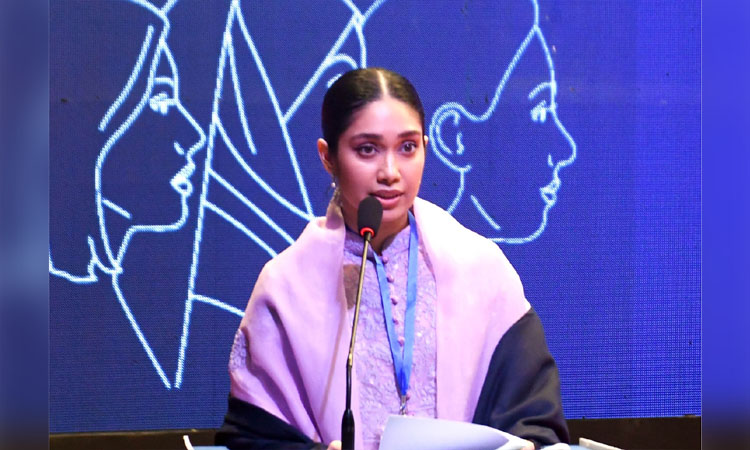
DHAKA, Jan 18, 2026 (BSS) - BNP Chairman Tarique Rahman’s daughter Barrister Zaima Rahman today articulated a vision for gender equality that bridges the gap between progressive policies and entrenched social realities.
Stressing that empowerment begins at home, she drew from her family’s legacy while presenting data on the challenges facing Bangladeshi women.
“The path to women’s empowerment in Bangladesh must move beyond symbolic policies and directly confront the everyday realities and unpaid burdens that shape women’s lives,” she said while presenting the keynote speech at a discussion titled ‘Women Shaping the Nation: Policy, Possibility & the Future of Bangladesh.’
Dhaka Forum organized the event at the Krishibid Institution Bangladesh (KIB) auditorium in the city. BNP Standing Committee member Amir Khasru Mahmud Chowdurhy was present as the chief guest. Women from different professions took part in the discussion.
Zaima rahman said, “Long before we encounter policies or laws or institutions, our homes become our first classrooms. They teach us what is possible, what is acceptable and what is expected.”
She rooted her perspective in her personal upbringing, describing a household where certain possibilities for women were never questioned. She cited the examples of her mother, a cardiologist excelling in government hospitals often within patriarchal settings, and her grandmother Begum Khaleda Zia.
“It was never questioned whether a woman could pursue an exemplary medical career while raising a family. It was never questioned whether a woman could build a nationwide social welfare organization on her own merit,” Zaima said.
She highlighted her grandmother’s early initiative, starting a free elementary school for vulnerable children from her own home in 1979, which evolved into the NGO ‘Shurubi.’
“This is the personal act of care. Women’s dignity must be recognized both privately and publicly,” she added.
Mentioning her grandfather Shaheed President Ziaur Rahman’s influence capacity, Zaima said, “He (Ziaur Rahman) understood that development was incomplete if women were excluded. He credited his leadership with the strategic expansion of the garment sector, which brought millions of women into the formal workforce for the first time, and the creation of the Ministry of Women’s Affairs, institutionalizing the intent to improve women’s lives.”
This legacy, she stated, was carried forward by her grandmother, former Prime Minister Begum Khaleda Zia, whose focus was on the transformative power of education. Zaima pointed to policies that treated girls' education as a right, such as free secondary schooling, and pioneering programmes like the Female Secondary School Assistance Project (FSSAP) that achieved gender parity and became an international model.
Zaima said, “She (Khaleda Zia) also understood that education alone was not enough if women were not supported to remain in public and economic life.”
She acknowledged her privileged upbringing, surrounded by confident, accomplished women and male role models who valued them. “I grew up with what I now recognize was a skewed understanding of society,” she admitted.
Zaima Rahman said women in Bangladesh perform roughly 85% of unpaid household and care work, spending over seven times as many hours daily on it as men-labor valued at 19% of GDP yet invisible in most economic planning. Despite gains in education, women’s labor force participation remains below 40%, compared to over 80% for men, she added.
“Gender equality is not a women’s issue. It is an economic and national issue. When women carry the bulk of responsibility, their participation in the formal economy suffers,” she said.
She warned that stalls when girls are taught to adjust their ambitions around family needs, while boys are not taught that care is a shared obligation. Celebrating the women leaders present, she noted, “Bangladesh’s progress bears your fingerprints even when history has not always said your name out loud”.
“Your support for women’s rights matters. Your celebration of women’s success matters. But equality cannot survive on words alone,” she stated, adding, “If systems and expectations continue to rely on women’s sacrifice as the default, inequality continues comfortably.”
Mentioning the cost of inaction, she said, “rising dropout rates for adolescent girls, harsher judgment for women in public life, and the alarming statistic that 78% of women in Bangladesh have faced online harassment, primarily on Facebook.”
“For a country facing climate change, economic and political pressure cannot afford to sideline half its population through exhaustion and social expectation,” she argued.
Zaima Rahman said, “If Bangladesh wants progress, not symbolic success stories, but sustained national development, then empowerment cannot stop only at classrooms, only in offices, or only in policies. They must reach our homes, our institutions and our mindsets. And it must be the responsibility of all of us.”