News Flash
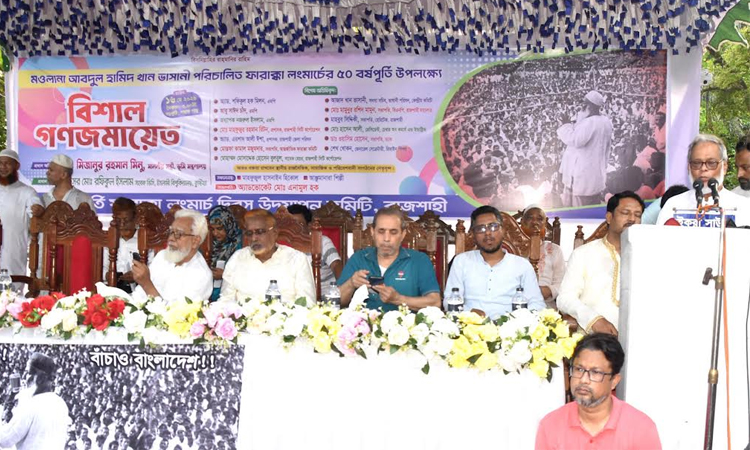
RAJSHAHI, May 17, 2026 (BSS) – Speakers have demanded the formation of a regional river commission comprising China, Nepal, Bhutan, India, and Bangladesh under the supervision of the United Nations and the World Bank to ensure fair share of Ganges water.
They made the demand at a mass gathering organized by the ‘Farakka Long March Day Celebration Committee’ on the bank of the Padma River at Barokuthi in Rajshahi city on Saturday afternoon marking historic ‘Farakka Long March Day’.
The regional commission would be able to ensure equitable distribution of water in the river basins of the region, environmental conservation, economic development of the people of the river basins especially the poor, improving living standard of people and protecting the rights of neglected women and children, they observed.
Advocate Enamul Haque, President of the Rajshahi chapter of the ‘Save the River and Environment Movement’ presided over the function.
The speakers urged the government to take necessary steps to save the Sundarbans, the world’s largest mangrove forest and the UNESCO World Heritage, from the reduced river flow and excessive salinity.
They said that the damage caused to Bangladesh due to the diversion of water through India’s Farakka Barrage in the Ganges River, the dam on the Teesta River, and dams on other rivers must be assessed.
In this connection, they said that remedies and compensation must be demanded from the Indian government for causing harm to Bangladesh by unilaterally withdrawing water from the river Farakka.
However, this problem cannot be resolved bilaterally either. In the interest of a fair share of international rivers, a regional forum must be formed comprising India, Bangladesh, China, Nepal, and Bhutan on river issues, they observed.
Besides, the speakers said that if reservoirs are built in Nepal to store Himalayan water, the water flow at Farakka during the dry season could be increased from 130,000 cusecs to 190,000 cusecs.
Everyone would be benefitted from that. With the help of reservoirs, Nepal would be able to generate about 10,500 megawatts of electricity annually, which Nepal could also export to Bangladesh, they added.
Professor M. Rafiqul Islam, former Vice-Chancellor of Islamic University presented the key-note paper at the event while Prof. Nazrul Islam Mondol, Member of Parliament from Rajshahi-5 constituency, Mostafa Kamal Majumder, President of the International Farakka Committee, Ershad Ali Esha and Administrator of the District Council took part in the discussion.
Dr. Wasim Hossain, President of DAB’s Rajshahi District Branch, river researcher Mahbub Siddiqui, Azad Khan Bhasani, Member Secretary of the Bhasani Council, and Sultan Mahmud Sumon, Vice President of the Rajshahi Interest Protection Committee also spoke on the occasion, among others.