News Flash
By Delwar Hossain Akaid
CUMILLA, Sept 5, 2026 (BSS) - Amid the hustle and bustle of Cumilla city, an old house in Chartha, quietly stands as a living reminder of a remarkable musical legacy of the Indian sub-continent. Though much of the century-old structure associated with the royal family has faded with time, its historical significance remains undiminished.
For this was the place where the childhood and formative years of legendary Indian music director, singer and composer Sachin Dev Burman--the beloved 'Sachin Karta'-- were closely intertwined, laying the early foundations of a musical journey that would later captivate generations across Bengal and the Indian subcontinent.
Sachin Dev Burman was born on October 1, 1906, at Golpukurpar in Chartha, Cumilla. Though born into the Dev Burman family of the royal house of Tripura, he spent a significant part of his childhood and adolescence in Cumilla.
The youngest of the children of Nabadwipchandra Dev Burman and Nirupama Devi, Sachin Dev Burman grew up in an environment that would later profoundly influence his musical journey.
His deep fascination with music began in childhood. The rivers, fields and villages of Cumilla, as well as the everyday lives of its people, played an important role in shaping his musical sensibilities. The songs of boatmen along the Gomti River, along with Bhatiyali, Sari, Baul and other folk melodies, left a lasting impression on him. In later years, after receiving training in Indian classical music, he blended those folk traditions with classical forms, giving them a distinctive new dimension.
A significant part of Sachin Dev Burman's education also took place in Cumilla. He studied at Yusuf School and Cumilla Zilla School before attending Cumilla Victoria College. Driven by his profound passion for music, he eventually chose music as the central pursuit of his life.
Among his musical mentors were eminent artists such as Krishnachandra Dey, Bhishmadev Chattopadhyay, Ustad Badal Khan and the legendary Ustad Alauddin Khan. Alongside rigorous training in classical music, he maintained a deep passion for Bengali folk music. The creative fusion of these two traditions would later become one of the defining characteristics of his musical style.
The musical journey that began in Cumilla eventually took him from Kolkata to Mumbai's film industry. There, he composed music for one successful film after another, establishing a distinctive place for himself with his unique melodies. Songs from films such as Pyaasa, Guide, Bandini, Taxi Driver and Aradhana, among many others, remain enduring landmarks in the history of Indian film music.
Many legendary singers of the subcontinent-including Lata Mangeshkar, Asha Bhosle, Mohammed Rafi, Kishore Kumar, Manna Dey, Geeta Dutt and Hemanta Mukherjee-lent their voices to his compositions. He also won a special place in listeners' hearts with the numerous songs he sang himself. The earthy essence of Bengal's folk music that resonated in his voice was one of the defining strengths of his artistry.
Sachin Dev Burman's family life was also deeply connected to the world of music. His wife, Meera Dev Burman, was a lyricist, while their only son, Rahul Dev Burman, later brought his own musical revolution to Indian cinema.
The creative genius of the father and son went on to create separate and distinctive chapters in the history of Indian film music.
He received numerous honours for his contribution to music, including the Filmfare Award, Sangeet Natak Akademi Award and India's Padma Shri. He was conferred the Padma Shri in 1969. His musical career spanned several decades before he died in Mumbai on October 31, 1975.
Sachin Dev Burman's ancestral home was once a sprawling, palace-like structure. Over the years, various parts of the house were damaged and gradually deteriorated. At one point, the premises were almost abandoned due to neglect and lack of maintenance. Locals said the area around the house eventually became a gathering place for drug users.
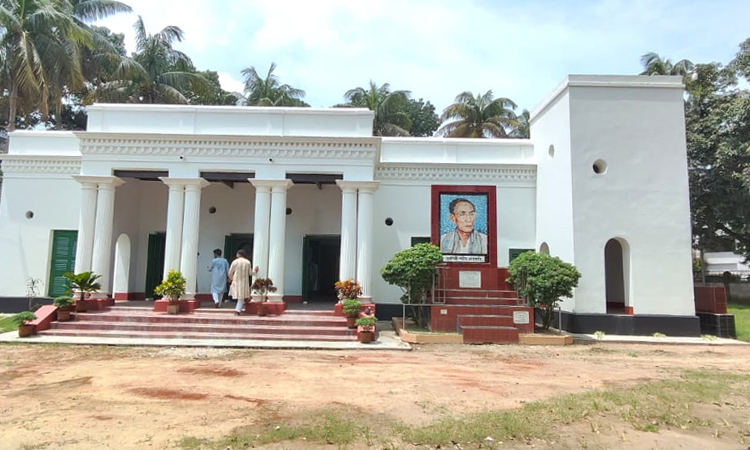
Following years of demands and efforts by cultural activists in Cumilla, initiatives were taken to preserve and restore a portion of the historic house. Through a series of steps by the district administration and relevant authorities, the appearance of the premises has changed significantly. Following the restoration, efforts are now underway to showcase Sachin Dev Burman's life, music and family history at the site.
A recent visit to the house found a large mural of Sachin Dev Burman beside the entrance, where visitors were seen stopping to take photographs. The combination of the surviving old architecture and newly restored sections has given the premises a renewed, nostalgic atmosphere-allowing visitors to connect with a place that witnessed the early years of one of the subcontinent's most celebrated musical legends.
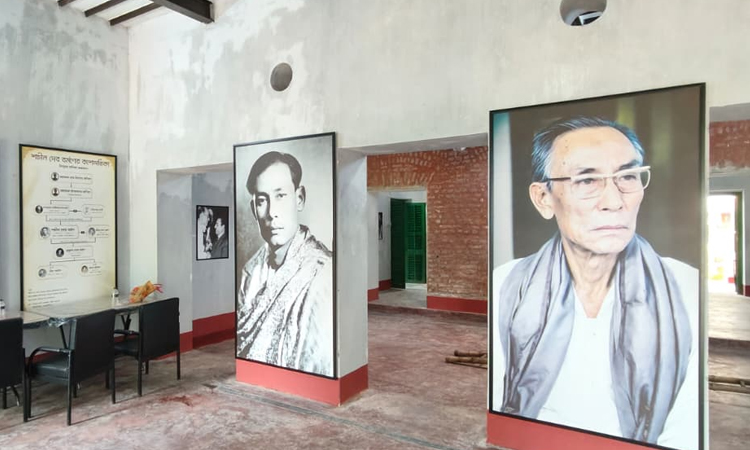
As visitors enter the house, two large portraits of Sachin Dev Burman greet them. Brief accounts of his life and work are displayed on the walls, while separate sections feature photographs and information covering different stages of his life-including his childhood, adolescence, career, married life, honours and musical journey.
An effort has also been made to create an ambience where visitors can listen to Sachin Dev Burman's songs as they walk through the old house with its high ceilings. As a result, the premises are gradually evolving from merely an old ancestral home into a place of memory and cultural heritage.
For years, cultural activists in Cumilla have been demanding the establishment of a full-fledged music museum and cultural complex centred around Sachin Dev Burman's birthplace. Such an initiative, they believe, could preserve the legacy of the legendary musician while creating a lasting cultural landmark in the city where his musical journey began.
Officials concerned said the Bangladesh National Museum, under an initiative of the Ministry of Cultural Affairs, has already formed a three-member committee to work on the preservation and development of Sachin Dev Burman's ancestral home. The committee is visiting the birthplace and assessing the feasibility of establishing a music museum there.
Recently, a delegation led by Md Serajul Islam, an official of the National Museum and convener of the committee formed for the proposed music museum, visited Sachin Dev Burman's birthplace to assess the site and explore possibilities for its development.
Cumilla-based musician Ikram Mostafiz Poplu said the folk musical traditions of the Cumilla region have reached audiences around the world through Sachin Dev Burman's voice and compositions. He said the birthplace should be preserved and used to introduce future generations to the musician's life and music, while also transforming the site into a more vibrant and functional cultural centre.
Cultural personality Hossain Mahmud said Sachin Dev Burman's birthplace could serve as a valuable centre for research into his life and works. Preserving documents, photographs, musical notations and audio-visual materials there would greatly benefit university students and researchers, he said.
Senior Vice-President of JASAS Cumilla Metropolitan unit and musician Ishtiaq Ahmed Pallab said Sachin Dev Burman was not merely a musician but also one of the enduring symbols of Cumilla's cultural heritage.
Preserving his birthplace, therefore, should be regarded not only as a local responsibility but also as a national one.
Mir Mofizul Islam, president of Love for Bangladesh Tourism Club, said Cumilla is rich in heritage and culture. Alongside its archaeological treasures, the district has made remarkable contributions to music and literature. Sachin Dev Burman's birthplace is an important part of that heritage, he said, adding that integrating the site more effectively into Cumilla's tourism map could open up new opportunities for cultural tourism.
The house of Sachin Dev Burman is already included among the district's tourist attractions.
Jahangir Alam Imrul, a researcher and director of Oitijhya Cumilla, said the historic house in Chartha should not be allowed to remain merely a silent relic of the past. He envisioned a music museum being established there one day, where future generations could learn about the life and works of a legendary musician born on the soil of Cumilla.
Such a museum, he said, would also allow music lovers from home and abroad to discover how the soil of Cumilla, the flowing waters of the Gomti and the folk melodies of Bengal came together to shape the musical genius of Sachin Dev Burman-one of the greatest music creators of the Indian subcontinent.
Researcher and academic Dr Ali Hossain Chowdhury said cultural activists in Cumilla have been working for years to preserve Sachin Dev Burman's birthplace. At different times, initiatives have been taken to recover and restore parts of the historic house. Local authorities and cultural organisations have also been organising fairs around his birth anniversary.
Establishing a music museum at the site would further strengthen Cumilla's cultural identity among both domestic and international visitors, he said.
Sajib Miah, field officer of the Cumilla office of the Department of Archaeology, told BSS that the department had acquired the house as part of efforts to preserve it and carried out restoration work at a cost of around Taka 18 lakh in the 2025-26 fiscal year.
A proposal has been sent in the current fiscal year for allocation of funds to construct a boundary wall around the house to improve its security, he said.
Once the security arrangements are ensured, there are plans to establish a museum at the site, Sajib added.
Sachin Dev Burman passed away in Mumbai on October 31, 1975. But the melodies he created never died. His songs continue to find new voices among younger generations, while his music remains a subject of research, discussion and admiration.
From the banks of the Gomti river in Cumilla to the heights of Indian cinema, the journey of 'Sachin Karta' remains a remarkable chapter in the musical history of the subcontinent. And his birthplace in Chartha continues to stand as a silent reminder of where that extraordinary journey began.