News Flash
By Md Aynal Haque
RAJSHAHI, June 13, 2026 (BSS): The mango season has begun across northern Bangladesh, turning districts such as Rajshahi, Chapainawabganj, Naogaon and Natore into major hubs of seasonal trade activity, generating an economy worth thousands of crores of taka and sustaining lakhs of livelihoods.
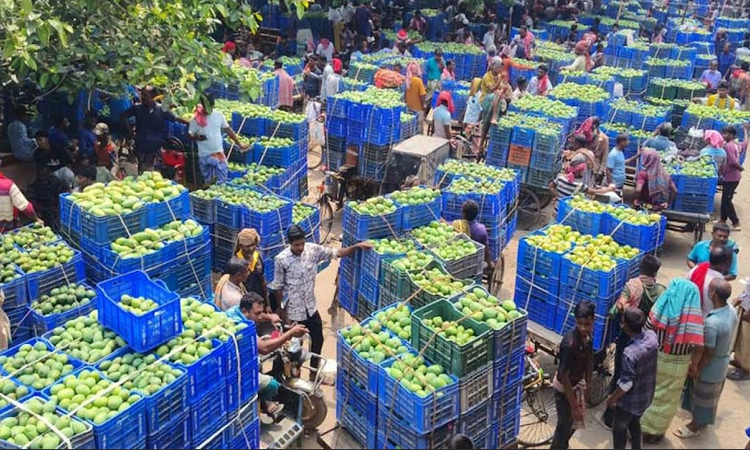
Orchards across the region are now filled with ripe mangoes while wholesale markets and trading hubs witness heavy crowds of growers, traders, labourers and transport workers as truckloads of mangoes are dispatched daily to different parts of the country.
According to the Department of Agricultural Extension (DAE), the four districts have set a production target of around 12.55 lakh tonnes of mango this season. Officials estimate that overall economic activity generated through production, marketing, transport, packaging, banking, courier services, basket-making and export may reach nearly Tk 20,000 crore during the season.
Once considered only a seasonal fruit, mango has now emerged as a key agro-based industry in northern Bangladesh over the past two decades, driven by improved varieties, expansion of commercial orchards, modern cultivation practices and the growth of organized marketing systems.
Chapainawabganj remains the leading mango-producing district, with about 37,487 hectares under cultivation and a production target of around 459,000 tonnes. The district is widely known for premium varieties including Fazli, Khirsapat, Langra and Ashwina. Its Kansat hub has become one of the country's largest mango trading centres during peak season.
Daily mango transactions in Chapainawabganj reach Tk 15-20 crore at major hubs, while overall daily trade in the district stands at Tk 25-30 crore. Seasonal turnover is estimated to exceed Tk 10,000 crore.
In Naogaon, around 30,000 hectares of land are under mango cultivation with an expected production of about 387,000 tonnes. Traders estimate seasonal business at around Tk 3,000 crore. The district exported about 100 tonnes of mangoes last year to Middle Eastern and European markets, with plans to double exports this year.
Rajshahi district has 19,062 hectares under mango cultivation with a production target of about 244,000 tonnes. Trading activity remains concentrated in Baneshwar and Bagha hubs, where wholesale markets operate from morning until late night.
In Natore, about 5,693 hectares of land are under mango cultivation this season with a production target of around 68,000 tonnes.
Officials and traders estimate that around three lakh people are directly and indirectly engaged in mango-related activities, including orchard workers, harvesters, packers, transport workers, basket makers, courier services staff and commission agents.
Seasonal labourers engaged in harvesting, sorting and packaging earn between Tk 1,000 and Tk 1,500 per day, providing vital income support for rural households during the harvest period.
A worker in a Bagha upazila orchard, Nirjhar, said the seasonal work plays a crucial role in sustaining his family, as employment opportunities remain limited throughout the rest of the year.
Mango farmer Nazrul Bhuiyan said cultivation costs stand at around Tk 25,000-30,000 per bigha, with production of 40-50 maunds, but farmers often face losses due to market practices and pricing pressure.
Traders said prices at the orchard level often remain low, while retail prices in major cities increase significantly due to transport costs, commissions, multiple intermediaries and handling charges.
Experts say weather-related risks, including heatwaves, nor'westers and sudden rainfall, continue to pose challenges for mango production in the region.
Dr. Shafiqul Islam, Chief Scientific Officer at the Rajshahi Fruit Research Center, said extreme weather remains a major threat during the mango season.
Professor Dr. Md. Farid Uddin Khan of Rajshahi University's Department of Economics said mango has become a key component of the northern economy after rice and potato, adding that planned development of mango-based industries could generate year-round employment opportunities.