News Flash
By Selina Sheuly
DHAKA, July 14, 2026 (BSS) - Kabi Kazi Nazrul Islam Institute is set to launch a one-year diploma course titled 'Diploma in Journalism and Media Studies' to explore the journalism legacy of national poet Kazi Nazrul Islam.
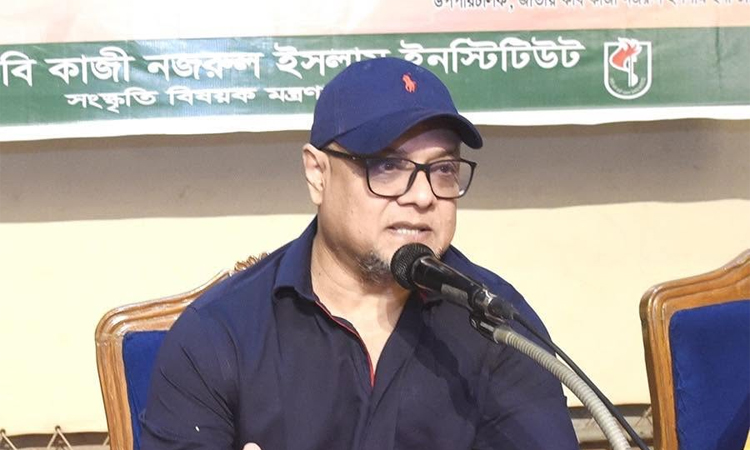
The institute has already sent a proposal for the programme to the Ministry of Culture, Executive Director of the institute Md. Latiful Islam Shibli told BSS.
Shibli said Nazrul was a pioneer of uncompromising journalism and a fearless editor. Nazrul began his regular journalism career with the daily Nabajug in Kolkata on July 12, 1920, after the end of the First World War.
Apart from serving as an editor, Nazrul worked in various capacities at around 10 to 12 newspapers, including Dhumketu and Langal, Shibli said. The institute has undertaken the initiative during Nazrul Barsho to encourage deeper study of Nazrul's contribution to journalism.
According to Shibli, the diploma course will examine Nazrul's journalistic work from multiple perspectives.
The proposed curriculum includes topics such as the legacy of Dhumketu in modern Bangladesh, Nazrul's ideals of journalism and media ethics, women's emancipation in Nazrul's journalism, and Nazrul's confrontation with British colonial rule.
The institute is also planning an international conference in August to mark Nazrul's death anniversary. Scholars and representatives from Turkey, Iran, Pakistan and India are expected to participate, reflecting the countries and literary traditions that frequently appeared in Nazrul's writings.
Although Nazrul never visited those countries, Shibli said he embraced their literary and intellectual traditions through extensive reading, drawing inspiration from renowned Persian poets such as Hafiz, Ferdowsi and Omar Khayyam.
"Likewise, when we think of Iran or Turkey, Nazrul naturally comes to mind. I have met the Iranian ambassador several times and requested him to translate the literature of our national poet," Shibli added.
On May 23 this year, Prime Minister Tarique Rahman declared a year-long Nazrul Barsho during celebrations marking the 127th birth anniversary of Kazi Nazrul Islam in Trishal, Mymensingh.
Subsequently, on June 21, the Cabinet Division issued a notification declaring the period from May 25, 2026, to May 25, 2027, as Nazrul Barsho, with effect from May 25 this year.
Shibli said the institute has undertaken several programmes to commemorate the occasion. It plans to identify places in Bangladesh where Nazrul was officially received during his lifetime and install commemorative plaques featuring excerpts from his poems to preserve those sites as cultural and tourism landmarks.
The institute has also adopted a five-year plan to preserve and promote Nazrul's legacy. As part of the initiative, Nazrul Utsab will be organised in all 64 districts. Festivals have already been held in Cumilla, Patuakhali, Bandarban and Cox's Bazar.
Claiming that Nazrul had long been neglected, Shibli said, "Through the 2024 mass uprising, Bangladesh entered a new chapter. Our identity as a nation of struggle, resilience and resistance has been shaped by several towering personalities, one of whom is Kazi Nazrul Islam. The institute also played a role in accelerating the process of officially recognising him as the national poet through a government gazette in 2024."
Shibli also said after a gap of 45 years, the institute unveiled a new English translation of Nazrul's selected works, Quintessence of Nazrul, on February 3 this year to help promote the poet internationally.
The book will also be available as an e-book.
"We want the book to be translated into different languages. Initial discussions have already been held with the Ministry of Foreign Affairs. The institute plans to publish at least one translation into a foreign language every year," he said.
Shibli said Nazrul remains relevant because of his global outlook and broad intellectual vision.
"He was not confined by narrow nationalist boundaries but was inspired by an international consciousness. The time has come to realise this long-cherished dream of Kazi Nazrul Islam," he said.
He welcomed the government's decision to observe Nazrul Barsho and drew parallels between Nazrul and Shaheed President Ziaur Rahman, saying both embodied patriotism and the spirit of resistance.
Nazrul proclaimed the call to "We Revolt" through an editorial in Dhumketu against British colonial rule, while Shaheed President Ziaur Rahman inspired the nation during the Liberation War through his declaration of independence in 1971, Shibli said.
Shibli also said Nazrul was the first recipient of the Ekushey Padak after the award was introduced.
"In 1976, Shaheed President Ziaur Rahman introduced the Ekushey Padak. Kazi Nazrul Islam became its first recipient in recognition of his outstanding contribution to literature. Nine others also received the award that year," he said.
On the occasion of Nazrul Barsho, the institute will write to the authorities requesting that Nazrul be posthumously honoured with the highest rank in both the Bangladesh Army and Bangladesh Police.
"Because we believe such recognition would make Kazi Nazrul Islam even more deeply connected with our national identity," Shibli said.
Shibli said the Kabi Kazi Nazrul Islam Institute currently houses more than 25,000 books and has published numerous works on the national poet. Its library remains open to researchers and the general public.