News Flash
By Md Aynal Haque
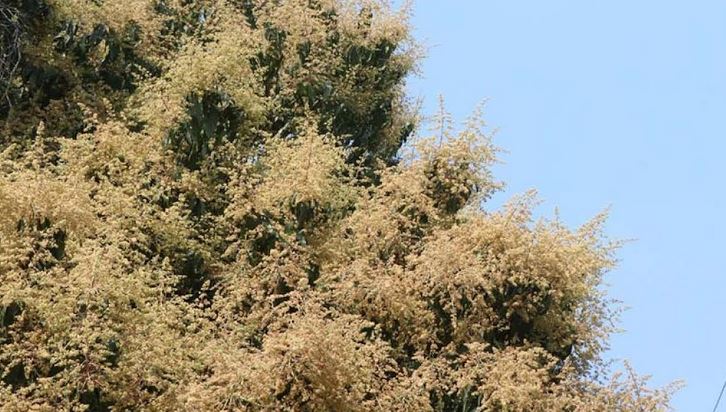
RAJSHAHI, Feb 26, 2026 (BSS) – Rows upon rows of mango orchards across the Rajshahi region are now adorned with blossoms, and in this spring month of Falgun, the trees stand awash in blended hues of yellow and green, each laden with blooms whose sweet fragrance drifts through the air and envelops the surroundings.
The abundance of blossoms at the very start of the season has lifted farmers’ spirits with hopes of a bumper harvest.
However, mango orchard areas have decreased in Rajshahi district this year, while they have expanded in Naogaon.
Nearly all mango trees in the Rajshahi region have produced blossoms to varying degrees this season. Early varieties have already begun to show small green fruit buds.
Weather conditions have been favourable so far, and the Department of Agricultural Extension expects a bumper yield as there have been no major natural disasters.
Compared to last year, almost all trees have borne blossoms this time. With favourable weather conditions, prospects for a bumper yield are strong.
Although production was good last year, excessive rainfall damaged a large quantity of mangoes, causing prices to drop and leaving farmers at a loss.
The Rajshahi region of the Department of Agricultural Extension comprises four districts—Rajshahi, Naogaon, Natore and Chapainawabganj.
Together, these districts have 92,552 hectares of mango orchards, with 34,960,554 trees. About 63 percent of the trees have blossomed so far. Agricultural officials and farmers expect all trees to come into full bloom in phases.
In Rajshahi district, mango orchards cover 19,062 hectares, down from 19,603 hectares last year—a reduction of 541 hectares. The district has 3,695,277 mango trees, of which 60 percent have blossomed.
In Naogaon, orchards span 30,500 hectares, up from 30,300 hectares last year. The district has 20,534,325 mango trees, with 71 percent in bloom.
Chapainawabganj has 37,487 hectares of mango orchards, slightly down from 37,504 hectares last year—a reduction of 17 hectares. The district has 9,244,765 mango trees, with 70 percent blossoming.
Natore has 5,069 hectares of orchards with 1,486,187 trees, 53 percent of which have bloomed.
Agricultural officials noted that many trees are yet to blossom, and early-blooming trees usually yield early-season mangoes.
Shafiqul Islam, a mango grower from Bagha upazila in Rajshahi, said more blossoms have appeared this year compared to last year.
“If there are no major storms, we expect a plentiful harvest. With good weather, yields will be excellent. But we cannot be complacent yet. We are regularly applying pesticides and maintaining the orchards,” he said.
Mohammad Ali, a mango farmer from Puthia, said weather conditions have been favourable for blossoming since the start of the season.
“We are getting the necessary daytime temperature through sunlight. Many trees have already bloomed. If this weather continues for another 10 days, even more blossoms will appear,” he said.
Dr Azizur Rahman, Additional Director of the Department of Agricultural Extension in Rajshahi, said they expect an excellent yield this year.
“We are also working to ensure farmers can export mangoes. Agricultural officers in every upazila are engaged in this effort. We hope for strong mango exports this season,” he said.
Dr Md Shafiqul Islam, Chief Scientific Officer at the Rajshahi Fruit Research Center, said winter ended smoothly this year, with no late fog or rainfall.
“Temperatures increased gradually without sudden fluctuations. As a result, the trees maintained their flowering process,” he said.
Kazi Zulfikar Ali, Associate Professor of Economics at the University of Rajshahi, said farmers are cutting down mango trees mainly because profitability has declined.
“Production has decreased and farmers are not getting fair market prices. Rajshahi once led in mango production, but Naogaon has now taken that position. Mango cultivation has also expanded in parts of Satkhira and Bandarban,” he said.
He added that Rajshahi previously focused more on rice cultivation, and farmers had shifted to mangoes expecting higher profits.
“Now rice prices and demand are high, prompting some farmers to consider returning to paddy cultivation,” he said.
He further noted that most mango varieties in Rajshahi are late-season types, while Satkhira’s mangoes reach the market earlier and fetch better prices.
Mangoes from the Rajshahi, Naogaon and Rangpur regions are mostly late varieties, leading to a simultaneous market supply and subsequent price drops.
“Since mangoes are perishable, farmers cannot store them like potatoes or other crops. Without proper storage facilities, low prices discourage them from continuing mango cultivation the following year,” he added.