News Flash
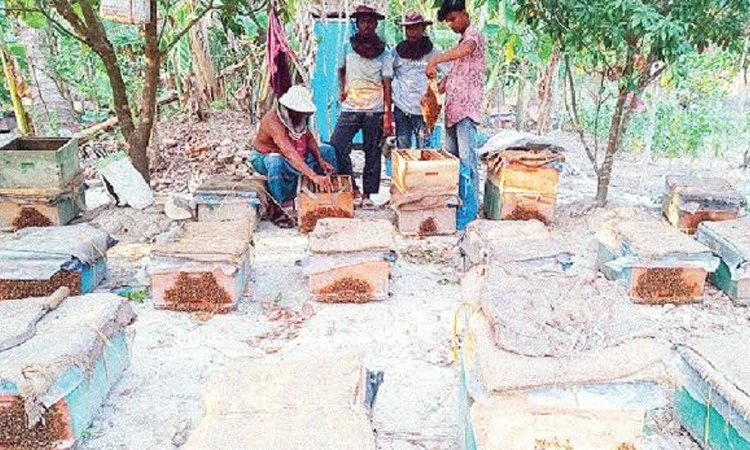
KHULNA, May 19, 2026 (BSS) - Modern beekeeping is emerging as a promising livelihood opportunity in Koyra, the coastal upazila of Khulna adjacent to the Sundarbans, as local entrepreneurs and farmers increasingly adopt bee box-based honey farming.
Where traditional honey collectors once risked their lives entering the dense forest to gather wild honey, many are now producing honey safely and sustainably by placing modern beehive boxes along riverbanks and open lands near the Sundarbans.
A recent visit to several villages in Koyra revealed rows of bee boxes installed beside rivers and homesteads. Local youths and farmers are regularly harvesting honey without entering the forest, making the practice increasingly popular in the region.
Beekeepers said the bees travel across rivers and deep into the Sundarbans—up to three kilometers inside the forest—to collect nectar from various flowers. A few days ago, they collected about three maunds of honey. With the blooming season of Keora flowers now underway, they expect honey production to rise significantly in the coming weeks.
A group of beekeepers from Satkhira has temporarily set up operations on the banks of Baniakhali village. Of their 400 beehive boxes, 120 are currently stationed there. To protect the bees from excessive heat, the boxes have been covered with straw and burlap sacks.
Similar scenes can be observed along the Shakbaria River in Koyra, where beekeepers are managing rows of hives. Honey is extracted using specialized machines that rotate the hive frames to separate the honey while allowing the bees to continue producing more.
In Mathbari village, local men and women were seen busy processing honey beside a house near the river. Workers carefully removed bees from the frames using brushes before placing the frames into extraction machines.
“These are our bee houses,” said beekeeper Rifat Hossain. “The bees collect honey from flowers in the Sundarbans. Now we no longer need to enter the forest. We can collect honey while staying near it.”
Rifat said operating 400 beehives costs around Taka 8 lakh annually. Last year, they earned approximately Taka 1.4 lakh from honey production. During periods when flowers are scarce, however, the bees must be fed sugar to keep them alive. He added that maintaining a queen bee in every box is essential, otherwise worker bees may abandon the hive.
Md. Nasir Uddin, an official at the Kashiabad Forest Station under the Forest Department, described the initiative as a positive development.
“This is reducing pressure on the Sundarbans, while also lowering the risks faced by honey collectors,” he said.
Koyra Upazila Nirbahi Officer Md. Abdullah Al Baki also praised the initiative, saying it is creating new income opportunities for local residents.
“A safe and sustainable alternative to collecting honey from the Sundarbans without entering the forest is being developed,” he said.
According to relevant sources, the unique flowers, plants, and natural ecosystem of the Sundarbans contribute to the superior taste and quality of honey produced in nearby coastal areas. As a result, modern beekeepers are increasingly choosing the Koyra coast as an ideal zone for honey production.