News Flash
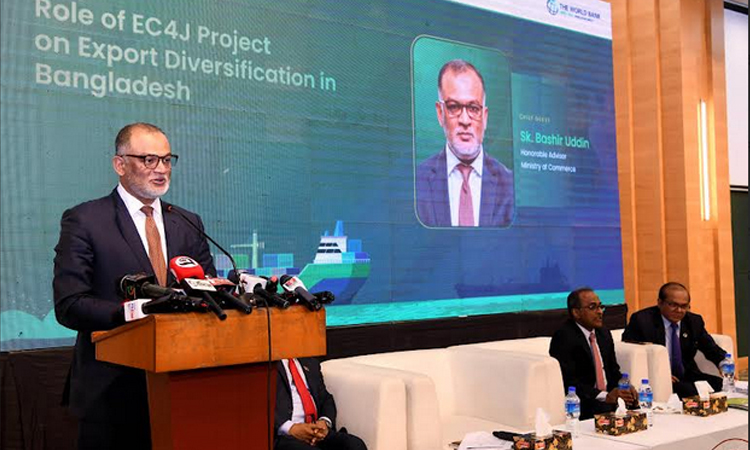
DHAKA, Jan 22, 2026 (BSS) - Commerce Adviser Sk. Bashir Uddin today said the government is actively working to make Bangladesh's export sector more diversified and competitive, reducing its overdependence on the readymade garments (RMG) industry.
"To expand Bangladesh's presence in global markets, we need policy support and dedicated entrepreneurs committed to product diversification. Entrepreneurs must be hardworking and enhance their capabilities through relevant knowledge and skills," he said.
The commerce adviser made the remarks while addressing a seminar titled "Role of Competitiveness for Jobs Project on Export Diversification in Bangladesh" as the chief guest at the Bangladesh-China Friendship Exhibition Center in Purbachal this afternoon.
He said the government has initiated major reforms and investments under the Export Competitiveness for Jobs (EC4J) project to achieve the national export target of US$100 billion by 2030, said a Commerce Ministry press release.
Bashir Uddin noted that for the past 16 years, policies were largely based on idealistic, expenditure-driven planning without sufficient debate. "Now we
are formulating policies through consultations, discussions and debates with business communities - all for the country's interest," he said.
Referring to the current global context, he said geopolitical factors are increasingly influencing global trade dynamics. "We are now trying to
identify Bangladesh's position within this complex geopolitical landscape," he added.
Commerce Ministry Additional Secretary (Export) and Project Director of the EC4J project Md Abdur Rahim Khan delivered the welcome address at the
seminar. Commerce Secretary Mahbubur Rahman spoke as a special guest.
The keynote paper was presented by LightCastle Partners CEO Bijon Islam. Panel discussions featured Vice Chairman of the Export Promotion Bureau (EPB)
Mohammad Hasan Arif, UNDP Bangladesh Senior Economic Adviser Weiss Parry, Policy Exchange Bangladesh Chairman Dr M Masrur Riaz, and World Bank SeniorPrivate Sector Specialist (Finance, Competitiveness and Innovation) Hosna Ferdous Sumi.
The Export Competitiveness for Jobs (EC4J) Project (3rd Revised) is a government and World Bank-funded investment initiative aimed at export diversification and market expansion. The project, with an estimated cost of Taka 1,264.17 crore (GoB Taka 172.12 crore and project loan Taka 1,092.05 crore), has been under implementation from July 2017 to June 2026.
Under the project, initiatives have been taken to remove export market entry barriers for four high-potential sectors beyond RMG - leather and leather goods, footwear, light engineering, and plastics.
As part of this effort, four international-standard technology centers are being established. These include the Design & Technology Center for Leathergoods and Footwear (DTCLF) on 5.00 acres in Kashimpur, Gazipur, and the Center of Excellence for Engineering and Technology (CEET) on 5.20 acres in Kaliakoir, Gazipur. Construction of both centers has made visible progress and is expected to be completed within the stipulated timeframe.
These world-class centers will provide appropriate technology services, modern training, and technical and business advisory support to manufacturing
industries, particularly SMEs, to enhance export readiness, market expansion, and employment generation.
Additionally, under the Export Readiness Fund (ERF), matching grants totaling Taka 128 crore have been provided to 106 factories to improve export capacity
and compliance. Market linkage activities included support for entrepreneurs to participate in five international trade fairs and the organization of the Meet Bangladesh Expo (MBX) in Bangladesh to connect local producers with foreign buyers.
At the MBX, 100 local companies showcased their products, with participation from around 300 domestic and foreign business representatives, buyers, sector leaders, and diplomats from various embassies in Dhaka.
Furthermore, an online market intelligence platform titled exportbangladesh.org has been established to strengthen B2B connections between exporters and international buyers, facilitating sustainable and balanced export growth.