News Flash
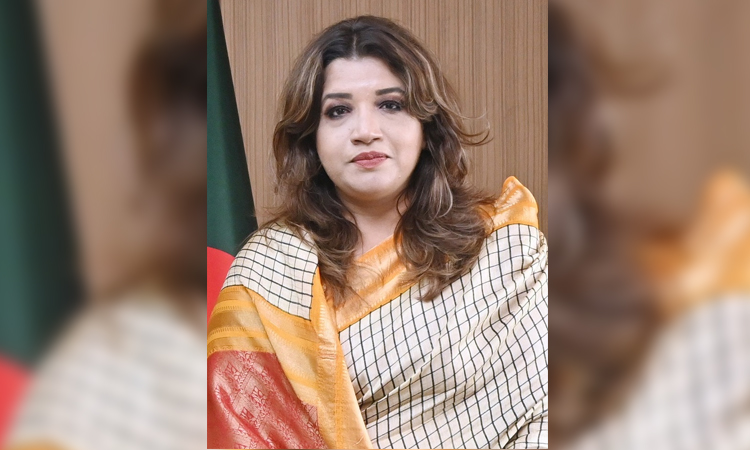
DHAKA, July 26, 2026 (BSS) - State Minister for Foreign Affairs Shama Obaed Islam said today Bangladesh is working to attract investment on the scale
needed to realise the government's vision of transforming the country into a $1 trillion economy,
"To reach a $1 trillion economy, we need investment on the necessary scale, and we are working to attract that level of investment," she told reporters
following a closed-door roundtable on "Roadmap for Trade, Growth and Economic Diplomacy-2026: The Capital Dialogue" held in the afternoon at the Ministry.
Prime Minister's Finance and Planning Adviser Dr Rashed Al Mahmud Titumir, among others, joined the roundtable discussion.
The roundtable was held as a follow-up to the "Trade and Investment Conference" organised by the Ministry of Foreign Affairs on June 13 as part
of the government's increased emphasis on economic diplomacy.
Shama said the investment process is already underway, with investors from China, Japan, the United States and other countries holding discussions on
opportunities across different sectors in Bangladesh.
"Many countries are already talking to us about how they can invest in different sectors," she said, adding that prospective investors are engaging
with the Bangladesh Investment Development Authority (BIDA), the Commerce Ministry and other relevant agencies.
She said the government's $1 trillion economy ambition would require substantial investment, and efforts are underway to mobilise investment
commensurate with that goal.
Shama said the discussions focused on issues including deferment of Bangladesh's LDC graduation, the capital market, foreign direct investment
(FDI), ease of doing business and challenges faced by foreign investors.
Participants also discussed measures required to address investment bottlenecks and procedural barriers to facilitate greater flows of foreign
investment into the country.
The State Minister said the government would take up the recommendations and concerns raised at the roundtable with relevant ministries to identify
possible solutions.
She said different groups of investors face different challenges, including non-resident Bangladeshis seeking to invest in their home country.
Referring to the state of the economy inherited by the government, Shama said the government is taking policy measures to rebuild the banking sector,
capital market and other economic systems and transform Bangladesh into a vibrant economy.
She described the government's budget as one of the first steps towards that transformation.
The discussions, she said, also covered investment in the country's economic zones and the facilitation and procedural reforms required to make investment easier for foreign businesses.
Asked about priority areas for investment, Shama identified energy, textiles, readymade garments (RMG), agriculture and agro-based industries among key
sectors with significant potential.
She also highlighted the creative economy as an emerging area for investment, saying the government wants to create economic opportunities involving
marginalised communities, cottage industries, heritage and culture.
Sports and culture also offer considerable investment potential, she said, adding that the Foreign Ministry is seeking to leverage sports and cultural
diplomacy to attract investment into these areas.
Shama said the blue economy is another priority sector where Bangladesh sees substantial investment opportunities.
"Blue economy is one of the priorities," she said, noting that a number of European countries have shown interest in investing in the sector.
The state minister said the Foreign Ministry's role is primarily to use economic diplomacy to identify new markets, sources of investment and
economic opportunities while working in coordination with the Commerce, Finance and other relevant ministries.
She said the government is pursuing diversification to help realise Prime Minister Tarique Rahman's vision of taking Bangladesh's economy to a new
height while ensuring that women, disadvantaged communities and other sections of society share the benefits of development.
Shama said the Foreign Ministry plans to organise more such roundtables to identify problems confronting investors and bring stakeholders together to
explore practical solutions.
"The investment process is already underway. Discussions are continuing," she said.