News Flash
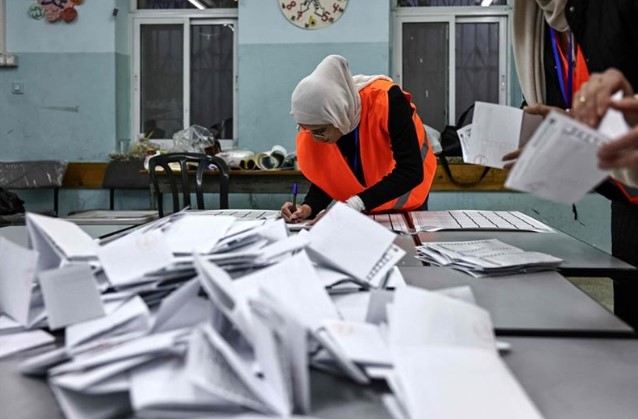
RAMALLAH, Palestinian Territories, April 26, 2026 (BSS/AFP) - Palestinian president Mahmud Abbas's Fatah movement was on track to lead municipal councils in several major West Bank cities, official election results showed Sunday, with about 95 percent of ballots counted.
On Saturday, Palestinians in the occupied West Bank and in central Gaza's Deir el-Balah area voted for municipal councils in the first elections since the Gaza war began.
Fatah's official electoral list, dubbed "Steadfastness & Giving", was ahead in Hebron, the West Bank's largest city, as well as in Tulkarem and Salfit, according to the Palestinian Central Elections Commission (CEC).
Speaking at a press conference announcing the results, Palestinian prime minister Mohammad Mustafa described the vote as "an expression of the national will of the Palestinian people".
He also welcomed the inclusion of Deir el-Balah in the local elections, calling it "a first step toward a more inclusive national framework... until we reach unity in all of Palestine".
In several important cities such as Ramallah, the seat of Palestinian Authority (PA), and Nablus in the north, no vote was held.
In both of those cases, only a single list was registered, either affiliated with or dominated by Fatah, making elections unnecessary.
In Jenin, a northern West Bank city long associated with armed resistance to Israeli occupation, Fatah won six of the 15 available seats, tying with an independent list also named "Jenin".
Footage on social media showed groups of young men celebrating in the city centre, chanting slogans linked to local armed factions, interpreting the outcome as a setback for Fatah.
In the city of Qalqilyah, no list was registered, leaving the PA in charge of appointing a municipal council.
Across the West Bank, voter participation reached 53.4 percent, with elections held in 183 municipalities.
But in Deir el-Balah the voter turnout was significantly lower, with 22.7 percent of the 70,000 registered voters casting ballots.
Most West Bank candidates ran on Fatah-aligned lists or as independents, some of whom were also loosely connected to the secular-nationalist Palestinian movement.
Fatah's main rival, Hamas, which still controls around half of the Gaza Strip, did not participate in the elections.
Palestinian city and village councils are responsible for essential services such as water, sanitation and local infrastructure, but they do not have legislative authority.
With no presidential or legislative elections held since 2006, voting for local councils has become one of the last remaining democratic mechanisms under the PA.
Many voters told AFP that municipal governance is increasingly tied to larger political realities, particularly Israeli settlement expansion in the West Bank, which Israel has occupied since 1967.
They pointed to worsening access to water, roads and basic services as settlements -- considered illegal under international law -- spread across the West Bank.
In 2025, the Israeli military installed around 1,000 gates at the entrances of towns and villages which, when closed, cut off residents from access to services they rely on in nearby larger municipalities.